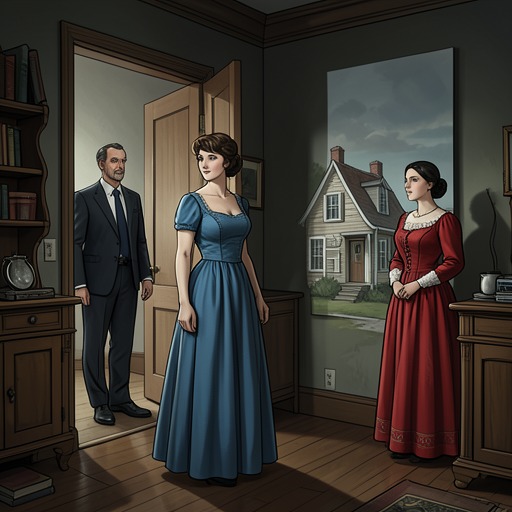
Fern discovers she is pregnant
MovingFern Woolbright’s discovery that she is pregnant transforms a moment of contraceptive carelessness into a crisis shaped by secrecy and uncertain paternity. At nineteen, she is confronted not only with an unexpected pregnancy but with the knowledge that James Frobisher may not be the father: Charlie Treadaway may be. While her mother and father respond to the news on the assumption that James is responsible, Fern cannot bring herself to correct them. James’s immediate proposal of marriage offers a response to the crisis, but it cannot resolve the secret that Fern is carrying alongside the pregnancy.
The missed precaution
The discovery begins with Fern’s uneasy attempt to make an afternoon with James intimate. She suggests going to bed and tries to sound sensual, but her nerves defeat the performance. In the bedroom, James praises her for leaving the window open, as he had advised before, and kisses her with a delicacy the narration pointedly compares to a maiden aunt nibbling a cucumber sandwich. The comic mismatch between Fern’s attempted seduction and his manner gives way to the physical discomfort of sex: she becomes sore, finds the bed dry and uncomfortable, and waits while James takes a long time to climax.
After he falls asleep, Fern goes to the bathroom to find paracetamol for her pounding head. In her quilted wash-bag, beneath the painkillers, is the spermicide she uses with her Dutch cap. The sight of the contraceptive gel prompts an elaborate, anxious fantasy about sperm being killed or drowned. Then she realizes what she has failed to do: she did not put the cap in. Her guilt and shame arrive bodily, as a flush that seems to flood her whole body, before she can turn the mistake into an explanation or plan.
Fern tries to undo the omission with improvised measures. She runs a bath, fills it to what the narration calls selfish levels, and ignores anyone knocking at the door while she tries to wash away the sperm. Fifteen minutes later she rubs spermicide around the walls of her vagina, hoping to catch any sperm that might remain. Her thought that there are two lots—Charlie’s and James’s—makes clear that the risk is not confined to the encounter with James. Afterward she returns to the bedroom and pretends everything is normal, even as James jovially suggests they go out for fresh air. The scene’s hurried concealment anticipates the larger secret: Fern can attempt to conceal the immediate mishap, but she cannot control what follows.
Symptoms and confirmation
By the time Fern visits Dr Leonard, her mother, Rosemarie Woolbright, has already guessed what may be happening. Fern has come at her mother’s insistence to discuss exhaustion, nausea, aversions to certain foods, and a newly heightened sense of smell. She does not arrive expecting a pregnancy diagnosis. When Dr Leonard tentatively raises the possibility that she may be with child, Fern initially takes the words literally and looks around the surgery, as though the absence of an actual child could disprove what he means.
Recognition comes slowly, then breaks into an involuntary laugh. Fern asks whether he means she is pregnant and rejects the possibility: she cannot be. Dr Leonard asks whether she takes the pill. Fern explains that she does not, but has a Dutch cap for when the occasion arises. His follow-up question about whether she uses it conscientiously exposes the weakness in that assurance. She pauses just too long. He explains that a barrier method works only if the device is in place, and Fern blushes from her throat to the roots of her hair. Dr Leonard notices and offers to take blood to be safe.
The confirmation is narrated as certainty before Fern can find a way to soften it: she is pregnant, nineteen, and believes she has ruined her life. Her response is not simply fear of an abstract future. The earlier bathroom scene has already shown the failed precaution, the bodily panic, and the futile attempts to reverse what has happened. The doctor’s questions give that private knowledge a public, medical form; the pregnancy is no longer a possibility she can dismiss.
The family’s assumptions and James’s proposal
Rosemarie is white-faced but efficient. She tells Fern that this is not the end of the world, distinguishing her daughter’s situation from what has happened to Minty Landreth and Paul Landreth. Fern briefly imagines that her mother might suggest an abortion and longs for the problem to disappear as simply as her tonsils did when she was nine. The thought registers a wish for escape, not a decision: the evidence shows Fern imagining that possibility, but not taking action on it.
Gordon Woolbright’s anger, by contrast, is terrifying but temporary. Rosemarie tells Fern to give him a couple of hours; when Fern returns, he is in his study with his head in his hands. He says he is disappointed in her, but thanks God that James is the father. His response reveals the family’s assumption of paternity and the relief attached to it. Fern cannot tell him that she does not know. Charlie Treadaway may be the father, and Fern connects him in her mind with the drugs that killed her cousin, but she cannot make herself speak that possibility aloud.
Telling James is awful at first: he is shocked and says he thought he was coming for Sunday lunch. Then he does something Fern does not expect. He gets down on one knee and asks her to marry him. The proposal immediately turns the pregnancy into a question of marriage as well as parenthood, offering a concrete next step at the very moment Fern’s own knowledge remains unresolved. James acts on the belief that he is the father; Fern’s silence leaves that belief intact. The pregnancy is therefore confirmed, but its central private uncertainty is not settled.