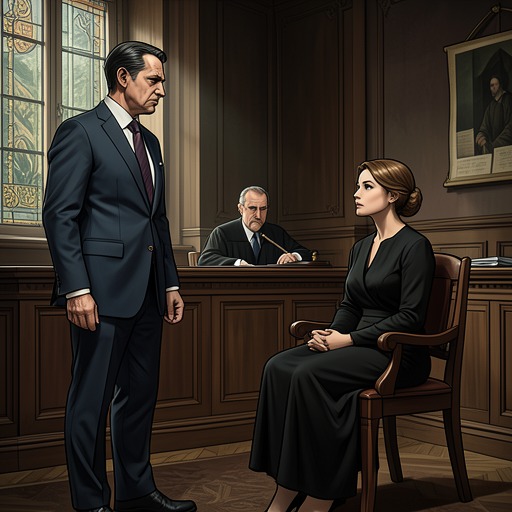
Lucas Identifies Charlie to His Mother, Prompting Police Involvement
MovingLucas Spinner’s identification of Charlie Treadaway to Barbara Spinner is the moment the news of Elise Landreth’s death becomes an accusation with consequences. Confronted by his mother’s belief that Elise had been safe with him, Lucas discloses that he saw her exchange money for something in a plastic bag and names Charlie as the man who supplied it. Barbara calls the police; Lucas does not stop her. The scene joins a death, an uncertain recollection, and a consequential act of speech, while leaving Lucas face to face with the fact that he had left Elise alone.
The call and the shock
Earlier that afternoon, Lucas had hoped to stay in with Barbara, eat scrambled eggs, and watch television before work. He was tired and anxious about his job: after making several mistakes, he had been warned that he was still on probation. That ordinary domestic expectation gives way when Barbara calls for him at about seven. Lucas has not heard the telephone ring, but he recognizes a familiar hysteria in her voice, one that recalls the earlier occasion when she was found in a bath of blood.
Lucas pads from his bedroom in his dressing gown and slippers. In the sitting room, Barbara is rocking in an armchair, distressed by news relayed after Minty Landreth and Paul Landreth returned from Chequers with a police escort. She tells Lucas that Elise is dead and that drugs may have been involved. Brandy, fetched by Lucas from the drinks cabinet, does not steady the exchange: Barbara’s hands tremble, brandy runs down her chin and neck, and she struggles to speak. The physical disorder of the moment makes the report hard for Lucas to absorb. He stands on the patterned carpet, looking down at his slippers and pyjamas, as if the familiar details of home cannot accommodate what he has just heard.
An accusation emerges
Barbara immediately connects Elise’s death to Lucas’s own part in the preceding events. She asks why he left Elise and why Elise was alone. The accusation lands with the force of a reprimand from childhood: Lucas feels as he did when he was four and Barbara scolded him for scribbling on a wall. For an agonizing second, he fears he may wet himself. The scene thus makes his answer emerge under pressure, not as a composed report offered at a safe distance from blame.
Lucas says that he saw a man whom he thinks may have sold Elise drugs. At the time, he did not interpret what he saw as significant: Elise gave the man money, and the man gave her something in a plastic bag. These are the concrete elements of his observation, but they do not by themselves establish what the bag contained. When Lucas identifies the man as Charlie Treadaway, Barbara asks whether he is sure. Lucas answers that he is positive. The exchange sharpens the difference between what he witnessed and what he now concludes from it: the transaction is his remembered evidence; Charlie’s identity is the decisive claim he makes from that evidence.
From disclosure to police action
Barbara’s question about certainty gives Lucas an opportunity to qualify or withdraw his identification. Instead, he affirms it, and Barbara says she will telephone the police. The action is simple and visible. She leaves the sitting room, sits at the telephone table in the hall, and picks up the receiver; Lucas watches through the open doorway. He does absolutely nothing to stop her.
That inaction matters because Lucas’s disclosure has already changed the scene. Until he names Charlie, Barbara has received terrible news and asked why Elise was left alone; afterward, she has an identified suspect and a reason to involve the authorities. Lucas does not make the call himself, but his words enable it. The episode presents the transition from private knowledge to official intervention through two small acts—his confirmation and her reaching for the telephone—rather than through a confrontation with Charlie or an account of police procedure. The extent of Lucas’s responsibility for leaving Elise alone remains emotionally charged, while the information he provides gives the police a specific person to investigate.
Guilt, memory, and consequence
Lucas’s first response to Barbara’s news is guilt without understanding: he feels he must have done something awful, though he cannot yet say what. Her questions give that diffuse feeling a particular focus. He had been with Elise and then left her; he now recalls having seen a possible exchange but says that he thought nothing of it at the time. The belated recognition does not undo his earlier failure to act, but it makes his memory consequential in the present. His certainty identifies Charlie, even as the account of the plastic bag remains an observation rather than proof of its contents.
The narration’s return to Lucas, suddenly cold on a recliner, frames the remembered scene as a painful recollection rather than an uninterrupted present-tense event. The contrast between that later stillness and the earlier sitting room—Barbara rocking, spilling brandy, and calling for help—underscores how the event continues to press on him. The episode also places Lucas between two forms of responsibility: Barbara holds him answerable for leaving Elise, while his disclosure contributes to the authorities’ involvement with Charlie. Neither responsibility cancels the other. The scene’s decisive turn is therefore not a resolution of Lucas’s guilt or a verdict on Charlie, but the moment Lucas speaks what he saw, names the man he believes was involved, and watches his mother call the police.