Westminster Abbey Choir School
MovingWestminster Abbey Choir School is the boarding school where Charlie Treadaway’s exceptional singing voice briefly seems to secure him a brilliant future. Its promise is bound up with Edwina’s pride, her reluctance to send her nine-year-old son away, and her later conviction that the opportunity she celebrated may also have helped set his life on a destructive course.
A rare musical gift
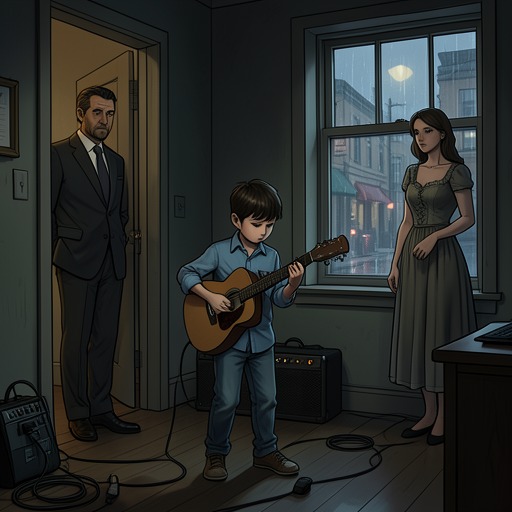
Charlie’s route to Westminster Abbey Choir School begins with a contrast among the children. Rowena works at her music, while Lucas gives up the cello after barely beginning and is described as tone-deaf. Charlie, by contrast, has an unusually beautiful voice and is pitch-perfect. A week after a disastrous parent-teacher evening, the music master at his preparatory school summons Edwina and recommends that Charlie try for the choir school.
The suggestion changes the scale of the decision. The school is not simply another place for lessons: it is a boarding school, and attending means that Charlie will no longer be at home. Edwina has never wanted her children to board. Yet the music master’s assessment makes the opportunity difficult to dismiss. She jokes that Charlie sounds as if he will become a professional golfer, a pun that the music master ignores while pressing the serious possibility of a place at the school.
Admission and separation
Edwina’s reluctance coexists with pride in what Charlie’s talent might make possible. She comforts herself that the school is nearby and imagines that she could travel by bus and wave to him through its windows. If separation proved unbearable, she tells herself, she could break in and bundle him home. Her imagined rescue plan makes clear how little the practical closeness of the school can change the emotional fact: at nine, Charlie will be living away from her.
Dickie encourages her to let Charlie apply, calling the opening a once-in-a-lifetime opportunity and pointing to Lucas’s experience of boarding school. Edwina later recognizes another consequence of his advice. At the time, she believes Dickie has Charlie’s interests at heart; in retrospect, she sees that removing Charlie also suited Dickie, who was having an affair with her and was increasingly present at the family home. Charlie’s habit of barging in on their intimacy made his absence convenient. That motive does not erase the musical opportunity, but it complicates the decision Edwina had understood as a sacrifice for her son’s future.
Charlie takes the entrance examination despite doubts about his academic ability. His musical gifts, his angelic singing, and Edwina’s status as a widow help tip the balance in his favour. The school accepts him because of his exceptional voice while warning that he is academically behind and arriving later than its usual entrants: he is nine, although it normally prefers to admit boys at eight. The school says it will try to address the academic weakness, but the admission itself makes the terms of Charlie’s welcome plain. His voice is the qualification that opens the door.
The chorister years and their end
For four years, Edwina experiences Charlie’s place at the school as the fulfilment of a dazzling promise. She proudly presents him to others as her Westminster chorister and believes his future is golden and safe. His voice gives that confidence a public, audible form: she remembers its clear tones rising beneath the Abbey’s vaulted ceiling, above his curly head. In the present of her recollection, even the shape of her red-painted mouth brings back Charlie’s mouth as he sang.
The school’s place in his life is nevertheless conditional on a gift that does not last. Edwina sometimes hears him trying to reach the notes he could sing the previous term, but his voice now sounds strained and wounded. She understands that he will not sing beautifully again at Westminster Abbey or before the Queen. At thirteen, the choristers leave the role; Dickie reminds her that none of them stays on beyond that age. Charlie must put away his cassock and white ruff and move to an ordinary school. The end of his singing is therefore also the end of the identity and security that Edwina had attached to the choir school.
A promise that cannot continue
Charlie’s departure from the chorister school does not lead smoothly into the next stage of education. None of the good London day schools wants him. Without his voice, he has little to offer those schools academically: his record is weak, and he cannot write an examination paper legibly. One refuses him because its staff cannot read the name at the top of his paper. Dickie must use his connections to approach Wyebourne, a separate school. The distinction matters: Westminster Abbey Choir School is the setting of Charlie’s musical success and its ending, not the school where the later abuse scandal occurs.
Edwina’s later judgment of her decision is neither simple gratitude nor simple blame. She remembers that she did not want Charlie to board, but also that talent, widowhood, and pride made acceptance feel like a rare opening she could not deny him. Looking back, she wonders whether her pride contributed to his downfall. Her memory of Westminster Abbey Choir School thus turns a celebrated opportunity into an unresolved question: whether the gift that seemed to make Charlie’s future safe was also the reason she accepted a separation she had never wanted.