2 Old Lansdowne Road
Moving2 Old Lansdowne Road is Fern Woolbright’s shabby shared home during her life away from her parents. Its attic flat gives her room to make her own choices, and it is where her relationship with Charlie Treadaway begins. Later, police take Charlie from the house for questioning. The same address that shelters Fern’s chosen independence becomes the setting for an irreversible change in her life.
The House and Its Shared Rooms
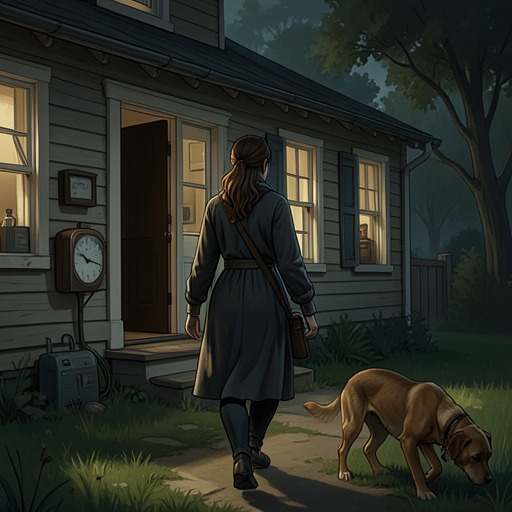
Fern approaches the house with newspaper-wrapped chips in one hand and a bottle of red wine under her arm, then turns a key in its blistered front door. She registers the address as a number rather than a name, a departure from the named houses she has known. Its condition seems to demand a harsher name: the stair carpet smells, bare bulbs hang without shades, and circulars and official-looking letters collect behind the entrance door. Beside the payphone, someone has covered the wall with random names and numbers. The details make the building feel neglected and communal, not like a carefully kept family home.
The attic flat is shared with Felicity and Dee, whose habits make the domestic disorder more immediate. They attack Fern’s nicer food, including Brie and pâté, with their fingers, and Fern doubts their hand-washing. One night, with the bathroom occupied, she catches Dee urinating in the kitchen sink. When she returns with her food and wine, Fern is relieved to find both flatmates out; she retrieves a corkscrew and the remaining pâté from the fridge and retreats to her bedroom. The house offers privacy in brief, practical intervals rather than through any broader sense of order.
A Place for Independence
The discomfort does not make Fern want to return home. After a weekend visiting her parents in Godalming, she makes the long journey back north, taking three trains and arriving near midnight. The account connects her return with Manchester and contrasts the icy rain there with the distance from home. Despite the inconvenience of using a coin-operated launderette and the absence of anyone whose small belongings she might tidy, Fern decides she likes living away. She can smoke in bed, eat biscuits instead of a balanced meal, and set her own routine.
At drama school, other people have worked out that Fern is posh, but they know little about her. In the unfamiliarity of her new surroundings she feels like a stranger, and that very anonymity gives her freedom. The house’s poor condition is part of this independence: it is not an improved or ideal home, but a setting where Fern can live differently from the life shaped by her family. Her private bedroom is a refuge from the communal kitchen and the flatmates’ habits, while the payphone and shared entrance keep the household’s other lives close at hand.
That mixture of distance and connection appears when Fern returns from Godalming to find a picture pushed under her door. It is painted on torn brown cardboard and shows dogs in heaven, with wings and halos. None looks much like Smudge, but the picture brings Fern to tears. Its arrival makes the house a place where a personal tenderness can reach her even amid the grim surroundings. The carefully contained tear contrasts with her usual image of the flat as a place for casual habits and escape.
Charlie’s Room and the Relationship
The house also contains Charlie’s room, which Fern calls his lair. During a gathering, the record player slows and the lights go out. As Jill Miller calls for coins, Fern feels someone take her hand; in the darkness, Charlie leads her from the kitchen into his room. By the time the lights return, she is naked. What begins amid the shared-house gathering becomes a private encounter in Charlie’s room, and Fern regards the change as a startling piece of magic. The room thus marks the move from a public, social setting into the intimacy of her developing relationship with Charlie.
That intimacy is recalled later through an object left behind there: Fern’s necklace. With Charlie’s room locked, she knows where to find the key, a Pinocchio key-ring hidden under the stairs. She slips into the empty house, lets herself into the room, and finds the curtains still half-shut. Sitting on the bed, she inhales the scent of Charlie’s pillow; it smells faintly of him and even more faintly of her. The necklace is where she left it. The room holds their recent closeness in small material traces, but Fern’s visit is interrupted by the sound of a key at the front door and Rob’s voice announcing that he will get the key to Charlie’s room.
The Police and the Aftermath
The house’s role changes sharply when police arrive for Charlie. After a night of strain, the phone rings and stops; at seven o’clock, someone hammers on the front door. Fern hears commotion in the hall and Jill scream. Two uniformed officers and a third man enter, carrying an official-looking letter. They have come to take Charlie for questioning, not to arrest him, but he has to go with them. In the room he sits up blinking, confused and shaking, still in pale blue underpants with a hole in them. Fern is told to leave; from the stairs, she watches the officers bundle him out and into a waiting police car.
The familiar landing and its grey payphone frame what follows. Fern feels numb and understands that her life has changed; the ringing phone then brings her mother’s hysterical, weeping voice. For Fern, the police visit becomes one of the dividing lines between a before and an after, alongside the call from her mother and Elise’s death. The location is no longer simply the untidy shared house where she has been learning to live on her own terms. It is now inseparable from the moment Charlie is taken away and from the shock that follows.
The open door to Charlie’s room carries that change into the next encounter. Fern has gone back for her necklace and left the door wide open. Rob arrives with Charlie’s mother, Edwina Treadaway, and his twin sister, Rowena Treadaway; they walk into the room Fern has just occupied. The house connects Fern’s private memories of Charlie with his family’s arrival into the aftermath of his removal. Its rooms and thresholds gather the story’s shifts in intimacy, exposure, and loss without ceasing to be an ordinary, badly maintained shared home.