137 Kennington Road residence
MovingThe 137 Kennington Road residence is more than a family address: for Lucas, it becomes the setting of a childhood divided between households, a home in which he feels like an outsider, and the place whose staircase is later bound to Edwina’s lasting rupture with Charlie. Its meaning changes over time, from a dark arrival and uneasy refuge to a site of strained family gatherings and finally a scene of injury and lost trust.
Arrival and first impressions
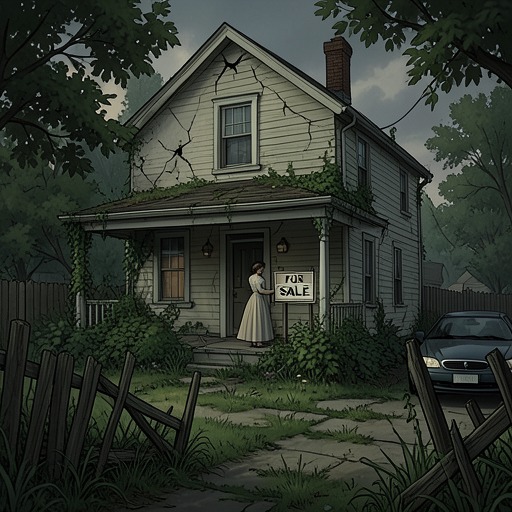
The house first appears to Lucas at night, after his father has packed his things and brought him across to Kennington. Tall and brown, with railings, it is already unfamiliar before he crosses the threshold. Edwina waits at the door. When she tries to hug him, Lucas gets away, making his first encounter with his father’s new household one of physical withdrawal rather than welcome.
That night, Lucas sleeps beside his father in a strange wooden double bed that seems like a boat. The image makes the house feel less like settled ground than a place of passage: the next morning his father takes him back to Chelsea, where Barbara’s friend Aunty June has moved into River Walk. The visit is followed by a request for secrecy. His father urges him not to tell Barbara that they went back to Kennington, and proposes pretending he stayed in Chelsea. The house is thus introduced not only as a destination but as part of a divided family life that adults manage through concealment.
A home within divided custody
The return is not a one-off. Lucas’s father insists on his right to see him, and raised voices in the dining room mark the conflict between the adults. For the next eight years, Lucas feels he has little control over where he is or whom he is with. The residence therefore acquires significance through repetition: it is one side of an arrangement that leaves him feeling persistently out of context.
Neither household offers him uncomplicated belonging. At Barbara’s home, he experiences his mother as deeply unhappy; at the 137 Kennington Road residence, he watches his father pine after Edwina. School, despite its own cruelties, seems more predictable because its hostility is consistent. The house is not presented as a simple refuge from his mother’s home. It is the other half of a divided existence in which Lucas feels he has little say.
The difficulty becomes especially sharp when Lucas wants to speak with his father about growing up. He can do so only during a Kennington Road weekend, yet entering the house feels to him like stepping into quicksand. The metaphor captures the contradiction of the visits: they bring him nearer to his father, whom he looks forward to seeing, while making him feel less secure and less able to move freely.
The twins and Lucas’s outsiderhood
The house also brings Lucas into daily proximity with Rowena and Charlie. He sees them as an unnerving pair, joined by an unspoken understanding of what the other needs and set apart by their boy-and-girl resemblance. Their odd habits, including layering lime marmalade over peanut butter, and their shifts from silence to sudden hilarity, make their shared world feel difficult for him to enter. Rowena’s intelligence and Charlie’s mercurial talent sharpen his sense that he is slow and outmatched.
Lucas reads the household as a two-against-one arrangement. He wishes he had a younger brother who resembled him and could act as an ally; instead, he feels lonely in a strange-smelling house among people he does not particularly like and who, in his view, do not value him as highly as Barbara does. The address is therefore not merely the setting for visits with his father. It is where the contrast between Lucas and the twins becomes part of his experience of family, and where kinship does not automatically provide companionship.
That estrangement follows him beyond the house. When Dickie brings Charlie to Lucas’s school after term has begun, Lucas watches from his dormitory window, anxious that Edwina might emerge from the car and deepen his embarrassment. Charlie’s new pale-blue trunk resembles Lucas’s own, and the resemblance provokes anger rather than connection. The episode shows how the family assembled around the Kennington home continues to unsettle Lucas even when he is elsewhere.
The birthday table and a remembered last visit
A twins’ birthday lunch provides a different, more public measure of Lucas’s place in the household. He is surprised to be invited and suspects that Edwina is answering his failure to invite the twins to his own birthday gathering the year before. Whatever her reason, the meal proves less excruciating than he had expected. Rowena makes an effort to eat; Charlie clumsily clears his plate, with peas ricocheting as he handles the cutlery in the wrong hands by conventional standards. Rowena explains his left-handedness, while Lucas privately interprets the behavior through his prejudices about the family’s background.
The lunch matters to Lucas as the last time he ever sits at the table at the 137 Kennington Road residence. A photograph of him, with his beard, becomes a reminder of that occasion; Barbara’s note on it identifies it as the beard’s last outing, since he shaved it off that weekend. The small domestic detail fixes a point of departure. What Lucas remembers is not simply a family meal, but the last occasion on which he occupied that place at the table.
The staircase and the break in trust
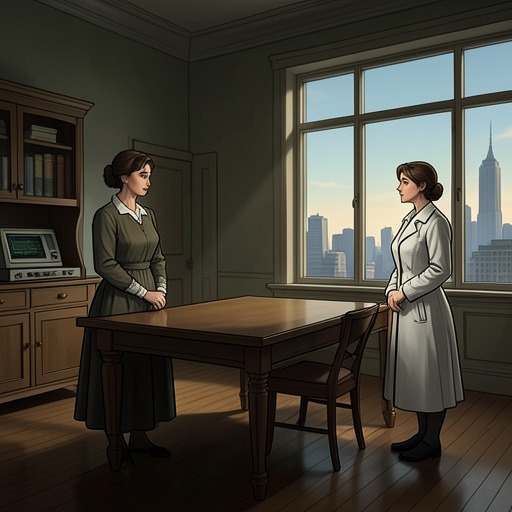
The residence’s most consequential later episode is recounted by Dickie as part of the family’s history. On a weekday in September, Edwina has gone into town to meet her agent and hopes to see Charlie for lunch and perhaps buy him shoes. Charlie promises to meet her but does not appear. Edwina waits until four o’clock before giving up and returning to the house.
There she finds Alicia in agony at the bottom of the stairs. According to Dickie’s account, Charlie has entered the house to steal antiques that can be sold easily, including silverware and two framed landscapes he knows are valuable. He has filled a rucksack and is about to leave when Alicia apprehends him. On the stairs there is a stand-off; Dickie says it is unclear whether Alicia was pushed or fell, but emphasizes that Charlie did not stop to help her. He runs and leaves her behind with a badly injured hip and collarbone.
The consequences are immediate and enduring. Edwina changes the locks, and Dickie describes the event as the moment her trust in Charlie is broken. He presents the loss as an emotional closing-off, not merely a practical response to a theft. Edwina remains unable to forgive Charlie and later believes he also stole her jewellery box years earlier, interpreting the house’s violation as part of a longer pattern of lies. Across Lucas’s memories and Dickie’s account, the residence holds incompatible meanings: a place Lucas approaches with hope and dread, a household from which he feels excluded, and the home whose breached threshold becomes inseparable from the family’s lasting fracture.