Wyebourne College
MovingWyebourne College is the Treadaway family's inherited ideal of education, but its prestige and old-boy loyalties become inseparable from the abuse scandal it tries to suppress. Lucas is sent there as his father's heir to a familiar route; Charlie arrives only after his musical gift has failed to secure him another school place. At Wyebourne, the brothers meet, Charlie reports Mr Robbins, and Lucas initially refuses to believe him. The institution that is meant to prepare boys for adult life instead exposes how privilege, silence, and a school's reputation can help protect an abuser.
Setting and educational inheritance
Wyebourne is a boys' boarding school and Dickie's alma mater. Its place in the family plan is visible well before Lucas arrives: he is entered for the school almost from birth, with Common Entrance at thirteen treated as the formal step before he goes there. Until then, he attends Witterings, a small feeder preparatory school on the South Downs with sixty acres of playing fields and, in Edwina's sardonic recollection, little risk of mixing with the wrong sort. The progression from one school to the next is presented as smooth and predetermined.
Dickie's own education supplies the template. He had excelled at Wyebourne and gone on to Brasenose College, Oxford; Lucas is expected eventually to choose between Oxford and Cambridge, with Oxford assumed to be the natural answer. Edwina sees her stepson's route as a succession of institutions with oak-panelled dining rooms, barely distinguishable from one another. That continuity is a mark of inherited advantage: school is not merely a place Lucas might attend, but a pathway whose next stages have already been imagined for him.
The school also represents Dickie's authority within the family. He recalls Wyebourne as an old boy and expects that connection to carry practical weight. His willingness to intervene for Charlie later reveals the other side of that inheritance: the same network that can open a school door can also bind a family to the school's private knowledge and demands for silence.
Lucas's arrival and school culture
Lucas reaches Wyebourne after Witterings, nervous in his new uniform and conscious of his father's record. In a later examination of childhood photographs, he remembers a plump boy in trousers so long that Mrs Glynne, the housekeeper, had to pin them up while he stood on a chair. The photograph catches him before he has met the failures he associates with school, while his mother responds to the uniform list with delight at the prospect of fencing. The contrast establishes the different expectations surrounding him: his parents can treat the school as an exciting institution, while Lucas experiences his arrival through embarrassment and apprehension.
On the drive to Wyebourne, Dickie talks around difficult feelings by discussing sports and the houses. He had been in Milton; Lucas is assigned to Bunyan, whose boys are known as lumps. Dickie urges his son to try rowing, volunteer, and join in, but Lucas is already convinced that his weight makes rowing impossible. In retrospect, he sees how little he took part. Self-conscious about his body and breath, he avoids the choir, photography society, philatelists, and chess club, maintaining an air of indifference until it hardens into apathy. The school's activities are available to him, but his experience of them becomes a record of withdrawal rather than opportunity.
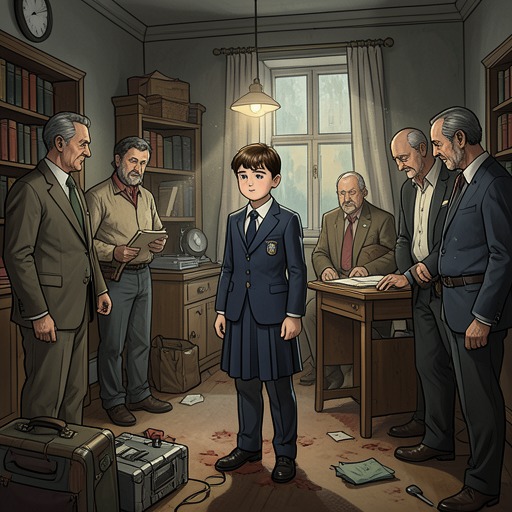
Wyebourne is also where his relationship with his father and stepfamily changes. Lucas regards leaving his mother for boarding school as one of the worst things Dickie has done to him; the arrival of Charlie becomes another. When the housemaster of Milton asks Lucas to show the new boy the school's customs, especially its uniform conventions, the request places the brothers together without repairing their distance. Charlie dismisses the rules, and Lucas avoids him. Their separation is easy to maintain because Charlie is often in detention, where the abuse begins.
Charlie's admission and the abuse scandal
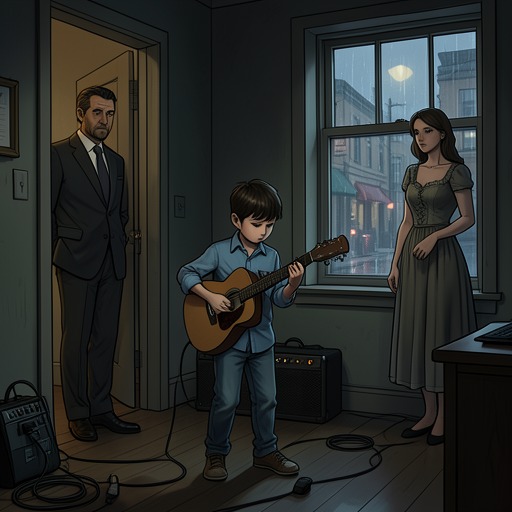
Charlie comes to Wyebourne after his voice, previously his most remarkable qualification, is lost. He had been a gifted singer, described as pitch-perfect, but choristers did not remain after thirteen. Without that voice, he has difficulty entering an ordinary school: London day schools reject him, his academic record is weak, and he cannot write an examination paper legibly enough for one school to read his name. Wyebourne is therefore not the continuation of a secure educational plan, as it is for Lucas, but the school that takes him when other options have closed.
Dickie promises to use his old-boy connection to speak to Wyebourne, and Charlie is admitted. Edwina is shocked by the place and, when the scandal emerges, becomes furious that Dickie arranged it. She comes to understand the admission as part of a coercive bargain: Dickie knew what Mr Robbins was capable of, and Wyebourne took Charlie because Dickie could otherwise expose what the school knew. This is Edwina's recognition of how the place was secured, not a story of a child being sent into a safe refuge. She remembers the expense of the uniform, the trunk, and the equipment as material evidence of the school's false promise of a future for Charlie.
The abuse takes place while Charlie is in detention. When he tells Lucas that Mr Robbins assaulted him, Lucas dismisses him as a fantasist and invokes Robbins's friendship with Dickie as proof that the accusation cannot be true. Charlie nevertheless tells matron, who already has suspicions. Two other boys then come forward with similar accounts. Charlie's disclosure is the act that helps crack open the story, even though his own stepbrother has first answered him with disbelief and an order to keep quiet.
Cover-up, memory, and consequences
Wyebourne's response combines a visible personnel change with concealment. Mr Robbins is placed on gardening leave, and the school employs a new sports master described as heterosexual to the core; meanwhile, the institution tries to hush up the scandal. A court case looms because one of the other boys' parents is determined to pursue Robbins. When Robbins later hangs himself, there is a brief burst of news coverage, but the school has already attempted to contain the revelations. The contrast between the boys' accounts and the institution's management of the crisis makes the scandal larger than one abuser: it also concerns what the school knew, what it was prepared to excuse, and whose reputations its response protected.
The scandal alters the meaning of Dickie's school connection. Edwina confronts him over having secured Charlie's place; he minimizes the seriousness of abuse and treats it as something boys endure. His own history makes that response more disturbing: years later, he admits that he was nine when a prefect assaulted him in his dormitory. The school has thus passed down not only an educational route but an inherited normalization of harm. Dickie's eventual admission does not undo his earlier failure to protect Charlie or Edwina's realization that he had exposed her son to a danger he understood.
Lucas carries his own failure forward. Forty years after telling Charlie not to speak, he recognizes that he had been wrong to reject the account simply because Robbins was his father's old schoolfriend. Wyebourne remains part of the explanation for the distance between the brothers: Lucas met Charlie there, was asked to look after him, and instead dismissed the disclosure that should have changed their relationship. Much later, while giving evidence at the inquest into Elise Landreth's death, Lucas identifies Charlie as his stepbrother and says he has known him since he was eleven. The testimony makes their shared school history publicly legible, but it does not erase the earlier moment when Lucas failed to believe him. Wyebourne's significance therefore persists beyond its gates: it is the setting of Charlie's report, Lucas's betrayal, and a family reckoning that continues long after both boys have left.