137 Kennington Road
Moving137 Kennington Road is both Edwina’s home of more than fifty years and a physical record of the family life she is preparing to leave. Its Georgian rooms hold memories of her marriage to Ollie Treadaway and the early care of Rowena and Charlie, while the house’s growing disrepair makes staying an increasingly difficult undertaking. When Edwina arranges a valuation, the property becomes at once a burden to relinquish, a repository of chosen memories, and an unexpectedly valuable asset.
A Home Entered at the Threshold
Edwina first came through the front door fifty-five years earlier, carried over the threshold by her new husband, Ollie Treadaway. She was twenty-two and five months pregnant. Having previously rented rooms with Ollie as impoverished artists, she was astonished that they now had a house of their own. The threshold therefore marks a change in circumstance as well as an arrival: a new marriage, impending motherhood, and a home that would outlast the early life she could then imagine.
The house’s scale also shaped ordinary family routines. Its front steps made taking the enormous Silver Cross pram out difficult; Edwina remembers having to set the brakes at the top so it would not roll into the road while she turned away. Decades later, returning up those steps can make the past feel close again. The building is not merely a backdrop to her recollections: its doorway, stairs, and rooms provide the precise places through which those recollections return.
Domestic Care and Family Memory
The house is also where Edwina’s early struggle to care for the twins became visible. After a rain-soaked outing, Alicia helped bring the babies and pram inside. In the warm kitchen, the Aga that Ollie had insisted on was useful to Edwina mainly for heat; she could not cook on it and relied instead on a Baby Belling to warm the children’s food. She bought tins of Heinz soup and jars of baby food, aware that the twins were not eating properly: Rowena had a gummy eye, and Charlie coughed repeatedly.
Alicia’s practical care transformed that scene. She stripped and dried the babies, changed them, and fetched dry clothes from the pulley. Once warm and fed with toast and honey, Rowena and Charlie could sit contentedly in their playpen. The episode gives the kitchen a history of both Edwina’s uncertainty and Alicia’s competence. Alicia continued to come to the house daily until the twins no longer needed a nanny, and then stayed to do ironing and cleaning. The home’s intimate history thus includes not only a mother and her children, but the sustained work of the woman who helped care for them.
Wear, Objects, and the Decision to Leave
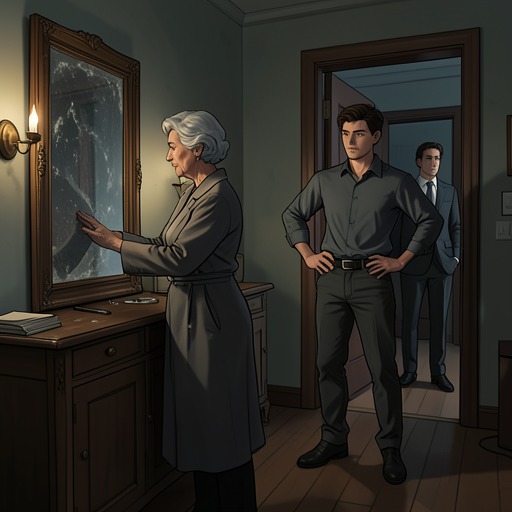
In Edwina’s later years, the house’s condition presses against the memories it contains. Hairline cracks run along the skirting boards; damp and mildew affect the carpet; ivy thickens over the basement windows until the kitchen is jungle-dark even in June. A downstairs lavatory pull cord has had to be retied, moths have damaged the woollens, and some radiators need attention. Edwina sees the building as requiring a firmer hand than her own, while the effort of opening the drawer in her mahogany chest of drawers makes the home’s physical demands personal.
Its furnishings preserve other kinds of time. Much of the good furniture came from Ollie’s parents, including the grandfather clock whose smiling sun-and-moon face contrasts with hands stopped at twenty past eight. A faded pink-velvet wicker chair has stood beside the chest of drawers for years, though Edwina cannot remember ever sitting in it. As she contemplates leaving, she distinguishes between objects she wants to keep and the larger mass of things she is ready to release: the Clarice Cliff pieces, parrot jugs, and Susie Cooper coffee set are among the things she chooses to save. Memories, like these selected possessions, can travel with her without requiring her to carry everything.
That distinction gives shape to her decision. Edwina understands the house as having had its turn in her life, and recognizes that she has clung to it too long. She plans to take a small case of good memories and close the door on number 137. The brief remembered sound of children running up and down the stairs, followed by silence, makes clear what cannot be packed: the living family activity that once filled the rooms.
Sale, Representation, and Value
Edwina acts on the decision by phoning the estate agent down the road and arranging for the house to be valued. She writes the appointment in both her desk diary and the wall calendar, giving herself two days before the Friday visit to hoover and bleach the lavatory. These practical preparations turn an inward resolve into a concrete process of sale, although the routines of maintaining the home continue alongside it.
The estate agent’s photographs present a polished version of the property. Carefully chosen angles emphasize its Georgian details, marble fireplaces, cornicing, and original oak shutters; light and framing conceal the skewed stairs and cracked plaster. The accompanying description markets a faded four-bedroom house on a Georgian terrace in Southwark, highlighting its West End and City transport links and need for care. Edwina recognizes how selectively the images show the place, but the valuation still surprises her: the house is priced at two million pounds. The figure reveals a gap between her experience of a deteriorating home and the property’s value to the market. For Edwina, however, its deepest value remains neither its architectural details nor its sale price, but the life held in its rooms and the memories she elects to take away.