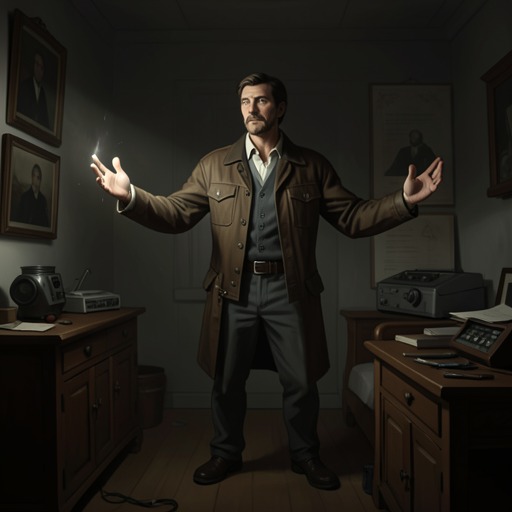
Life begins on the other side of despair
Nausea“Life begins on the other side of despair” presents despair as a threshold rather than a final state. Introduced as a statement by Sartre within a discussion of Existentialism, the expression gains a more unsettling resonance through Antoine Roquentin’s experience: confronting existence may sharpen awareness without making that awareness comforting or easy to escape.
Formulation and Context
The expression appears alongside Dostoevski’s statement that “Suffering is the origin of consciousness.” The pairing connects suffering with heightened awareness, while Sartre’s formulation points beyond despair toward the possibility of life. In the surrounding discussion, Existentialism confronts anguish and despair, and Sartre is presented as a writer and thinker who has helped bring that philosophical tradition to a broad readership.
The phrase is thus more than an assurance that hardship will simply pass. Its emphasis falls on the far side of despair: whatever life begins there is reached by confronting suffering, not by pretending it has not occurred. The novel’s first-person narrative tests this proposition through Roquentin’s increasingly immediate sense that existence cannot be set aside by thought or explanation.
Thought, Existence, and the Failure of Escape
In one episode, Roquentin tries to stop thinking and finds that the attempt folds back on itself: even thinking that he does not want to think remains thought. He concludes that thought is inseparable from his existence, and that his effort to draw himself toward nothingness instead renews his awareness of being. The passage makes despair less a single mood than a bind: consciousness recognizes existence, but cannot step outside it.
Roquentin then tries to make a change by injuring his palm with a knife. The wound is superficial, and he sees no transformation in what has happened; what remains for him is an image on the paper before him. He resolves to give up writing his book on the Marquis de Rollebon. This moment places the expression’s promise under pressure: a decisive act and a change of purpose do not automatically deliver a way beyond the predicament that provoked them.
The Phrase Tested by Events
Soon afterward, Roquentin reads that Little Lucienne’s body has been found and that the criminal has fled. The news intensifies his fixation on existence and thought. His attention moves in a disordered rush between the report, his surroundings, and his own sense of being; he drops the newspaper and flees. The episode supplies no consoling resolution. Instead, the external report of a child’s death becomes entangled with his inability to stop thinking and with his awareness that he, too, exists.
At the public garden, Roquentin’s encounter with a tree root brings him to what he calls the key to existence and to his nausea: absurdity. He distinguishes this from something merely inexplicable within a particular situation. The root is not made meaningful by its function or by an available explanation; it exists in a way that explanation does not master. In this encounter, the movement beyond despair is not a return to ordinary reassurance. It is a recognition of existence’s irreducibility, reached through sustained attention to something concrete.
Meaning and Tension
Read against Roquentin’s episodes, the expression holds together hope and difficulty. It names the possibility of life after despair, yet the novel’s scenes do not present that passage as a clean recovery: thought persists, attempts at change do not erase existence, and the discovery of absurdity offers recognition rather than an easy answer. Despair can be a threshold to seeing more clearly, but that clarity carries its own burden.
The novel also complicates the boundary implied by the phrase. Roquentin cannot first leave existence behind and then return to life; his awareness of trying to escape is itself part of his continued existence. The expression’s force therefore lies less in promising that despair will be overcome than in insisting that life begins on its far side—even when what follows is a more direct, and more unsettling, confrontation with being.