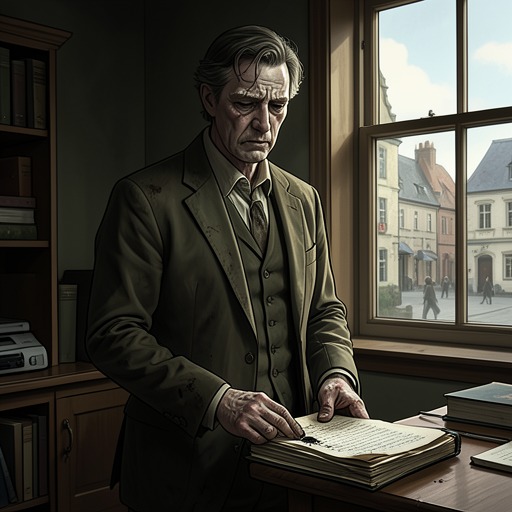
Nothing happens while you live
Nausea“Nothing happens while you live” names Antoine Roquentin’s distinction between living events and the stories made from them. Days accumulate without an inherent plot, he argues, while telling turns that accumulation into a sequence with beginnings, portents, and an ending. The expression also resonates with his embodied crisis: existence persists, unbidden, even when he wants to stop thinking or escape it.
Life Without a Plot
Roquentin describes ordinary life as a succession rather than a story. Scenery changes and people come and go, but there are no natural beginnings; days are added to days without rhyme or reason. People retrospectively total their time by saying they have travelled for three years or lived in a city for three years, yet neither statement converts that duration into a coherent adventure.
Nor does life provide clean endings. A person does not leave a lover, friend, or city all at once. Places can become indistinguishable after a short stay, and the calendar continues its monotonous progression through weekdays, months, and years. At rare moments, a person recognizes a landmark—a relationship or entanglement—but the moment passes and the counting resumes. The claim is not that nothing changes, but that change alone does not arrive already arranged as meaningful plot.
How Telling Creates Adventure
The contrast shifts when experience is recounted. A story seems to start at its beginning, but Roquentin argues that it has already started at its end: the ending is present invisibly, giving the opening its apparent importance. A character’s passing mood or money troubles become significant because the reader knows they belong to a story that will culminate in later events.
Narration thus reverses the character of time. In life, moments pile up without knowing what follows; in a story, the ending draws them into a purposeful sequence. A seemingly incidental detail, such as a deserted street at night, is retained as information whose value will become clear later. The reader consequently imagines the protagonist as if he had experienced details as promises or signs, although the future that gives them meaning was not available to him at the time.
This retrospective structure explains how an adventure can feel real without having existed as an adventure while it was lived. In a remembered episode from Hamburg, Roquentin recalls sitting alone in a café while a phonograph played “Blue Skies.” He began narrating events to himself, linking the woman he was waiting for to an earlier encounter; only then did he feel that he was having an adventure. When she returned and sat beside him, the feeling collapsed into dislike. The episode makes the distinction concrete: the narrative voice supplies the pattern, but returning to the immediate situation does not preserve it.
Narration, Thought, and Existence
Roquentin wishes that the moments of his life would follow and order themselves like those in a remembered life, then recognizes the impossibility of trying to catch time in that way. The wish exposes the gap between experience and retrospective arrangement: a life can be narrated into order, but the order cannot be inserted into the moments as they occur.
That gap has an existential counterpart. During a later crisis, Roquentin experiences thoughts as continuing without end and recognizes that he is the one who keeps them going. Trying not to think becomes another thought, so the effort to stop consciousness renews it instead. His reflection that he exists because he thinks makes existence feel less like a stable conclusion than an activity he cannot switch off.
The newspaper report of Little Lucienne’s death intensifies this collision between event and awareness. Roquentin encounters the news as a concrete fact while his own thoughts return insistently to existence; his response shifts between the reported death, his surroundings, and the knowledge that he himself continues to exist. The episode does not give the event a consoling narrative resolution. Instead, it shows how an external occurrence can break into consciousness without settling the questions that consciousness raises.
Significance
The expression is a compact statement of the novel’s challenge to adventure as a structure imposed on life. A remembered story makes events appear necessary by selecting details and drawing them toward a conclusion; lived time, by contrast, offers no such guarantee. Roquentin’s wish for life to arrange itself like a story is therefore inseparable from his awareness that this arrangement belongs to telling, not to experience itself.
The idea also clarifies why narration cannot simply solve the problem of existence. Stories can confer retrospective value on incidents, but Roquentin’s thoughts and sensations continue in the present, resisting a final, orderly account. The phrase joins a theory of narrative time to the novel’s broader attention to existence as unchosen and persistent: life goes on, while the shape that makes it seem like an adventure is made afterward.