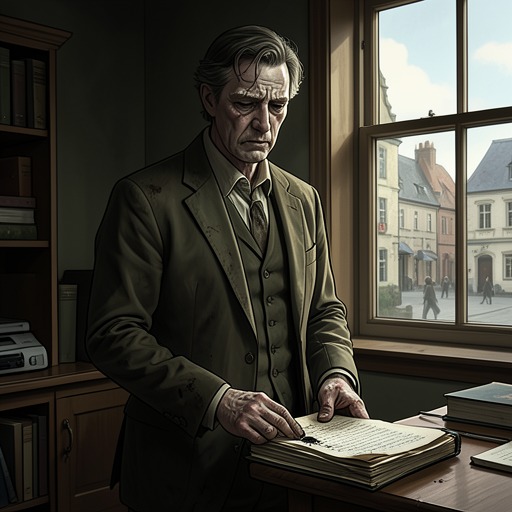
You have to choose: live or tell
Nausea“You have to choose: live or tell” is Antoine Roquentin’s formulation of the tension between living an event and narrating it as a meaningful story. His remembered experience in Hamburg shows how telling can transform ordinary events into an adventure in retrospect, while the present-tense force of life resists such narrative order.
The Choice Between Experience and Story
Roquentin argues that a banal occurrence can become an adventure simply by being recounted. People live amid stories, seeing what happens to them through their own accounts and those of others; they try to live as though their lives already formed a story. The phrase’s force lies in the separation it identifies: to tell an experience is to arrange it into a meaningful sequence, but that arrangement is not the same as living through it.
The distinction is not merely between silence and speech. It concerns the standpoint from which experience becomes legible. Roquentin recalls that he was in the middle of his life without reflecting on it; only later, when he began recounting what had happened, did it take on the shape of an adventure. The story’s sense of beginning and expectation emerged through narration, not from the event as it unfolded.
The Hamburg Example
Roquentin illustrates the idea with a memory from Hamburg, where he was with Erna, a woman he distrusted and who was afraid of him. One evening, in a small cafe in San Pauli, Erna left for the ladies’ room while a phonograph played “Blue Skies.” Alone, Roquentin began telling himself what had happened since he arrived. He framed the scene as the third evening of a story, recalled entering a dance hall called ha Grotte Bleue, and imagined a large, half-drunk woman who would return and sit beside him.
As he narrated this anticipated sequence, he suddenly felt that he was having an adventure. Then Erna returned, sat next to him, and put her arms around his neck. Instead of confirming the story’s romantic anticipation, her return made him hate her, though he did not know why. The mismatch exposes the gap between the scene as lived and the scene as narrated: the story supplies expectation and coherence, while the actual encounter interrupts the meaning Roquentin has just constructed.
Narrative Meaning and the Return to Life
Roquentin concludes that he had to begin living again, and that the adventure then faded. The return to immediate experience does not complete the story; it dissolves the narrative frame that had made the moment feel adventurous. The episode thus gives the phrase an unsettling edge: telling can lend experience a shape, but living on can undo that shape rather than fulfill it.
The broader reflection describes ordinary time as an accumulation without clear beginnings or endings. Days follow one another; people do not leave a woman, friend, or city all at once, and places can begin to seem alike after a short stay. Only rarely does a moment serve as a landmark. Against this unmarked succession, narrative creates apparent boundaries and direction. “You have to choose: live or tell” condenses Roquentin’s recognition that the adventure belongs to the story made of life, not necessarily to life as it is being lived.