Privileged situations
NauseaDefinition and Origins
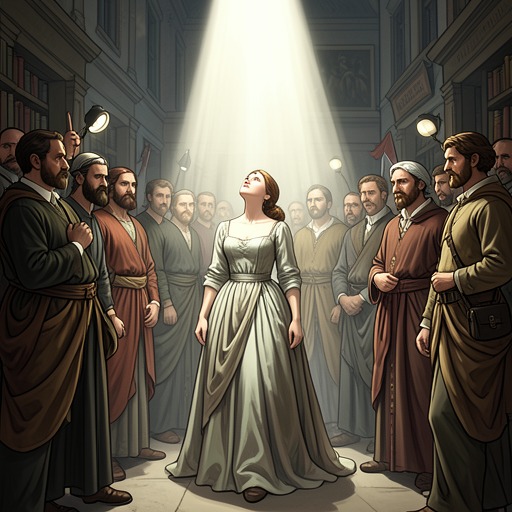
Anny’s “privileged situations” are circumstances she understands as exceptional: they possess a rare quality and style that seem to lift them above ordinary life. In her account, the idea begins with the illustrations in the history books she carried to an attic. Each picture occupied a page of its own, and its scene often appeared far from the relevant passage of text. Their separation from the surrounding narrative made the depicted events feel specially selected, as if they carried a significance beyond their place in a chronological account.
The illustrations did not need to be accomplished to persuade her. Anny remembers their awkward drawing, with limbs imperfectly joined to bodies, but also their grandeur and unity. A depiction of the assassination of the Duke of Guise gathered spectators’ gestures into a chorus of amazement and indignation; small details such as pages falling, dogs running away, and jesters on the steps of a throne belonged to the same composed whole. The images taught her to imagine that certain situations possessed a distinctive quality that made them worthy of being singled out.
Her examples extend beyond public history. As a child, she regarded being a king as a privileged situation; dying could seem to be one too, since historical pictures and the sublime words spoken at death appeared to raise people above themselves. Even entering the room of a dying person seemed to transmit some of death’s grandeur to those present. She recalls being taken upstairs to see her father for the last time: she was unhappy, yet also felt a religious ecstasy at entering what she understood as an exceptional scene. Her mother and aunt, kneeling beside the bed and crying, disrupted the composed grandeur she had expected. The memory shows that a privileged situation is not simply an important event; it depends on how its participants inhabit it.
Expansion into Love
Anny later added love—not merely romantic feeling in the abstract, but the act of love—to her catalogue of privileged situations. She explains this as the background to her refusal of some of Antoine Roquentin’s demands: in her understanding, there was something in the situation that had to be saved. The relationship between them therefore becomes a test case for her theory. Intimacy does not automatically make an occasion perfect; it creates material that may need to be handled according to the situation’s demands.
Her conception also grew beyond a limited set of historically or personally momentous occasions. Anny first imagined that there could be many more privileged situations than she could count, and eventually accepted that their number might be infinite. This expansion makes the idea less a fixed list of special occasions than a way of interpreting experience: an apparently ordinary or particular circumstance might acquire exceptional significance if it is recognized and shaped accordingly.
From Situation to Perfect Moment
Anny distinguishes the privileged situation from the perfect moment made out of it. The process begins with annunciatory signs; then the exceptional situation enters people’s lives slowly and majestically. Only afterward comes the question of whether to turn it into a perfect moment. The sequence matters: perfection is not simply a quality already guaranteed by the event, but a possible achievement within it.
That achievement imposes practical constraints. In discussing the theory with Roquentin, Anny accepts his suggestion that a situation supplies material for exploitation: certain acts, attitudes, and words are called for, while others are forbidden. She describes the person as being plunged into something exceptional and feeling as though they must put it in order. If all the necessary conditions are realized, the moment can become perfect. Her language makes the process both interpretive and active: a person must recognize what the circumstance asks and compose their conduct in response.
Roquentin compares the result to a work of art, but Anny corrects the emphasis. For her, making a perfect moment is not merely aesthetic arrangement; it is a duty and a moral question. The shift from style to obligation is central to the doctrine. What began in the visual unity of historical illustrations becomes a rule for living: exceptional circumstances are not to be passively admired, but transformed through fitting choices.
Meaning and Limits
The doctrine joins selection and action. The illustrated histories had encouraged Anny to believe that some events possessed a rare, precious quality, although the pictures themselves did not establish that those events were objectively more important than episodes with greater historical interest or visual force. Her explanation instead locates their distinction in the way they are framed and made to cohere. A privileged situation acquires its character through attention, interpretation, and the conduct demanded of its participants.
The account also exposes a tension between lived feeling and composed form. At her father’s deathbed, Anny’s grief and her sense of entering a grand situation coexist, while her relatives’ tears frustrate the scene’s imagined order. In love, too, the exceptional situation does not settle what should happen; it introduces demands and prohibitions that may be difficult to satisfy. The perfect moment remains something to be made, not something that follows automatically from passion, death, or historical importance.
Anny’s doctrine thus gives experience a structure of signs, arrival, decision, and disciplined action. It promises that a situation can be rescued from mere succession by being made meaningful, yet it makes that meaning contingent on the participants’ ability to perform the required acts and attitudes. Its artistic vocabulary and moral force belong together: the moment must be composed, but composing it is a responsibility.