Some of These Days
Nausea“Some of These Days” is a ragtime song heard on an old phonograph record, but in Antoine Roquentin’s experience it becomes more than a tune: its disciplined passage through time briefly quiets his Nausea, and its endurance beyond the lives and circumstances that produced it suggests a possible purpose for art. The song does not console by making ordinary life beautiful. Instead, its hard, self-contained form exposes the disorder of existence—and, at the end of the novel, gives Roquentin a tentative model for a book that might make his life bearable to remember.
The record and its first effect
Roquentin asks Madeleine to play the piece he likes, naming it as “Some of these days.” He is among card players in a café and has been overwhelmed by the sounds, smells, and slackened sense of time there. The request sets the song against the room’s habitual, unshaped activity: while the players remain absorbed in their cards, Roquentin strains to attend to something with a beginning and a direction.
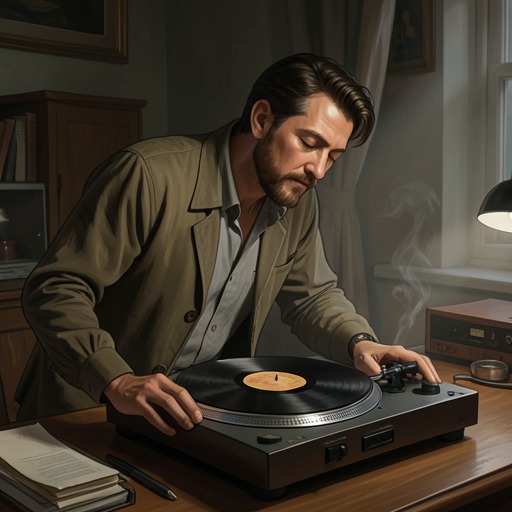
The record is an old ragtime with a vocal refrain. Roquentin recognizes it from the opening bars and remembers American soldiers whistling it in the streets of La Rochelle in 1917. He thinks the song itself must date from before the war, though this particular recording is more recent; it is the oldest disc in the café’s collection, a Pathé record made for a sapphire needle. The layered age matters: a familiar melody survives in a physical recording that is already old, so its apparent continuity depends on a vulnerable object.
At first the instrumental passage seems to offer a different kind of time from the one Roquentin inhabits. Its notes arrive as tiny jolts, each pressing forward and vanishing, held together by an inflexible order that gives them no pause in which to settle into independent existence. He cannot preserve a note without changing it into something languishing and inert. The music’s force lies instead in his acceptance of its passing: each sound must die so that the sequence can continue.
That formal movement produces a small, bodily change. Roquentin warms and feels a modest happiness spread through the same “time” as the café’s ordinary objects and gestures. Yet he also senses a second time: the music cuts across that duration with sharply defined notes, neither stopping it nor belonging to its shapeless drift. The song’s order does not abolish the world; it makes a contrasting experience of time perceptible within it.
A momentary suspension of Nausea
Roquentin waits for the voice, which seems to him the event toward which the preceding notes have been preparing. The music’s arrival feels inevitable, but not secure. A broken spring or the whim of Cousin Adolphe could stop the record; its apparent hardness is exposed as fragile. This tension between formal necessity and mechanical vulnerability sharpens his attention: the song seems able to proceed by its own law, though a small accident could interrupt its performance.
After the last chord dies away, Roquentin feels that something has happened. When the singer’s voice enters, his body seems to harden and his Nausea disappears. The music swells through the room with a metallic clarity, pressing the café’s shabby time against the walls. Even the glass of beer on the table appears denser and more indispensable. Roquentin reaches for it, and the movement of his arm seems to him to have acquired the shape and purpose of a musical theme, as though he were dancing.
The relief is real but limited. The record has not repaired the room, changed the people in it, or supplied Roquentin with a lasting escape from existence. Rather, while the music sounds, his gestures and surroundings briefly become legible through a form that does not resemble their ordinary drift. The song’s capacity to hold attention without turning into an explanation of life distinguishes this moment from the comfort Roquentin rejects in people who imagine that fine art simply nourishes or soothes the bereaved.
The final listening in the café
Near the end of the novel, Madeleine offers Roquentin the record once more before he leaves for the train. He agrees out of politeness and admits to himself that he is not inclined to listen to jazz; nevertheless, he decides to pay attention because it will be his last hearing of a record he expects not to find in Paris. He imagines the steel needle jumping through the grooves until it reaches the disc’s center and the singer falls silent forever. The farewell makes the record’s material limit part of the experience from the outset.
As the saxophone begins, Roquentin contrasts the song with his own suffering. Before the music, he had been morose but calm amid the café’s dirty glasses, stained mirror, Madeleine’s apron, warm beer, and the thoughts that would not leave him. That ugly, familiar world had made him feel at home. The song changes the terms of his attention: its four notes seem to demand suffering in rhythm, with neither complacency nor self-pity. Roquentin envies the music’s clean, shaped pain but recognizes that his own distress remains heavy, bodily, and unresolved. He refuses to mistake the tune for compassion.
A scratch makes an odd noise in the record, but the melody seems untouched by the needle’s cough. Roquentin understands the contrast as a separation between the song and the conditions of its transmission: the disc wears out, the singer may be dead, and he himself is about to leave, while the melody remains young and firm in the performance. Its persistence is not proof that material things escape decay. The scratch and the approaching end of the record make decay audible even as the tune seems to stand apart from it.
When the song stops, the café resumes its habitual absorption in existence. Roquentin imagines how the tune might have been written by a perspiring musician in a hot New York room, amid bills, trouble, and the possibility of a woman who did not return his feelings. He does not know that this is how the song was made; he recognizes that it might have happened that way, or another way. What moves him is the thought that an unglamorous, contingent life could have produced a form that outlasts the moment of composition and can be heard elsewhere.
Roquentin asks Madeleine to put the record back on just once more before he goes. This time he no longer thinks chiefly of himself: he tries to imagine the person who wrote the tune and finds the sweat and trouble behind it moving. He also waits to hear the singer again. The repetition changes the emphasis from the song’s effect on Roquentin to the unknown people carried forward by it: composer and singer, each partly detached from the conditions of their lives yet still present through the record.
From the song to a possible novel
The final performance brings Roquentin a tentative sense that the composer and singer are, in a limited way, saved. Their lives have not been made innocent or fully known, and their art has not abolished the fact that they existed. Yet the song lets him think of them with a gentleness he says he has not extended even to Anny. The thought surprises him: after a long period in which he had not expected such a possibility, he feels a small joy and wonders whether he might also try to make something.
The distinction he draws is between writing history and making another kind of book. History concerns what has existed, and he no longer believes that an account of the past can justify one existence through another; his effort to revive the Marquis de Rollebon has been an error. A different kind of work—a story, perhaps an adventure—might be beautiful and hard as steel, giving readers a form that stands above the mere fact of existence. The song offers a precedent not because a book would reproduce music, but because a made work can possess a clear shape that ordinary life does not provide.
Roquentin does not leave with a completed plan or confidence in his talent. He imagines the book as tiring work that would not immediately stop him from existing or from feeling that he exists. Only after it was finished might some of its clarity fall over his past, allowing him to remember his life without repugnance. He entertains the possibility that he could someday look back on this gloomy hour before the train as the beginning of that effort. “Some of These Days” therefore closes not as a cure or a promise of success, but as the form through which Roquentin first considers transforming his relation to his past by making something that can endure beyond the moment of its creation.