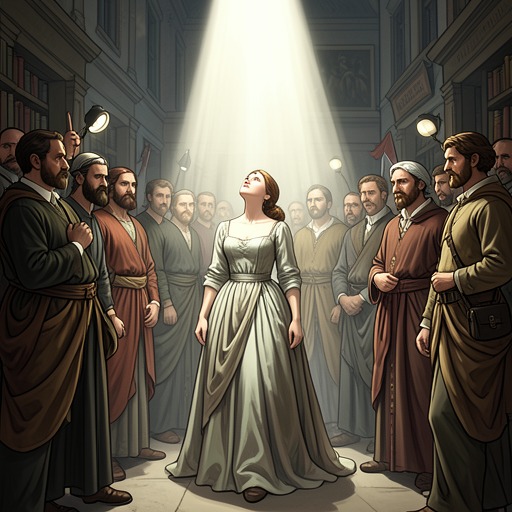
Michelet, History of France
NauseaMichelet’s History of France is both a physical book and a formative imaginative template in Anny’s account of her childhood. Its sparse, striking illustrations taught her to treat certain historical episodes as “privileged situations,” moments seemingly set apart from ordinary life by rarity, grandeur, and style. Recalled during her meeting with Antoine Roquentin, the book helps explain the origins of her former ideal of exceptional moments, while its presence in her room gives that past a tangible place in the present.
The book in Anny’s present
When Antoine Roquentin visits Anny, he notices a volume of Michelet’s History of France on the night-table by her bed, a familiar feature of the room. The detail establishes the book as more than a memory: it remains among her immediate surroundings, alongside a reproduction of a portrait of Emily Bronte. Yet the conversation that follows does not simply show Anny returning to an old reading habit. She uses the childhood book to explain how she learned to imagine certain events as exceptional, and how the idea of such moments took shape in her mind.
The physical volume she remembers from childhood was much larger than the one beside her bed. After her father died, her Uncle Joseph took all its volumes away. Anny called him a dirty pig; her mother whipped her, and Anny jumped out of the window. The book’s removal therefore belongs to a sharply remembered family episode, not an abstract story of literary influence. Its loss is tied to grief, conflict with her uncle, punishment, and a violent gesture of escape.
An illustrated history and its gaps
As a child, Anny carried the enormous books up to the attic. They contained very few pictures—perhaps three or four in each volume—and each occupied a large page by itself, with the reverse left blank. Anny says these pages affected her more than the tightly arranged text, printed in two columns to save space. She knew the pictures by heart and anticipated them while reading: she would wait for one some fifty pages ahead, experiencing its return as a kind of miracle.
The illustrations did not necessarily appear beside the events they represented. A scene might be placed on a page whose neighboring text had no relation to it, requiring the reader to search thirty pages farther on for the corresponding episode. The book thus separated image from explanation and made historical meaning something Anny had to pursue across a gap. The delay and misalignment helped make the images feel rare and consequential, rather than ordinary accompaniments to the prose.
The disproportion between the small number of illustrations and the breadth of the history encouraged Anny to infer a special status for the episodes selected. She recognized that other events might have greater visual appeal or historical importance, yet the pictures seemed to confirm that the depicted scenes had been chosen above all others for a reason. Their importance was not delivered as a clear proposition in the text: it emerged for her from selection, scarcity, and the charged act of finding an image again.
From pictured history to privileged situations
Anny recalls three illustrations for the whole sixteenth century: the death of Henri II, the assassination of the Duc de Guise, and Henri IV’s entry into Paris. The drawings were awkwardly made, with arms and legs that seemed poorly attached to bodies, but she experienced them as full of grandeur. In the scene of the Duc de Guise’s assassination, spectators stretch out their hands and turn their faces away in collective astonishment and indignation, like a chorus. Pages fall, little dogs run, and jesters sit on the steps of a throne. Such incidental details do not diminish the scene; in Anny’s recollection, their clumsiness and grandeur belong to one strict unity.
She named the situations represented in the illustrations “privileged,” reasoning that they must be terribly important to have been granted such rare images. The word describes not only historical distinction but a style: a precious quality that seems to lift an event above the ordinary. The book’s pictures gave this idea a visible form, making selected moments appear to possess an elevated significance independent of their place in the surrounding text.
That pattern extended beyond history. At eight, Anny thought being a king must itself be a privileged situation. She also imagined that dying could transport a person above himself, partly because so many figures were depicted at the moment of death and spoke sublime words. Even being in the room with a dying person seemed to her to transmit something of death’s grandeur to everyone present. The reading experience had become a way of interpreting life: the illustrated scene offered a model for recognizing occasions that seemed charged with a special quality.
Her father’s death and the remembered ideal
Anny connects this childhood understanding directly to her father’s death. When her family took her to his room to see him for the last time, she remembers climbing the stairs in unhappiness, but also being intoxicated by a kind of religious ecstasy. She believed she was entering a privileged situation and tried to make the proper gestures, as if she could inhabit the grandeur she had encountered in the pictures.
That imagined elevation collided with the grief of the adults around the bed. Her aunt and mother were kneeling and crying; Anny says their tears spoiled the scene. Recalling this to Antoine Roquentin, she speaks angrily, as though the memory still burns. The episode shows both the force of the book’s influence and its limits: a historical image had prepared her to expect death to confer a heightened meaning, but an actual family death arrived with distress that would not conform to the composed unity of an illustration.
In the conversation, Anny asks to speak about privileged situations and traces their origin to these pictures. The book therefore supplies a remembered genealogy for her idea of perfect moments, without making the childhood ideal identical to her later doctrine. Its illustrations taught her to look for rarity, selection, style, and grandeur; her recollection also exposes how that aesthetic expectation could be frustrated by lived experience. The book’s significance lies in this double role: it gave Anny a language for imagining exceptional moments, and it preserves, in the present, the childhood history from which that language arose.