M. de Rollebon’s letters
NauseaM. de Rollebon’s letters are the material foundation of Antoine Roquentin’s abandoned historical study—and, in its final scene, the evidence of that study’s failure. The yellow pages and their inked marks survive in Roquentin’s hands, but they cannot make the Marquis present: after Roquentin recognizes that the past does not exist, the documents no longer open a passage to a living person. Their changing significance, from archive to imagined companionship to inert paper, concentrates the book’s distinction between traces of the past and existence itself.
The Archive and the Historical Project
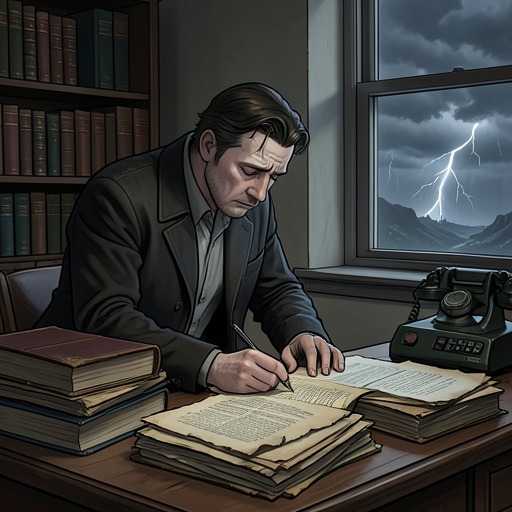
At three o’clock, Roquentin sits at his table with the file beside him. He has stolen the letters in Moscow and has been using them to write about M. de Rollebon. The scene begins not with an abstract account of historical method but with the close circumstance of a man working from a particular file: the documents lie next to him as he tries to place the Marquis within history.
The passage Roquentin is composing describes sinister rumours and reports that Rollebon wrote to his nephew on September 13 that he had made his will. In Roquentin’s project, a dated statement in a letter can be arranged into a narrative about the Marquis’s life. Yet the act of writing is also bound up with Roquentin’s own sense of purpose. He has previously lent his life to the Marquis, waiting to install him definitively in a niche in history; when Roquentin can no longer continue the book, the letters remain, but the enterprise that made them seem meaningful has ended.
From Living Presence to Paper
For a time, Rollebon has seemed to Roquentin more immediately alive than people around him. Roquentin describes him as quiet and warm within him, stirring occasionally and appearing, on a fine day, with a pale face and bluish cheeks. Even when the Marquis does not appear, he remains a weight in Roquentin’s heart. The letters are therefore not merely research materials: through his work on them, Roquentin has experienced the absent historical figure as an intimate, recurring presence.
That relation breaks when Roquentin finishes the sentence about Rollebon’s will. An immense sickness comes over him, and his pen falls, leaving ink to splutter. The room still looks ordinary; what has disappeared is not the table or the familiar setting but the Marquis’s presence. Roquentin understands that Rollebon has, in a sense, died for the second time. The letters cannot prevent this disappearance simply by preserving the words written by his hand.
Provenance and the Limits of Evidence
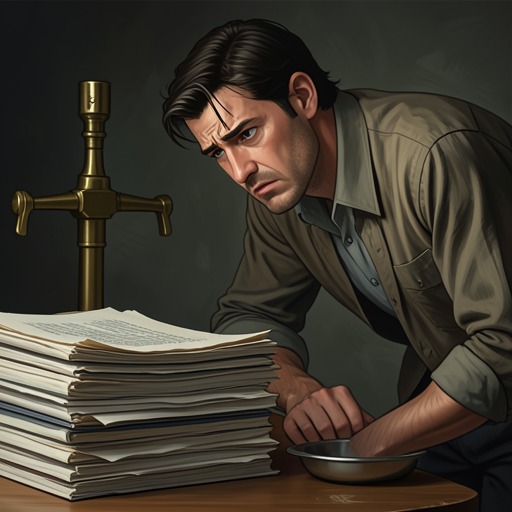
Roquentin holds the letters and imagines the physical acts behind their marks: Rollebon leaning on the paper and holding the sheets steady as he wrote. But this reconstruction no longer restores contact. The pages are in Roquentin’s hands, and the marks can be attributed to a writer, yet the inference from trace to presence has lost its force. What remains is a bundle of yellow pages, not the person who made them.
The archive has a complicated history. Rollebon’s nephew was assassinated by the Czar’s police in 1810, his papers were confiscated and taken to the Secret Archives, and, a hundred and ten years later, the Soviets deposited them in the State Library. Roquentin stole them there in 1923. He can set out these circumstances as a plausible chain of custody, but their plausibility does not make them experientially real to him: he has no genuine memory of committing the theft, and the story seems hollow beside the scored sheets he can actually touch. The provenance explains how the documents came to his room; it cannot make the dead Marquis present.
The Past, Recalled and Lost
Roquentin identifies his own decisive words as the point of rupture: he had said that the past did not exist. Until then, the letters had sustained an imaginative relation to Rollebon, allowing an absent life to feel inhabited. Once Roquentin accepts that the past is not a place in which the Marquis continues to live, the papers return to their material condition. Even the possibility that Rollebon’s bones remain offers no continuation of the person: bones would exist independently, as phosphate, calcium carbonate, salts, and water.
Roquentin makes one last attempt to summon the Marquis by repeating Mme de Genlis’s description of his small, wrinkled, pitted face and singularly malicious expression. The image comes readily; Roquentin can shape the pointed nose, bluish cheeks, and smile as before, perhaps more easily than before. But this ease now confirms the loss rather than repairing it. The face is an image in Roquentin, a fiction, and the letters that once seemed to anchor the historical figure cannot turn that image into a living presence. Roquentin leans back in his chair with an intolerable sense of loss.
Documentary Trace and Existence
The letters’ force depends on a distinction the scene steadily sharpens: a trace can attest to contact with a past person without making that person exist again. Their marks have a writer, and their custody can be narrated through archives, confiscation, transfer, and theft. But the archive’s historical chain and Roquentin’s imagined reconstruction cannot overcome the absence at the center of the papers. Once the narrative he has built around Rollebon collapses, the documents disclose their own thing-like materiality: pages, ink, and marks.
This shift makes the letters a measure of Roquentin’s relation to history as well as a set of sources for his research. While he believes his writing can install Rollebon in history, he lends the Marquis his own life and experiences him as a presence. When that belief fails, the same papers cannot supply either a continuing past or a purpose for the present. Their ending is not the destruction of the archive but the end of its power to mediate a living connection: Roquentin still holds the letters, and Rollebon is no longer there.