Olivier Blaive portrait
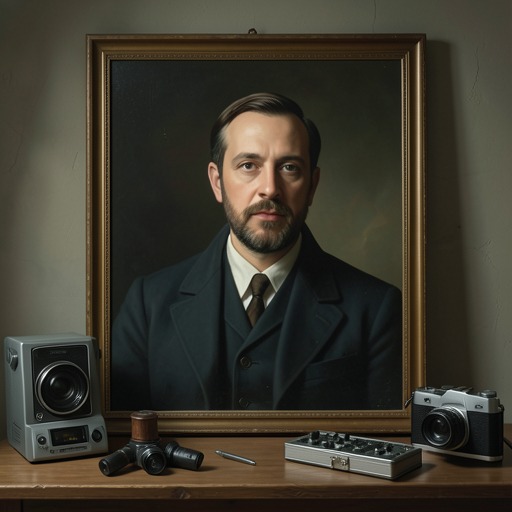
NauseaThe portrait of Olivier Blevigne is a museum painting by Bordurin that transforms a former deputy of Bouville into an enduring public figure. Antoine Roquentin’s discovery that Blevigne was five feet tall resolves a visual discrepancy that had troubled him on several visits, but the portrait’s deeper importance lies in what its distortions accomplish: it converts a contingent, vulnerable life into an image of authority fit for posterity.
Discovery and Setting
The painting hangs in the Bouville museum among the portraits of the city’s elite. Roquentin first noticed it the previous year and could not decide whether its proportions or perspective were at fault. Something about the deputy’s position on the canvas seemed wrong, though Roquentin resisted the possibility that Bordurin, a Prix de Rome artist, had simply made a mistake.
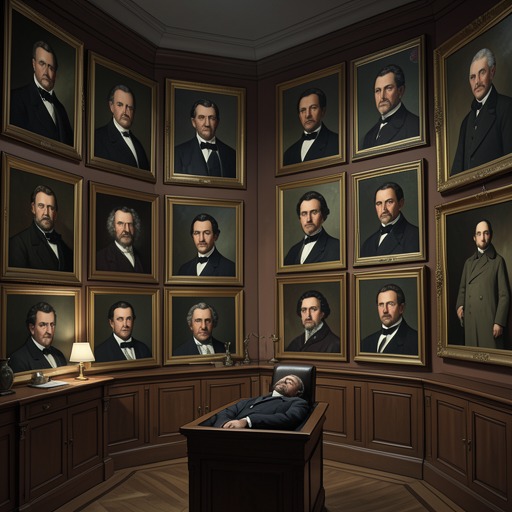
The question becomes answerable when Roquentin finds an old issue of the Satirique Bouvillois, dated 6 November 1905 and devoted to Blevigne. He goes directly from the library to the museum. Before entering the main portrait hall, he passes the newly displayed painting The Bachelor's Death, a gift of the State. Its image of a solitary man’s death prompts Roquentin to consider the warning it seems to offer about isolation and posterity. He then enters the hall, where more than 150 portraits of Bouville’s elite confront him.
The Man Behind the Image
The satirical newspaper supplies the physical fact that unlocks the portrait: Blevigne stood only five feet tall. Its cover depicted him clinging to the mane of the politician Combes under the mocking caption The Lion's Louse; the issue also ridiculed his squeaking voice and alleged that he used lifts in his shoes. It described his wife, Marie-Louise Pacome, as a horse, making the public caricature of the couple part of the same account of Blevigne’s stature.
Roquentin had already read a biographical entry on Blevigne in the Petit Dictionnaire des Grands Hommes de Bouville. It presented him as a lawyer educated in Paris, a businessman who founded the Club de l'Ordre, and a politician who had vowed to restore order after the Paris Commune. He married Marie-Louise Pacome in 1880 and later established the firm Pacome-Blevigne & Son. His son Octave’s premature death deeply affected him; Blevigne died in February 1908, two years later. The portrait’s imposing political identity thus belongs to a life also marked by bereavement and by the far less flattering public mockery preserved in the newspaper.
Composition and Correction
Once Roquentin knows Blevigne’s height, the painting’s furnishings become evidence of deliberate adjustment. Bordurin surrounded the figure with objects unlikely to make him appear smaller: a hassock, a low armchair, a shelf of small books, and a little Persian table. Yet he gave Blevigne the same apparent stature as Jean Parrottin, whose portrait has the same dimensions. The two paintings’ objects do not match that equivalence: Blevigne’s little table is nearly as large as the immense table in Parrottin’s portrait, while his hassock would almost reach Parrottin’s shoulder. Roquentin recognizes that this comparison had caused his unease.
The discovery changes the character of the visual puzzle. The portrait has not simply misplaced Blevigne within the frame; it has concealed his small stature by arranging the surrounding scale and granting him a grandeur comparable to his neighbor’s. Roquentin imagines that a person speaking with Blevigne would have had to lean down or bend his knees. The canvas, by contrast, makes its subject spring forward as a formidable political presence.
Posterity and Political Memory
In the museum’s gallery, the elite portraits participate in a larger civic project of remembrance. The men represented there built Sainte-Cecile-de-la-Mer and founded the Federation of Shipowners and Merchants of Bouville in 1882. The group’s account of its own work included expanding and dredging the harbor, developing technical and professional education, breaking the 1898 shipping strike, and sending sons to war in 1914. Museum visitors, meanwhile, respond to the portraits as records of achievement: one calls Remy Parrottin’s portrait History, while another praises the intelligence and handsomeness the image appears to convey.
Roquentin first finds it possible to admire the apparent perfection of these figures. But he comes to see that the portraits have removed the weakness and natural connections visible in human faces, presenting their subjects instead as polished embodiments of civic authority. In that setting, Blevigne’s portrait exemplifies how artistic representation can select what survives: the awkward scale of a five-foot man gives way to a threatening face, a commanding gesture, and eyes rendered like those of a bull. His political image becomes monumental even as the satire and the biography preserve details the museum portrait does not foreground.
Significance
The portrait’s discrepancy is both a practical solution to Blevigne’s stature and an instance of the elite’s broader self-presentation. In the gallery, Roquentin sees the canvases as a human-made ordering of nature and history, a public inheritance shaped into portraits of rights, rank, and accomplishment. The painting does not merely record Blevigne; it helps determine which version of him will be remembered.
That transformation also sharpens the contrast between the portrait’s permanence and Roquentin’s sense of himself as existing by chance, like a stone, plant, or microbe. Looking at the dead, faultless-seeming Blevigne, he feels judged by a world of inherited rights and duties in which the museum’s honored figures appear to have possessed an unquestioned claim to live and be remembered. The portrait therefore resolves a problem of proportion while opening a more unsettling one: how an image can grant authority and immortality to a life whose physical vulnerability, personal loss, and public ridicule remain outside its polished surface.