Pathé record of “Some of These Days”
NauseaThe Pathé record of “Some of These Days” becomes, for Antoine Roquentin, more than a piece of recorded music: its disciplined passage through time briefly overcomes the nausea that makes ordinary existence feel viscous and shapeless. The song offers a narrow, fragile order against the café’s contingent present, and when it ends, that order disappears with it.
Identity and Place in the Scene
Antoine Roquentin asks Madeleine to play the record he likes, naming “Some of these days.” She hesitates because the card players may object to music while they play, but goes to ask them. The request arises amid the café’s distracting activity: a cousin sways precariously near the bar, and four men are playing cards. Against this unsettled human scene, the record will provide a different kind of duration, one not governed by the players’ gestures or the room’s interruptions.
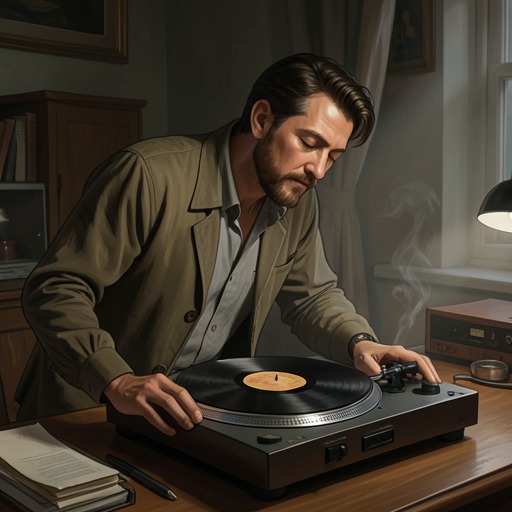
Madeleine turns the crank. Roquentin fears she may have chosen the wrong record, as on a previous occasion when she played Cavalleria Rusticana, but recognizes this one from its opening bars. It is an old ragtime song with a vocal refrain. He remembers American soldiers whistling it in the streets of La Rochelle in 1917 and infers that the song itself must be older than the war; the recording, however, is more recent. It is the oldest record in the collection, a Pathé record made for a sapphire needle. The object thus carries several layers of time: the age of the song, the later act of recording it, and Roquentin’s recollection of hearing it abroad.
Musical Time and Fragility
Before the singer enters, Roquentin listens to the instrumental notes as a succession of minute shocks. They have no rest: an inflexible order brings each one into being and destroys it before it can exist for itself. He imagines trying to hold a note back, but knows that if he stopped it, it would become only a languishing sound between his fingers. To hear the music, he must accept—and even will—the passing away of its notes. Their evanescence is not incidental to the record’s effect; it is the condition of the song’s forward movement.
The approaching vocal refrain seems to gather the notes into an event for which they have all been preparing. Roquentin loves the singer’s voice not simply for its fullness or sadness, but because it arrives as the culmination of that prior sequence. Yet the apparent inevitability is precarious. A broken spring, or the whim of Cousin Adolphe, could stop the record. Its hard, unwavering passage is therefore also vulnerable: nothing seems able to interrupt it, yet almost anything could break it. The mechanical object makes musical necessity perceptible while exposing how easily that necessity might fail.
A Temporary Release from Nausea
As the ragtime continues, Roquentin grows warm and happy. He distinguishes this small happiness from the music’s own duration: ordinary time remains a viscous puddle, filled with broad, soft instants that spread and seem old almost as soon as they begin. The music, by contrast, forms a narrow band of steel that cuts through that time with its sharp points. It does not repair everyday existence or make its objects meaningful; for a little while, it supplies another temporal order alongside it.
The café’s events continue, but the music seems to pass through them without being caught by them. A door opens, cold air reaches Roquentin’s knees, and a veterinary surgeon and his little girl arrive. The girl sits stiffly, eyes wide, and rubs the table with her fist as she listens. Their presence does not redirect the song’s progression. The record’s duration holds its course through the room’s incidental movements, making the contrast between musical sequence and ordinary time newly vivid.
The Voice, the Gesture, and the Change
When the singer’s voice enters after the short silence, Roquentin feels that something has happened. The nausea disappears: his body hardens, and the music swells until it seems to fill the room with metallic transparency, pressing the café’s miserable time against the walls. He feels himself inside the music. The transformation reaches his own movement. His beer glass appears dense and indispensable; when he stretches out his hand to take it, the gesture seems to develop like a majestic musical theme, gliding along with the song. A familiar action, ordinarily exposed to Roquentin’s nausea, briefly feels composed and complete.
The words of the refrain, “Some of these days You'll miss me honey,” are heard as part of that vocal arrival. At the moment Roquentin’s hand closes, he sees Adolphe’s face against the chocolate-coloured wall and reads it as witnessing the necessity of a conclusion. He presses his fingers against the glass and feels happy. The change is not a lasting alteration of the café or of Roquentin’s circumstances; it is a temporary alignment among the song’s progression, his body, and a single gesture.
Ending and Significance
The record stops, and the café’s ordinary time returns to the foreground. Night has entered unnoticed, veiling the lamps; the card players resume their movements, and a nine of hearts left behind is eventually noticed and passed to the young man. Roquentin decides to leave. The card, like the song, belongs to a small sequence of events, but without the record’s sustained musical order it remains part of the room’s unremarkable and contingent activity.
The record’s significance lies in the limited nature of its reprieve. It does not abolish the nausea permanently: for the duration of the song, music gives passing moments a purposeful shape, and its cessation leaves Roquentin among the people and objects of the café again. The same feature makes the experience moving and fragile. Musical order can seem inevitable as it unfolds, but it depends on a mechanism that can break, and its resolution cannot be held after the sound is gone.