The Death of a Single Girl
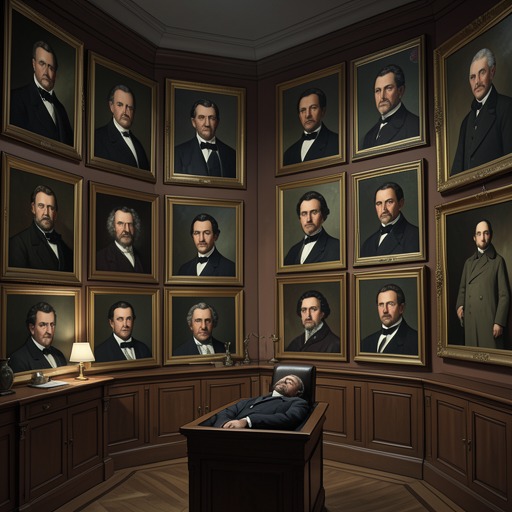
NauseaRichard Severand’s painting “The Bachelor’s Death,” displayed above the entrance to the Salon Bordurin-Renaudas in Bouville’s museum, turns an imagined deathbed into a moral warning. Its abandoned bachelor and the people already taking advantage of his death stand in sharp contrast to the family bonds and social privileges celebrated in the portraits beyond the doorway.
Display and Scene
The large canvas, a recent addition to the museum and a gift from the State, is signed by Richard Severand. It depicts a bachelor lying in bed after a prolonged final illness. His daughter is present, but the scene offers no comfort in her presence: a maid who is also his mistress has opened a bureau drawer and is counting money, while a man waits in the shadows beyond an open door. A cat laps milk nearby, indifferent to the death.
The figures turn the bedroom into a tableau of abandonment and opportunism. The bachelor’s body and the disordered bed establish the aftermath of a long death agony; the open drawer, waiting visitor, and unconcerned animal make the surrounding world appear to have moved on before he has been laid to rest. The painting’s title gives this private scene the force of a general social example.
The Warning
Antoine Roquentin reads the bachelor’s death as a punishment for a man who had lived only for himself. In his interpretation, no one has come to close the bachelor’s eyes, and the absence of that final act of care exposes the cost of isolation. The scene also becomes a warning directed at Roquentin: there is still time for him to retrace his steps rather than follow the bachelor’s path.
That warning is sharpened by the painting’s position at the threshold of the main portrait hall. Roquentin understands that more than a hundred and fifty portraits await inside, making the bachelor an exception against which the museum’s celebrated dead can be measured. The canvas therefore functions not simply as a depiction of death, but as a point of transition into a gallery that embodies a competing account of how a life should end.
Contrast with the Portrait Gallery
Roquentin contrasts the bachelor with nearly all the people represented in the adjoining room. Apart from a few young people who died before their time and a school’s mother superior, the painted figures had not died bachelors, childless, without wills, or without the last rites. They had entered death surrounded by the forms of family continuity, property, religious observance, and social recognition that the bachelor lacks.
The contrast reveals the values upheld by the gallery’s respectable dead. Their portraits associate entitlement with life, work, wealth, command, respect, and even immortality. The bachelor’s lonely end is thus set against a civic ideal in which family and property help secure a person’s place in the world and in its memory. By making that ideal visible beside its opposite, the painting gives Roquentin’s warning both personal urgency and social force.
Narrative Significance
The canvas shapes Roquentin’s approach to the portraits: before entering the hall, he pauses to compose himself, then crosses its threshold under the gaze of a hundred and fifty pairs of eyes. Its warning is therefore embedded in the museum’s arrangement. The bachelor’s solitary death comes first; the crowd of honored dead follows, surrounding the visitor with the collective standard against which his possible future has just been measured.
The painting’s moral clarity belongs to Roquentin’s reading of it, not merely to the depicted scene. He turns the bachelor’s isolation into a lesson about the consequences of living only for oneself, while the gallery supplies the social terms—family, inheritance, religious rites, and public esteem—through which that lesson becomes legible. Together, canvas and portraits make death a test of belonging and make the museum visit a moment of self-examination.