Bouville Elite Portraits
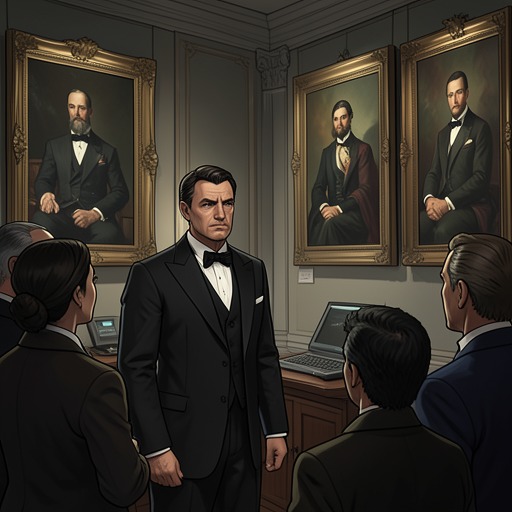
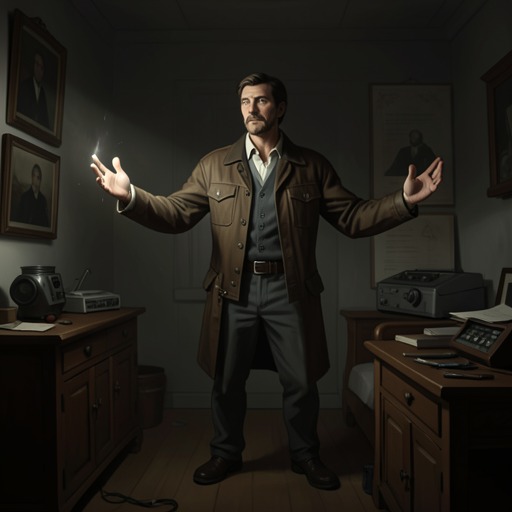
NauseaThe Bouville elite portraits are the museum’s grand visual record of Bouville’s ruling class—and, for Antoine Roquentin, a formidable image of how power converts its own privileges into apparent rights and historical truth. Gathered in the Salon Bordurin-Renaudas, the paintings commemorate civic achievement and respectable family life with such composure that the town’s social order seems not merely successful but deserved. Yet the gallery’s certainty turns against its visitor: the dead man whose portrait holds the room can make Roquentin feel that he has no right to exist.
The Gallery and Its Memorial Program
The portrait group occupies the Salon Bordurin-Renaudas, the main hall of the museum. Before entering, Roquentin encounters a recently hung canvas by Richard Severand, titled The Bachelor's Death, a gift of the State. It depicts a bachelor dying alone while the woman at his bedside counts money and a waiting man stands in the doorway; the cat lapping milk remains indifferent. The scene supplies a pointed counter-image to the elite portraits beyond it. Where the bachelor’s death is exposed as isolation and disorder, the gallery presents a community whose members are surrounded by family, public respect, and the assurance of a proper end.
Roquentin pauses at the warning implicit in the bachelor’s fate. More than 150 portraits hang in the room, and, with only a few exceptions, their subjects did not die bachelors, childless or intestate, or without the last rites. They appear to have passed into death reconciled with God and the world, entitled to the eternal life they had claimed as their due. The contrast makes family continuity and religious observance part of the gallery’s political argument: the honored dead are represented as people whose private conduct confirms their public worth.
The hall is organized around that conviction. A guardian sleeps by the window, pale light falls across the paintings, and a frightened cat flees as Roquentin enters. The room is otherwise still, but he feels the gaze of a hundred and fifty pairs of eyes. The portraits do not function as isolated likenesses; together they stage a collective presence, surrounding the living visitor with the authority of a community that has already written its own history.
The Class on the Walls
The works represent all those belonging to the Bouville elite between 1875 and 1910, men and women painted meticulously by Renaudas and Bordurin. The men’s record is presented through religious, commercial, and civic institutions. They built Sainte-Cecile-de-la-Mer and founded the Federation of Shipowners and Merchants of Bouville in 1882, declaring its purpose to unite men of good will, aid national recovery, and restrain parties of disorder. They enlarged the port’s quays and Marine Terminal, improved its anchorage through dredging, and helped make Bouville a leading French port for unloading coal and wood. The anchorage reached a low-tide depth of 10.7 meters; the fishing fleet’s catch rose from 5,000 barrels in 1869 to 18,000 barrels twenty years later.
The account also portrays the elite as patrons and disciplinarians. Its members established technical and professional study centres under their protection, broke the shipping strike of 1898, and gave their sons to France in 1914. The women are credited with founding most of the town’s charitable and philanthropic organizations, but their memorial identity is framed above all through marriage and motherhood. They raised children in the knowledge of rights and duties, religion, and traditions said to have made France great. Public benefaction and private family roles thus reinforce one another: civic leadership appears as an extension of household authority, while inherited privilege is presented as a reciprocal burden of service.
The display gathers this class into a procession of offices and reputations. Roquentin passes portraits of Jean Pacome, President Hebert, the Parrottins, General Aubry, and numerous municipal, commercial, medical, and religious figures. A label identifies Remy Parrottin as born in Bouville in 1849 and later a professor at the Ecole de Medecine in Paris. A visitor recognizes the academic title and painter’s prestige as History, while his companion admires the subject’s handsome, intelligent appearance. Such responses show how the gallery’s labels and likenesses make local status legible: institutional credentials and polished faces turn individual portraits into evidence of a shared civic greatness.
Jean Pacome and the Authority of Rights
Jean Pacome becomes the image through which Roquentin most sharply confronts the class represented by the gallery. He is shown with his head slightly raised, a top hat and gloves in one hand, and a figure combining slender hands and small feet with broad shoulders. Roquentin finds him strikingly handsome and difficult to criticize. But Pacome’s grey eyes do not smile; Roquentin reads in them a calm, implacable judgment.
That judgment matters because it seems to reach beyond appearance. Roquentin distinguishes his own psychological interpretation of Pacome from the portrait’s forceful verdict on the viewer. The encounter makes him recognize that he has always felt he lacked the right to exist: he has appeared by chance, like a stone, a plant, or a microbe, and his life has reached uncertainly toward small pleasures. Pacome, by contrast, seems to embody a life whose every impulse has been converted into an entitlement.
The portrait’s implied biography makes rights and duties mutually confirming. Pacome has performed what he understands as his duties—as son, husband, father, and leader—and has expected, in return, the right to a united family, a prosperous inheritance, tender care, veneration, and unquestioning obedience. He has never doubted that he was entitled to live as he did. His family has become the richest in Bouville, a success that could not surprise him within this worldview: each advantage appears not as an accident of circumstance but as the rightful reward of a life correctly ordered.
Even pleasure is absorbed into this system. Roquentin imagines Pacome enjoying himself with moderation, treating refreshment as another due rather than as an unruly desire. The handsome bindings of the books near the portrait suggest a cultivated routine: perhaps Montaigne or Horace before sleep, perhaps contemporary writers such as Barres and Bourget. These details extend the portrait’s authority beyond business and family into taste and learning. Pacome’s privilege looks complete because the gallery can represent it as a harmony of public duty, private conduct, cultural refinement, and untroubled self-belief.
Painted Nature, Public Memory, and the Fracture
The portraits’ immaculate finish helps turn that social ideal into an apparently settled truth. Across the gallery Roquentin sees faces made clear and cold, their features stripped of the mysterious weakness found in living faces. He cannot find in them a relation to trees, animals, or the elemental life of earth and water. The paintings seem instead to offer humanity reconsidered by humanity, decorated with the achievements of civic order and the Rights of Man and Citizen.
That polish has a political history. The elite had transformed the coast and town through dredging, construction, and the enlargement of the port; in Roquentin’s interpretation, the painters perform an analogous operation on their faces. Renaudas and Bordurin smooth away uncertainty just as the men’s projects remade land and sea. Portraiture does not simply preserve individuals for posterity: it converts a particular class’s account of itself into a disciplined public image, one in which natural contingency and human vulnerability have been painted out.
The gallery’s authority nonetheless depends on the visitor’s response. Roquentin first admits admiration for the reign of man, then finds that the painted faces cannot answer the existential question they have raised. Their serene certainty exposes the disparity between Pacome’s unquestioned rights and Roquentin’s sense of accidental existence. After traversing the salon, he turns back in farewell to the beautiful lilies of the portraits, calling them the pride and reason for existing before rejecting them as bastards. The abrupt reversal breaks the spell of the memorial display without erasing its power: the portraits remain an image of how an elite makes its privileges look eternal, while Roquentin leaves unable to continue the historical study through which he had sought meaning.