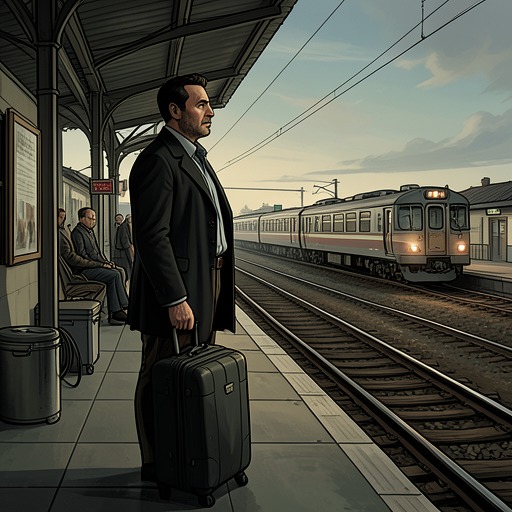
Railwaymen's Rendezvous
NauseaRailwaymen's Rendezvous is a place in Bouville associated with Antoine Roquentin’s recurring experiences of nausea and, later, with the strange happiness he finds in an old ragtime record. It enters the novel not as a fully described setting but through memory: a named point in the pattern by which ordinary surroundings suddenly become insistently present.
Setting and Recollection
Roquentin recalls Railwaymen's Rendezvous while describing how his first intense encounter with the existence of an object—the pebble he had meant to skim across the water—was followed by other bouts of nausea. The place appears among those subsequent episodes, alongside a night spent looking out of a window and a Sunday in the park. The recollection gives Railwaymen's Rendezvous a specific place in his personal history of these disturbances, while emphasizing that the experience there was one occurrence in a continuing pattern rather than an isolated event.
Nausea and Repetition
The remembered visit helps Roquentin distinguish the recurrence of nausea from its changing intensity. Objects sometimes begin to exist in his hand, he says, and such moments have happened in different places and circumstances; none, however, had been as strong as the present episode he is describing. Railwaymen's Rendezvous therefore functions as a marker in a repeated but uneven sequence: the earlier occurrences establish that the disturbance has returned before, while the comparison makes the current experience seem more powerful.
Music and Later Association
Later, Roquentin tells Anny about Railwaymen's Rendezvous and the old ragtime he had played on the phonograph. He associates the music with a strange happiness and begins to wonder whether something might be found or sought in that direction. Anny does not appear especially interested in his account, and the scene leaves uncertain whether her next words respond to it or follow her own thoughts. The recollection nevertheless gives the location a second association: alongside nausea and the apprehension of existence, it becomes connected to music and a happiness Roquentin cannot yet explain.
Narrative Significance
The place’s meaning is built through these brief returns rather than through a sustained description of its appearance or history. First it belongs to Roquentin’s catalogue of earlier nausea; later it is recalled together with the ragtime that affects him differently. This contrast brings two strands of his experience into contact without resolving them: the unsettling force of things existing and the possibility of a happiness attached to an old song. Railwaymen's Rendezvous thus serves as a compact landmark in his remembered experience, not as a fully narrated destination.