Mabel Peloponnese—Amyntas relationship
NeverthelessMabel’s relationship with her father, Amyntas, is defined by unusual closeness and by a form of guidance that gives her room to choose her own life. He spends time with her in the fields, teaches her skills conventionally reserved for a son, and answers her doubts not by prescribing a future but by affirming her capacity to decide. When he is killed during the attack on their village, that bond is cut short just as Mabel is beginning to ask what his lessons mean and what she should do with them.
A bond formed in the fields
From childhood, Mabel repeatedly leaves the activities expected of girls her age to be with Amyntas in the fields. Darice can find her in the same place, doing the same thing with her father; after such days, Mabel returns with a dirty dress and untidy hair. The account presents this as a lasting pattern, beginning when she first learned to stand and continuing into the present. With Amyntas, she forgets the conduct expected of her elsewhere. Their closeness is not described through formal instruction alone: it grows out of their shared time and Mabel’s freedom to be herself in his company.
That freedom places Amyntas at odds with the caution Darice feels about standing out. Mabel has a distinctive appearance and an evident attachment to the fields, while her mother would rather she blend in and avoid notice. The difference does not erase the family’s affection, but it helps explain why Amyntas’s influence matters so much to Mabel: alongside the skills he teaches, he makes space for a way of life that does not conform to ordinary expectations for a girl.
A veteran’s history and a father’s counsel
Amyntas was once a brave and honorable commander in the King’s Army. After he was injured, he became a veteran whose former service seemed to have been forgotten. He had repeatedly risked his life to protect his soldiers and expected, at least, to be remembered. The King, his old army companion, had not forgotten his loyalty, however, and eventually summoned him to the Royal Palace to reward him. Amyntas’s history thus joins private fatherhood to a larger record of service: Mabel’s father is both the companion she seeks in the fields and a soldier whose past has shaped what he can teach her.
During a walk with Mabel, Amyntas speaks of Balthasar’s expansionist threat to Navon. He explains that Balthasar conquers villages and kingdoms, enslaves the conquered, and seeks dominion beyond his own kingdom. He then tells Mabel that she will become a princess and asks her to find her brother, Gael, so that together they can help save Navon. This conversation places a national danger and a family search before Mabel at once. Amyntas does not simply pass on military knowledge; he trusts her with a role in the future of her family and kingdom.
Mabel also asks whether he would still be proud of her if she did not want to be a princess and instead wanted to become something girls were not expected to be. Amyntas answers that he would be proud of anything she did, while urging her to choose something that matters rather than wait for others to do it for her. When she presses him about why he taught her things she should not know and made her someone she might not be allowed to become, he does not claim to have a complete explanation. He says that a parent can guide a child only so far; Mabel must work out the rest herself. His counsel joins affirmation with limitation: he offers support, but does not take the decision away from her.
Loss and the unfinished inheritance
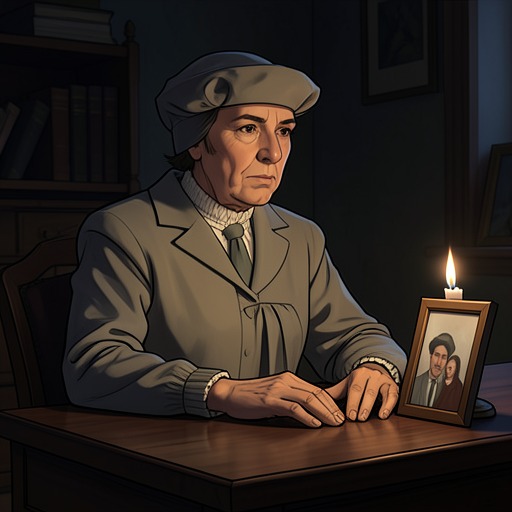
During the attack on the village, Mabel sees residents being driven from their homes but continues toward the place where she hopes to find her parents. She discovers Amyntas beneath the wooden structure used to store pots, after he has been beaten and killed. She arrives too late for a final farewell or for the last recommendation she might have asked him to give. The loss is therefore also the loss of a conversation still in progress: the questions she had brought to him have no further answer from their source.
The account contrasts his death with the honorable service that had defined his earlier life. Amyntas had protected soldiers in battle, but he is killed away from a battlefield, in a dishonorable manner. Mabel thinks of him as strong and capable of fighting, then turns her concern toward Darice, whom she considers more vulnerable. Her grief is bound up with a wish that she could have been better able to protect her family. She prays that she could be better, giving the father-daughter relationship a consequence that continues beyond his death: his care had helped form her, but she must now face danger without the person she would have asked for guidance.
What Mabel carries forward
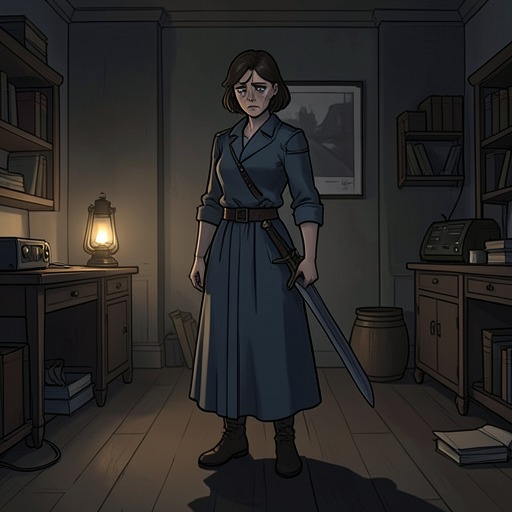
After Amyntas’s death, Mabel speaks with Navi and explains that her father taught her to handle a sword and fight, giving her everything he could have taught a son. She admits that she does not know why he taught her those things. Her uncertainty matters: the text establishes the training and the closeness, but does not supply a settled explanation that would resolve her question. She begins to say what she thinks may have motivated him, yet the available account does not complete that thought.
The relationship’s legacy is therefore not a simple instruction passed from father to daughter. Amyntas’s example combines loyalty, practical teaching, and respect for Mabel’s agency; his words tell her to choose meaningful work, while his actions have already equipped her to imagine a life beyond customary expectations. His death leaves that inheritance open-ended. Mabel must interpret what he taught without the answers she wanted, carrying both his confidence in her and the responsibility to decide for herself.