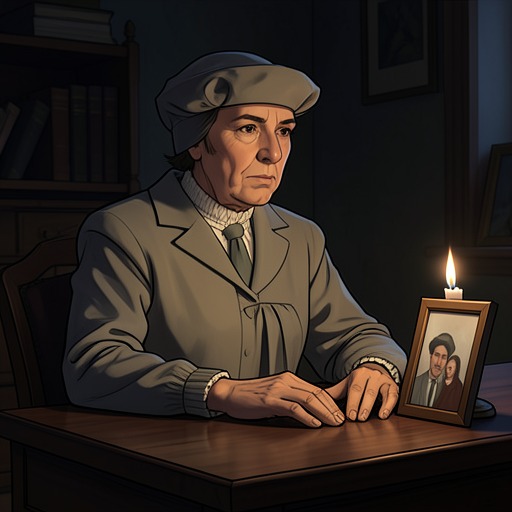
Mabel Peloponnese—Darice relationship
NeverthelessMabel Peloponnese and Darice share a close, affectionate relationship shaped by a difference in how they imagine a safe life for Mabel. Darice hopes her daughter can blend in and be protected by familiar domestic expectations; Mabel repeatedly follows her own path instead. Their tenderness is plain, but so is the cost of living at different speeds: Mabel leaves, Darice misses her, and the massacre that kills Darice turns their ordinary partings into a permanent absence.
A Daughter Who Would Not Blend In
From childhood, Mabel’s strongest attachment was to her father and the fields where they worked together. When Darice could not find her, she knew where to look: Mabel would be in the same place, doing the same work beside Amyntas. She might return home with a dirty dress and untidy hair, having forgotten the behavior expected of a girl. The routine had begun when Mabel first learned to stand and, the narration suggests, would continue for the rest of her life.
That closeness to the field marked Mabel out from other village girls. She had golden skin and wild, burnt hair, and neither she nor Amyntas cared that she was considered an eccentricity in Navon. Darice saw difference less romantically. She believed that a good life required blending in, becoming like other people so as not to attract notice. The disagreement is not presented as a lack of love: it is a conflict between Mabel’s ease in an unconventional role and a mother’s wish to shield her through conformity.
Darice’s concern surfaces when royal servants arrive to take Mabel to the king. Seeing the servants and two other men standing together at her door, Darice asks what her daughter has done wrong. The question reflects the uncertainty with which she meets an unexplained summons, while the servant Amir withholds its real reason on the king’s orders. Darice receives reassurance that nothing too serious is happening and that good news may follow, but she remains skeptical rather than comforted. Her protectiveness is immediate; confidence in an official promise is not.
Pride, Advice, and Repeated Partings
In a later reunion, Mabel arrives with wet eyes and addresses Amyntas before turning to Darice. She hugs and kisses her mother, telling her that she missed her too. Darice’s first response is a teasing observation that Mabel came to see her father at the first opportunity. The exchange carries affection without concealing the small ache beneath it: Darice notices where her daughter’s attention goes, while Mabel answers by making sure her mother is embraced as well.
Darice’s pride becomes especially clear when she learns that Mabel is to marry a prince. She is delighted by the prospect that her daughter will become a princess, though she says she cannot tell her friends until the engagement is announced. She also reflects that Mabel’s time in the fields with Amyntas has not prevented her from securing a marriage, a remark that reveals how strongly she had connected a respectable future with conventional expectations. Her happiness that those fears have failed is genuine, even as the occasion shows how differently mother and daughter understand the life Mabel has chosen.
When Darice asks whether the prince has treated Mabel well, Mabel replies without much enthusiasm that she thinks she could live with him, even if he frowns whenever she says something wrong. Darice counsels her not to tease him too much and warns against annoying a husband, particularly a prince. Her advice places Mabel’s future inside the standards of marriage and rank that Darice knows; Mabel’s subdued answer, by contrast, offers little sign that the promised match has become a source of excitement for her.
Their affection is also marked by departures. When Mabel says she will return soon, Darice answers that she always does this. She explains that she misses her daughter and wants a moment alone with her, preferably without Amyntas present. Mabel does not dismiss the request: she kisses Darice again and promises to be back soon. The repeated leaving and returning gives their closeness a rhythm of reunion, complaint, reassurance, and renewed absence.
The Domestic Future and Its Limits
Darice’s hopes are associated with the domestic roles prescribed to girls around Mabel. Other girls might be buying food, choosing fabric for gala dresses, or learning sewing and cooking from their mothers as preparation for becoming good wives. Mabel’s own daily life instead draws her back to the fields. The contrast helps explain why Darice wants her daughter to blend in: the conventional route offers a recognizable place in the village, while Mabel’s preference makes her conspicuous.
That domestic expectation appears again later in Mabel’s circumstances, though the evidence does not make it Darice’s direct influence. After her military service is interrupted, Navi arranges work for her as a tailor, a job Mabel protests is unsuitable: she is poor with needles, cannot stay still, and dislikes being indoors. The position echoes the sewing skills associated with a girl’s expected upbringing, but Mabel’s response shows how little that prescribed identity fits her. In this way, the domestic path Darice once hoped might keep her safe remains a point of contrast with the life Mabel actually wants.
Darice’s Death and Mabel’s Belated Loss
After the attack on Navon, Mabel finds Darice beside an unfinished dress. The simple prom dress is red, but its fabric has been marked by a permanent, cruel red. Mabel holds her mother by the arms and embraces her, crying out in grief. In that moment she reaches for the intimate language of childhood, calling Darice her mother as she struggles to understand what has happened.
The loss is not fully understood all at once. Mabel cries over Darice, but only later, alone in the small house that now feels too large, does she realize that she is an orphan and has lost the only people who cared for her in the world. The delayed recognition gives the relationship’s earlier pattern of departures a devastating reversal: Mabel had always said she would return soon, and Darice had always been able to miss her in the expectation of another meeting. After the massacre, there can be no next visit and no second kiss at the door.
Darice’s death also precedes Mabel’s decision to seek a place in the army. She sees young people from across Navon gathering at the military base and joins them despite being the only girl who should not be there. She wants to take part in something that matters and feels compelled to make up for the people killed in the invasion, beginning with her parents. Darice is therefore not simply a figure from Mabel’s domestic past: her death is part of the catastrophe that leaves Mabel without a home to return to and helps set the stakes of the life she chooses afterward.
Significance of the Bond
The relationship holds together two forms of care that do not always agree. Darice loves Mabel and takes pride in her future, but her hope for safety is tied to fitting in, marriage, and domestic life. Mabel’s attachments and ambitions lead her toward the fields and, eventually, the army. Their partings show that closeness does not eliminate this difference; the reunion scenes make affection visible precisely as Darice voices her longing and Mabel promises to come back.
The unfinished dress concentrates the relationship’s loss into a domestic object. Earlier, clothing and sewing belong to the ordinary future Darice would recognize; at Darice’s death, the dress is unfinished and stained, and the home itself will later seem too large to Mabel. Their story thus moves from a mother’s wish that her daughter live inconspicuously to a daughter’s belated recognition that the person who wanted her near is gone. The result is not a reconciliation of their different expectations, but a lasting measure of what Mabel has lost.