Mabel and Sven: From Enmity to Growing Acceptance
NeverthelessMabel and Sven: From Enmity to Growing Acceptance is a relationship shaped first by the struggle over whether Mabel belongs in the army and later by the unlikely solidarity of soldiers who have learned to see one another as teammates. Their conflict is concrete: the soldiers want their food back, Sven challenges Mabel to settle the matter in a fight, and she loses. Yet his later choice to dance with her in public, after she has been ignored at a festival, gives their antagonism a new direction. They remain capable of trading barbs, but the contest no longer defines the whole relationship.
A Disputed Place in the Army
Mabel enters military life as an exception. While other young people gather to join the army, she knows she is the one who should not be there; when she tells the commander she wants to become a soldier, he answers that she would have to be a man. Her gender is thus not a passing point of friction but part of the structure of her reception. Even after she is given a place around the troops, she is not formally introduced or incorporated as an ordinary soldier. Her work consists of polishing and checking weapons and armor, attending to the cavalry outfits, and following the commander, while soldiers make nasty comments about a woman in their midst.
Mabel adapts to the scrutiny without surrendering her purpose. She spends five silver coins on leather pants and a vest—three times what a dress would cost—so she will not have to move around camp in her conspicuous dresses and give the soldiers another reason to ridicule her. That calculation helps frame the later confrontation with Sven: the issue is not merely a disagreement about rations, but a struggle over whether Mabel can set terms and be taken seriously in a group where she is already treated as an outsider.
The Rations Dispute and the Duel
When the soldiers demand their food back, Mabel refuses. Rather than yield to pressure, she proposes that the dispute be settled by a bet: “The word of the one who wins will prevail.” Sven accepts, making the contest a fight between the two of them. He says he is seeking retaliation for “that other day,” linking the challenge to an earlier grievance without specifying its circumstances. The exchange turns their disagreement into a public test: the winner’s word will govern, and the whole camp will watch.
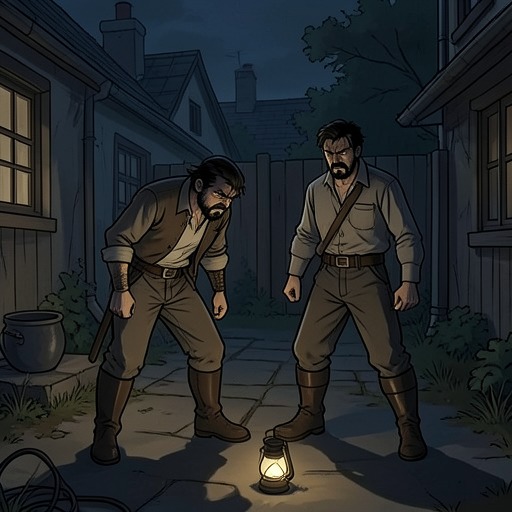
The physical imbalance is plain. Sven is twice Mabel’s size, and he catches her off guard by pushing her shoulder with both hands, sending her back to the ground. Mabel gets up, wipes the dirt from her hands, and protests that the move was unfair. Sven climbs over a ruined wall with practiced balance and challenges her from there. The encounter shows him using his superior strength and ease of movement to dominate the contest, while Mabel answers the disadvantage with defiance rather than retreat.
Mabel does not break her nose, but the loss has a social cost beyond the injury. The soldiers read Sven’s victory as their own: losing to him means losing to them, and they feel that they have won a battle. Their food is restored. As Mabel walks through the training camp the next day, soldiers stop to watch her hurry away; she looks at no one. The episode leaves her exposed to the group’s judgment, even as she has shown she will contest their demands rather than accept intimidation.
Teasing, Recognition, and a Change of Scale
Sven does not respond to the aftermath with solemn concern. His hoarse question, “How's your nose today, Mabel?” is another tease, and Mabel replies that she is having a little trouble breathing but is fine. Her answer keeps the exchange on the same combative, joking register: she does not pretend the fight was harmless, but she refuses to let the injury become a sign that she has been broken. Yelsew adds a different reading, telling her that she did well for a girl and that Sven was kind, since her nose will not look too bad. The praise remains qualified by gender, but it also recasts Sven’s conduct as less brutal than it might have been.
The decisive change comes at a festival, where Mabel is being ignored. Sven faces her in the middle of the field, an action that surprises her because he is doing it where everyone can see. The narration makes the choice costly for him: Mabel had made him feel ashamed at the training camp, yet he sympathizes with her and is willing to make a fool of himself before the people of Navon. He has no sisters, but understands that being ignored in that way is painful for a girl. Yelsew’s observation that the soldiers are on the same team now gives this gesture its immediate context. Sven’s solidarity is not presented as a private apology or a declaration; it is enacted openly, through joining her when others have left her out.
The response changes Mabel’s position in the festival crowd. Navon’s girls become jealous as she receives more dance partners than they do. Mabel, unfamiliar with the social competition among women, remains uncertain how to manage this attention. Her history has trained her for swords and fights rather than friendships, clothes, and shoes, and the festival brings that divide into view. Sven’s choice cannot erase the exclusions she faces, but it helps reverse her immediate isolation and makes her visible on different terms.
Rivalry Without Reconciliation
After the music ends, Mabel and Sven look at one another. She tells him, “You were the worst dance partner I had tonight.” It is teasing rather than a conventional thank-you, and the narration notes that she cannot say thank you to him as she might to other people. His surprised “Really?” leaves the exchange open-ended. The scene does not turn them into intimate friends or suggest that their earlier conflict has been resolved by a single kindness. Instead, their shared language remains mockery, now capable of carrying recognition as well as hostility.
Their relationship therefore changes less by abandoning conflict than by changing what conflict means. In the duel, Sven’s strength and the soldiers’ verdict reinforce Mabel’s precarious place in the camp; at the festival, his public participation aligns him with her and the team they now share. The movement from challenge to dance is a compact measure of growing acceptance: Mabel and Sven can still provoke one another, but she is no longer only an opponent to defeat, and he is no longer only the man whose victory gives the soldiers their food back.