Navon and the Exiles: From Distrust to Alliance
NeverthelessThe relationship between Navon and the exiles shifts from a history of rejection and distrust to a practical alliance forged under threat. Navon has treated deserters as offenders beyond the kingdom’s protection, while the exiles have lived outside its political community. When Tzara threatens Navon, however, Shai argues that the exiles’ homes are endangered along with the kingdom itself. Their cooperation develops not through a sudden erasure of past grievances, but through a shared defensive purpose and concrete acts of mutual assistance.
A kingdom short of allies and soldiers
Navon’s need for help grows out of its political vulnerability. The kingdom had historically fought on behalf of other states rather than defending itself against invasion; those alliances demanded soldiers, and men who did not wish to fight other kingdoms’ battles deserted. Now Tzara seeks Navon’s land and gold, while a former ally is too afraid of Tzara to stand with it. Navon faces the threat with too few soldiers and recognizes that its earlier choices helped produce that weakness.
The shortage also shapes the kingdom’s diplomacy. In Navi Spyridaki’s crowded office, he favors offering Navon’s best products in return for political alliances, but his counselors resist terms that would impose lasting disadvantages. Navi sees special privileges demanded in exchange for protection as unfair, yet feels he has little room to refuse. Against this background, Shai’s proposal is not simply a request to forgive the exiles: it offers Navon a potential source of manpower when conventional alliances have failed.
Shai’s proposal and Navi’s reservations
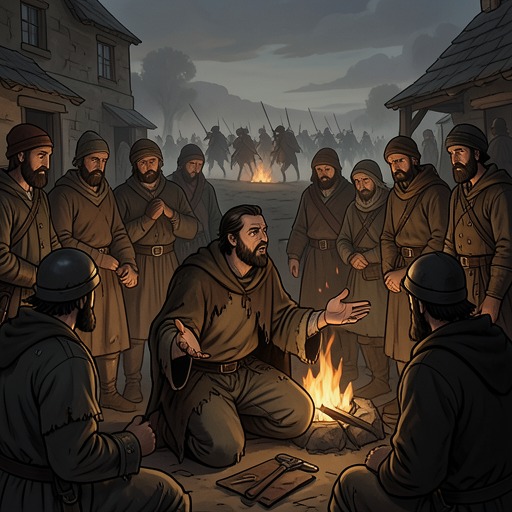
Shai presents the exiles as a numerous force willing to join the Navon King's Army. He says he has persuaded them to fight because both sides need assistance, and explains that he had previously traveled to speak with Navi but had not obtained a meeting. His appeal rests on a change in circumstances: the exiles’ homes, like Navon itself, are now threatened. In Shai’s account, the danger gives them a reason to defend the kingdom even though it once expelled them.
Navi’s hesitation reflects the kingdom’s judgment of its deserters. He fears accepting men who have already, in his view, let Navon down, and worries that he will be held responsible if they become unmanageable. Shai accepts that responsibility rather than presenting the exiles as a force without leadership. Still, Navi cannot make the decision alone: he tells Shai that his ministers and counselor may oppose an arrangement with no precedent, and that he must consult them before giving a final answer. His response is therefore cautious rather than a completed formal settlement.
The financial terms sharpen the difference between the offer and the kingdom’s ordinary calculations. Earlier, Shai had described his group’s services as work for which people paid, and suggested that fighting for Navon would require money. During the later audience, however, Navi asks what the exiles demand, expecting a payment; Shai answers that they want nothing. Their offer is not a bargain for immediate reward. Navi nevertheless recognizes the military value of the proposal, reasoning that even fifty men could make a difference.
Cooperation tested in combat
The exiles’ commitment becomes visible in the defense of their mountain position against Balthasar's Army. As the enemy climbs, the defenders plan to shoot before the soldiers can reach the top; archers remain concealed among rocks and on the roof while others fight on the ground. Mabel Peloponnese, present with the group, wants to take part rather than remain a spectator. The scene shows the exiles acting as an organized defensive force, while Mabel’s participation connects Navon’s struggle to the people sheltering beyond the kingdom’s usual military structures.
The battle also gives the alliance a human cost. Mabel kills a soldier while fighting, although she had not intended to kill anyone when she left Navon with Shai. She understands the immediate conflict as a war in which both sides face one another as combatants, while holding Balthasar responsible for the invasion. Shai helps her away after the killing. The episode makes cooperation more than a political proposition: defending Navon means taking part in violence and accepting its consequences.
Admission to Navon and a shared defense
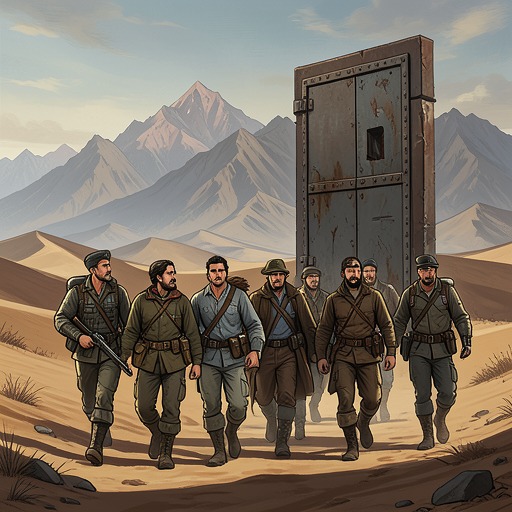
When Shai later comes to the throne room with news that Tzara is preparing to invade, he says he has brought his men and that the expatriates will also come. Navi asks how Shai knows the attack is coming; Shai cites the group’s scouts and allies. Faced with the warning, Navi tells the guards to let them through. This is a decisive practical change from treating the exiles only as former offenders: the kingdom opens its boundary to forces it needs for its defense.
Navi’s first arrangements are directed toward protecting the population and assembling resistance. He orders that the whole village be brought to the castle and says he must find the soldiers. During the nighttime evacuation, Shai’s men help villagers leave their homes and reach the castle for shelter. The plan distinguishes between women and children, who are to go inside the castle walls, and men, who are expected to stand and fight. Mabel, unwilling to abandon the soldiers she has stood beside, puts on her armor and takes her sword to defend the city.
The relation thus advances from disputed membership to cooperation enacted at the border, in the village, and on the battlefield. Navi’s distrust is not shown simply disappearing, and the available events do not establish that every political obstacle has been resolved. What changes is the kingdom’s response to the exiles’ presence: where their past service was judged through the fact of desertion, their actions in the new crisis demonstrate a shared stake in protecting Navon. Shai’s force and the expatriates enter not as paid outsiders but as participants in a defense whose success depends on their inclusion.