Mabel Peloponnese—Gael relationship
NeverthelessMabel Peloponnese—Gael relationship is a bond shaped almost entirely by absence. Gael is Mabel’s older brother, but he was exiled from Navon when she was too young to understand what had happened; by the time she sets out to look for him, she has not seen him for so long that she doubts she would recognize him. The search is therefore more than a reunion sought between siblings: it confronts the lasting division created by Navon’s punishment of deserters and gives Mabel a reason to cross the boundaries of the home she loves.
Family Background and Separation
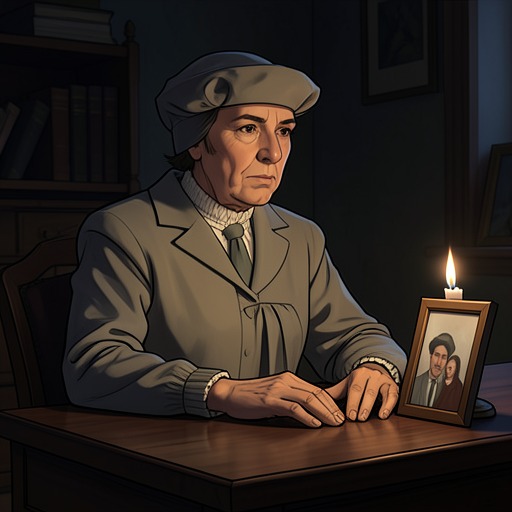
The relationship enters the story through the history of Amyntas’s family and the king’s explanation for Mabel’s engagement to Navi. Amyntas had once asked the king to do something for him after saving the king’s life. He had mentioned his son, Gael, but by the time the king explains the arrangement, Gael has become a deserter and Mabel is the only daughter left. The king presents his debt to Amyntas and his promise as the reason for choosing Mabel; Gael’s exile is part of the family circumstance surrounding that choice, not a demonstrated cause of the engagement by itself.
Navon’s treatment of deserters makes the siblings’ separation more than a long absence. A deserter is expelled from society and condemned to remain beyond the kingdom’s boundaries. The exile bears a distinguishing mark, must survive outside Navon, and faces death if found back on Navonian soil. The rule closes off ordinary routes home: even if Gael wished to return, the kingdom’s law makes return perilous. For Mabel, who was not old enough to understand the exile when it happened, this system has removed her brother before she could form a conscious memory of him.
A Promise Becomes a Search
Amyntas makes the search explicit when he tells Mabel to find Gael and help him find her brother. He links that request to the danger facing Navon, presenting the search as part of a wider effort to protect the kingdom. Mabel asks what this has to do with Gael, showing that her father has not yet explained the full connection to her. The moment leaves the relationship suspended between family loyalty and a political purpose that Mabel does not yet understand.
The request gains force because it is also a promise to her father. Later, Mabel recognizes that she cannot ignore a promise made to him. Her stated reason for following the general on a mission is not simply distrust of his troops: she wants to find Gael. She believes that in ordinary circumstances they would never meet again, that no one would know where to look for him, and that leaving Navon is her only chance. The search thus gives a concrete direction to her departure from home, even as its outcome remains uncertain.
The Brother Mabel Imagines
Mabel has almost no reliable description to guide her. When she asks a tavern keeper about Gael, she can offer only approximate physical comparisons: he should be somewhat younger than the man she is addressing, taller and thinner, with more hair, and perhaps resemble her. Her uncertainty is not a lack of commitment; it is the consequence of having lost contact before she was old enough to retain a clear picture of him.
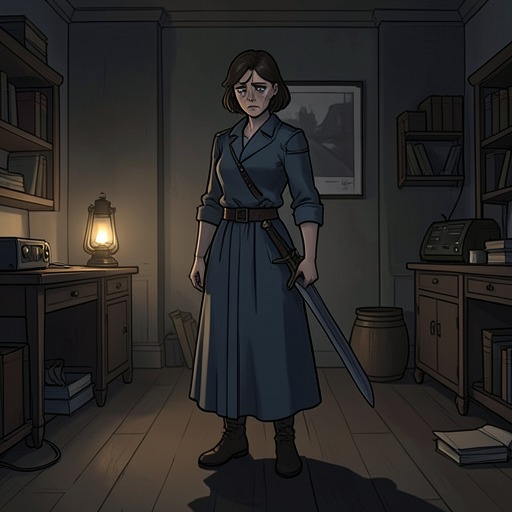
The few details she can provide are practical rather than intimate. She knows Gael was exiled from Navon long ago and says he is good with knives and must fight well. She asks the tavern keeper to tell her anything he knows, but receives no information. The exchange makes the search’s imbalance plain: Mabel carries a powerful family obligation, yet has only fragments with which to identify the person she seeks. Gael remains a brother in her purpose before he can be a familiar presence in her life.
Home, Exile, and the Unresolved Bond
Mabel’s pursuit takes its meaning from her attachment to Navon as well as her separation from Gael. Leaving the castle for the village is already difficult without a horse; she chooses the longer road along the riverbanks because she loves walking there. Her childhood home holds memories of Amyntas and Darice and the life she once imagined continuing in Navon. That rootedness contrasts with Gael’s forced existence beyond the kingdom, making the siblings’ different positions in relation to home central to the bond: one remains attached to the place from which the other has been permanently expelled.
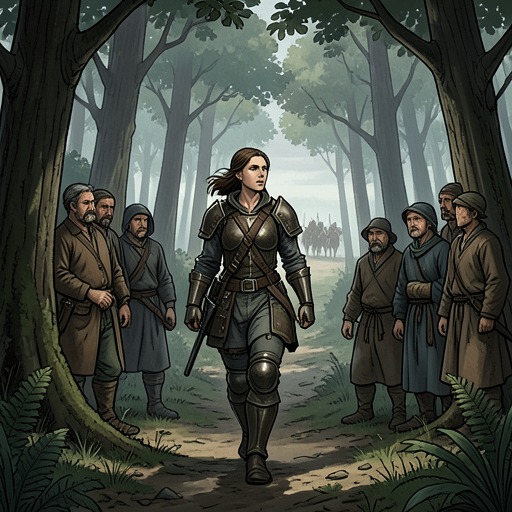
As Mabel travels farther from her familiar village, she passes through spaces that emphasize how difficult access and return can be: the forest refuge reached by a narrow canyon, the long bridge on the route ahead, and finally Tzara’s heavily fortified border. These places do not establish that she finds Gael; rather, they place her search within a story of restricted movement, dangerous crossings, and separation between territories. At the border, Mabel sees a city protected by a wall that makes entry harder than leaving. The contrast recalls the exile rule that has already made Gael’s return to Navon nearly impossible.
The relationship remains unresolved in the evidence presented here. Mabel has not met Gael again, and no passage confirms that she locates him. What changes is her willingness to act on the bond despite its uncertainty: an older brother she can barely remember becomes the reason she leaves the safety of home and pursues a promise made to their father. The story makes that absence consequential without turning it into a reunion; Gael’s place in Mabel’s life is defined by the search itself and by the political boundary that keeps the siblings apart.