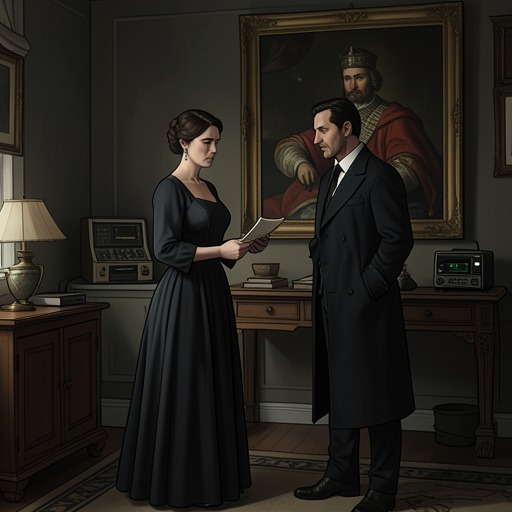
Mabel and Shai: Trust and Suspicions of Betrayal
NeverthelessMabel and Shai’s relationship grows from recognition into a consequential alliance, then turns under the weight of a concealed identity and a possible betrayal. Shai is among the first men after Mabel’s father to treat her ambition as real rather than improper: he argues that a woman on the battlefield could make men question their own limits. His confidence helps draw her into his cause, but the later revelation that he is Golnar, Balthasar’s missing brother, makes that encouragement difficult to separate from his political use of her.
Unequal Worlds and a Shared Opposition
Mabel’s determination to become a soldier takes shape against a world that assigns girls other work. While other peasant girls are expected to learn domestic skills or prepare for marriage, Mabel prefers the fields and her father’s company. Her mother worries that Mabel’s unusual appearance and behavior set her apart, but Mabel and her father do not share that concern. This background matters to her later connection with Shai: being taken seriously by him answers a long-standing exclusion, not merely a disagreement about one military post.
When Mabel presents herself to join the King’s Army, she meets a crowd of young recruits from different towns and trades, many of them uncertain and untrained. The commander assumes that financial hardship might explain her request and offers her help, but Mabel insists that she wants to be a soldier. The answer she receives is that a soldier must be a man. Even after she enters military service, she is not properly introduced to the troops; instead, she polishes and checks weapons and equipment, follows the commander, and endures hostile comments about being a woman in camp. Shai’s later proposal confronts this pattern directly: he sees her presence on a battlefield as a challenge to the men around her, not as a reason to keep her away from it.
Recognition, Protection, and Mabel’s Choice
Shai tells Mabel that she could help Navon and that her example might push men to do better. He contrasts the respect she receives from the men around him with the treatment she has encountered among the King’s Army. The distinction is important to Mabel: Shai is not simply offering her a place in a force; he is telling her that her ability is visible and consequential. Alastair objects that no woman will represent him, while Gaspar rebukes him for continuing to use a slur for the group. Their disagreement makes clear that Shai’s view is not shared by everyone around him.
Shai also promises that he and his men will not let anything happen to her and says he would not involve her if the plan were unsafe. Mabel is wary of how quickly he seems to care. Her father had been the only man who treated her as important, and she recognizes that she cannot know from words alone whether Shai is sincere. Still, she decides to judge what she sees. When she tells him that he is the only one who has said she can do this, Shai answers that she can. His affirmation gives her a reason to accept a role in his plan without pretending that her doubts have vanished.
When Mabel asks why Shai cares whether Navon wins or loses, he says that he wants to redeem himself. He then asks whether she is in, and she replies that she is already there. Her acceptance is both personal and practical: she believes she can act, and Shai’s cause offers a route to the battlefield denied to her within the kingdom’s army. The decision does not resolve the question of his motives; at this point, Mabel has his stated desire for redemption and the evidence of his treatment of her, but not the truth about his identity.
An Alliance Built Around Her Access
Shai’s group proposes to speak to the prince, but its marked members cannot enter Navon. Mabel is to carry their message. Shai explains that if the prince will not see her, the group will make him worry and then send a message, ensuring that he hears them. Mabel resists the premise that she can influence Navi: she believes he wants to stay away from her and that using her will waste the plan. Shai counters that Navi’s earlier refusal to let her accompany the group shows that he is not indifferent to her.
This exchange places Mabel between two forms of exclusion. She has been denied a soldier’s role because she is a woman, while Shai’s people are barred from the royal city because they are exiles. Their alliance depends on her ability to cross a boundary they cannot. That gives her genuine agency in the plan, but it also makes her useful to Shai in a way she does not yet understand. The later revelation will sharpen the distinction between being recognized as capable and being recruited for another person’s purpose.
Concern Amid the War
During the invasion, Shai’s concern for Mabel becomes visible in a different form. He asks Navi to make sure she is among the women and children brought to safety, and insists that she must still be alive when the fighting is over. He says he is not doing it for Navon; his men are, but he personally needs Mabel to survive. Navi agrees to have someone look for her, and the request brings a possible expression of jealousy to his face. The moment places Shai’s personal attachment beside the broader cause he has advanced, without settling what that attachment means or whether it can excuse his earlier concealment.
The scene also complicates any simple picture of Shai as concerned only with political advantage. His request is urgent and specific: he asks for assurance about Mabel’s life, even while distinguishing his own reason from his men’s participation in the war. Yet his concern does not erase the fact that he has made her a bridge between his excluded group and the prince. Care and instrumental use remain present together in the relationship.
The Revelation and the Suspicion of Betrayal
After Mabel is captured, she is told that she was brought there because she joined Shai, and that Shai is Balthasar’s missing brother. She objects that Shai is an exile with a marked neck, apparently unable to enter Navon, and therefore cannot be the heir she is being told about. The explanation she receives overturns that assumption: Shai, whose actual name is Golnar, was never marked in Navon because he never belonged there. The King’s Winner claims that Shai manipulated Mabel to obtain an army and overthrow Balthasar, making her, Navon’s army, and the outlaws who call themselves expatriates puppets in his hands.
The accusation forces Mabel to reconsider the trust on which she accepted Shai’s plan. His appeal to redemption, his assurance of her safety, and his confidence in her ability may all have been sincere in some respect, but the revelation gives them a political context he had withheld. Mabel’s response is not immediate certainty: she asks whether the King’s Winner had pursued Shai in Tenerife and doubts the account because the speaker has already tried to capture Shai. She is horrified by the possibility that her judgment of Shai has failed, particularly because accepting him had also meant believing that he had treated her honestly.
The King’s Winner then says that Mabel’s connection to Golnar is why she was taken: Shai is attached to her, and his captors intend to use that attachment to bring him to Balthasar. He also declares that Gael is dead and that Golnar killed him. Mabel cannot simply accept this further claim; she asks how the speaker can be sure. The relationship’s final condition is therefore unresolved suspicion rather than a confirmed reconciliation or a settled verdict. Shai’s earlier insistence that Mabel mattered to him now carries a double edge: it may indicate genuine attachment, but it has also become leverage in the struggle against his brother.