Navi Spyridaki—Dareh relationship
NeverthelessThe relationship between Navi Spyridaki and Dareh is both a father-son bond and a struggle over what it means to inherit a kingdom. Dareh loves his only son and fears the danger of his becoming a general; Navi, already carrying much of the work of rule, believes that protecting Navon requires him to lead its army in person. Their intimacy appears in moments of care and loneliness, but it does not spare either of them from using royal authority to press the other toward an unwanted choice.
A father and heir in an unfinished succession
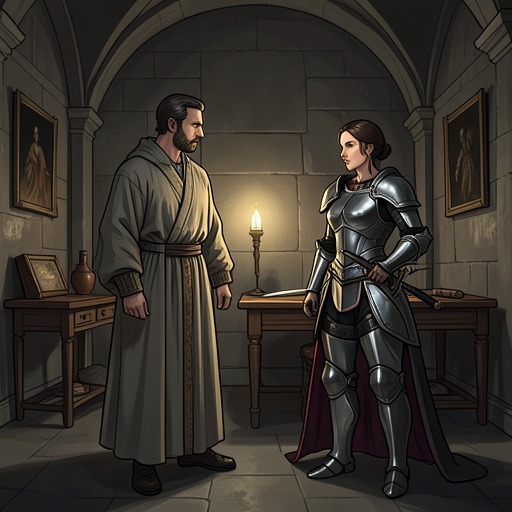
Dareh is king, but his authority has become increasingly private and withdrawn. He lives in the castle without a wife, grows attached to his possessions and familiar clothing, and becomes less able to deal with people beyond his son and personal servant. As he loses interest in thinking through the kingdom’s affairs, Navi has to perform the role of a king before he has inherited the throne. The succession is therefore not simply a future arrangement: it is already shaping their daily relationship, with a young heir carrying responsibilities his father no longer consistently undertakes.
Navi’s standing is nonetheless incomplete. He has control over the castle’s political affairs, but Dareh has not appointed him to command the army, the role Navi has always wanted. Dareh’s hesitation is personal as well as political: he does not want his son exposed to battle, where a kingdom’s leader may be among the first to fall. Navi sees that protection differently. He argues that he was not raised to remain behind castle walls while Navon is slowly taken from him, and that soldiers need confidence in a leader who will stand at the front. The disagreement pits a father’s effort to keep his son alive against the heir’s belief that leadership entails sharing the army’s danger.
Authority tested in public affairs
The tension between them is reflected in Navi’s dealings with the royal counselors. When an adviser dismisses him as a child and argues that Dareh, not the prince, should be consulted, Navi answers that he is the person placed in charge. He orders the counselors to report to him about what they do and even what they intend to do. They comply because Dareh is away and Navi is the heir, though their obedience does not erase the challenge to his authority. The episode shows the arrangement produced by Dareh’s withdrawal: Navi must exercise power in his father’s place while still confronting the assumption that only the king can truly command respect.
Dareh’s decision about the generalship sharpens that contradiction. He promises Navi command, but makes it conditional on an engagement: once the engagement is announced, Navi can become the next general in the history of the King’s Army of Navon. Navi recognizes the bargain as coercive and says that the kingdom needs a general regardless. For him, military leadership is not a prize to be traded for a private concession; it is the most important work he can do for Navon. Yet he does not openly break with his father. He remains composed, accepts Dareh’s condition, and bows to him as king, putting the kingdom’s needs ahead of the argument he might otherwise continue.
Marriage, fear, and an heir
The engagement condition arises from Dareh’s fear that his son may die without securing the royal line. When Navi questions how a royal wedding can be contemplated in a crisis, Dareh answers that he needs an heir who is alive. His blunt insistence gives the succession its most intimate and painful form: Dareh is not only king arranging the future of the dynasty but a father imagining the possible loss of his son. He explains that Navi is everything he has and that he would not give him up unless someone else could take his place.
Navi does not reject marriage as such. He assures his father that it will happen, but asks whether it can wait and whether marriage might instead be used as bargaining power to secure allies for Navon. That proposal exposes their different calculations. Navi treats his marriage as a political resource in a kingdom under pressure; Dareh objects to the idea that his son could be treated as a commodity, even as he makes the engagement a condition of military advancement. Navi reminds him that Dareh once taught him he might become the victim of just such a situation. Dareh replies that he warned him but would never force him into it; then he insists that the marriage is his condition and names Mabel Peloponnese as the bride he has chosen. The contradiction is not resolved. Dareh’s paternal concern and royal control occupy the same decision.
Care beneath the conflict
The father-son dispute is not presented as a simple contest between a cold king and an ambitious prince. Dareh worries that he is overloading Navi with responsibility and asks Mabel Peloponnese whether he is being too hard on his son. He describes his aim as preparing Navi for the position he will inherit, particularly now that Navi has returned. Mabel answers that Dareh is a demanding tutor, like her own father, and Dareh admits that he is not as good as hers because her father did not force her to marry his son. He says he wanted to see Navi happy and believes she can manage it.
That wish sits uneasily beside the coercion of the engagement, but it reveals how Dareh understands his actions: as a father trying to secure both his son’s future and his happiness, even when his method denies Navi an unconstrained choice. Navi, for his part, is not unaware of his father’s vulnerability. He raises the possibility of using marriage to gain allies rather than merely rejecting the demand, and accepts the condition after weighing it against the kingdom’s needs. His composure does not mean the conflict is painless; it shows how thoroughly he has learned to subordinate personal resistance to royal duty.
From guarded prince to commander
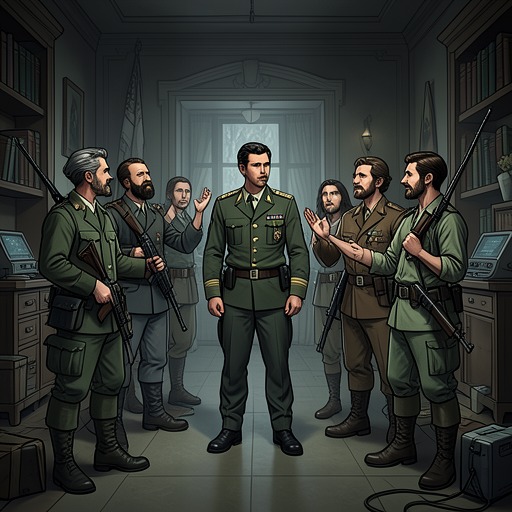
Dareh’s fear of seeing Navi in battle is eventually set against the public reality of Navi’s command. When Navi stands before the army, its commander remarks that he has never seen a prince in front of an army. Navi answers that these are hard times, and the soldiers await his orders. The scene makes visible what the father-son argument had anticipated: Navi’s leadership means appearing among the troops, not merely holding authority within the castle.
The relationship’s central tension therefore remains legible in both its private and political dimensions. Dareh tries to preserve his son and the royal line; Navi accepts the risks and compromises he believes Navon’s survival demands. The father’s protection can become pressure, while the son’s duty can look like a willingness to leave his father alone. Their bond endures through these opposing claims, with care expressed less as ease than as the burden each believes he must carry for the other and for the kingdom.