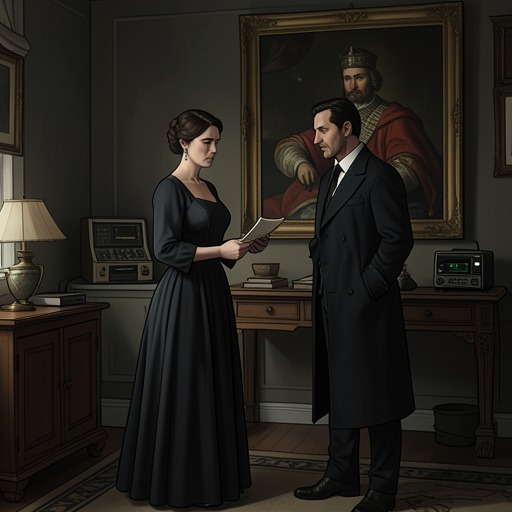
Mabel Peloponnese—Shai relationship
NeverthelessMabel Peloponnese and Shai’s relationship begins in a moment of danger and develops into a tentative political partnership. Shai first appears as the leader of the men who stop an assault on Mabel; later, he offers her practical help, leaves her a means of finding him, and asks her to help bring Navon’s royal forces and outlaw groups together against Tzara. Their connection is built less through familiarity than through repeated acts of recognition: Shai takes Mabel’s fighting seriously, while Mabel comes to see his band as a possible source of help beyond the prince’s reach.
A Meeting Forged in Danger
Mabel encounters Shai’s group while she is in a vulnerable position, struggling against an attacker as armed men watch nearby. The newcomers dismount quickly, and their arrival interrupts the assault. One man tells Mabel she will not need to use her sword that day, but she does not let it go. Her guarded response matters: rescue changes the immediate balance of danger without erasing her need to protect herself.
Mabel asks the strangers who they are. Gaspar introduces himself, while the younger leader explains that the men are his brothers and offers to escort her back. The contrast between their calm intervention and the violence she has just endured gives their offer weight, but Mabel does not simply surrender judgment to her rescuers. The sword remains in her hand, and her next actions show that she is still deciding what kind of help she can trust.
When Shai later approaches her as she tries to leave on horseback, he asks her to calm down and says he can help. Mabel answers that he cannot. Shai explains that his group works as bounty hunters or mercenaries, undertaking tasks such as rescuing people, capturing murderers, and recovering stolen money. Rather than promise protection in the abstract, he presents a practical offer: the group could fight for Navon, though it would require payment. When Mabel asks how much, he names three gold weights. The exchange makes their early connection transactional as well as urgent; Shai offers a service, and Mabel presses him for its cost.
From Transaction to Personal Trust
Shai then reframes the offer. Mabel does not have to face her problem alone, and the help may cost nothing if she comes with the group. She hesitates, considering that the men know the place and are offering assistance while she has little reason to expect better help elsewhere. In her assessment, Navi Spyridaki does not know the place or her brother’s situation, and she considers him unreliable because she believes he has failed to keep his promises. Mabel decides to go with Shai’s group.
At their table, Shai introduces himself by name, and Mabel gives hers. He tells her that he has never seen a girl fight as she did and says she fought bravely. His attention recognizes a capability that has often made Mabel an outsider: she is not behaving according to the expectations imposed on women, and Shai treats her fighting as evidence of usefulness rather than as a reason to dismiss her. Gaspar extends the possibility of belonging further, saying Mabel could stay with the group and that they would be a family if she were unwanted elsewhere.
Mabel asks whether the men can help her find her brother, Gael. Shai answers plainly that they cannot. That refusal limits the promise of their companionship: the band cannot provide the particular information she wants. Yet Shai does not pretend otherwise, and his honesty does not end their contact. Instead, he leaves her a route back to him. He puts a note with coordinates into her hand and tells her to look for him if she needs anything in the future, anticipating that the prince may not let her join them. Mabel admits that she thinks so. The note turns a brief encounter into an open possibility of future trust, even though their immediate paths may separate.
Shai’s Political Proposal
Shai later invites Mabel to see a gathering where outlaws are expected to set aside their disagreements and unite to protect Navon. He says that the men in Tenerife had considered fighting Tzara alone, but that their forces would be stronger together. His proposal is therefore not simply to add mercenaries to a royal army: it is to create cooperation between groups that have been acting separately and to make that cooperation visible to both sides.
Mabel recognizes the strategic sense of the idea. It resembles the alliance Navi is seeking, but differs in its method: Shai’s proposal treats the outlaws as participants who can deliberate together, rather than as a group to be ignored because they are not nobles or conventional soldiers. Mabel does not claim that the prince’s search for powerful kingdoms is wrong; she objects to excluding a smaller, socially marginal force that could still accomplish something in concert with others. Her response indicates that she understands the proposal as both military strategy and a question of whose contribution counts.
Shai believes Mabel can help persuade Navi. He says he has already asked the prince and been refused, describing Navi as hostile to relationships with outsiders and to Shai’s people. Shai points to what he believes he observed between Mabel and Navi at the tavern, and trusts his intuition that she could move the prince where direct argument did not. Mabel’s account is less hopeful: she says Navi will not listen, despises the group, and will not agree. Still, the fact that Shai makes her the proposed intermediary shows how he understands their connection. He sees her not merely as a person he has rescued, but as someone whose access to the prince might bridge a political divide.
Routes, Boundaries, and an Unfinished Alliance
The places associated with their relationship reinforce the uneven access each has to safety and power. Navon’s castle stands on a hill amid trees, with a stone bridge as the passage to the fortress. Mabel’s own route between castle and village is different: leaving the castle is difficult without a horse, and she chooses the longer road along the riverbanks because walking there matters to her. Shai’s world lies beyond these royal spaces. The group meets in a tavern in the forest, then rides up a hill and through a narrow canyon to a high place where outlaws hide from the king’s sight. Mabel is entering a space organized outside the court’s authority, under Shai’s guidance but not as a royal emissary; she explicitly says she was not sent by the prince.
The relationship’s development remains a proposal rather than a completed political settlement in the evidence here. Shai offers Mabel immediate shelter and a continuing point of contact, then asks her to help make an alliance possible. She recognizes the value of bringing isolated forces together, but also tells him that Navi has already refused. Their connection therefore occupies the space between personal assistance and political outcome: Shai trusts Mabel’s capacity to reach someone who rejects his group, while Mabel has reason to value Shai’s practical support without assuming that either his promise or his plan can solve everything. What begins with a sword held tight after a rescue becomes a fragile channel between people and factions that have little reason to trust one another.