Mabel and Aury's Friendship
NeverthelessMabel and Aury's Friendship is a relationship of companionship and practical care formed under the pressure of military life and an approaching war. Its most telling gestures are small: returning to a familiar place beneath a tree, promising not to vanish again, sharing a crowded meal, and asking for help to avoid the front line. These moments make Aury more than a casualty of war and show how Mabel’s loyalty persists even when she cannot promise to protect him.
A Familiar Place and a Return
When Mabel returns from Tenerife, she and Aury are together beneath a tree on elevated ground that reminds Mabel of her father. The place has become theirs through repeated visits; the narration presents it not simply as a convenient meeting point but as a durable landmark in their friendship. Mabel’s connection between the tree and her father gives the setting a private emotional association, while Aury’s presence makes it shared.
Aury tells Mabel that her former employer noticed she had failed to come to work and warned Navi Spyridaki that she had disappeared. Navi sent Amir to look for her, and after repeated unsuccessful attempts, went himself with guards. They eventually broke into the place where she was staying, only to discover that she had not been captured: she had left. Mabel asks whether the general worried about her or felt guilty; Aury answers that Navi was relieved because a major problem had disappeared. His smile and embrace make clear that this teasing account is not the measure of his own response. He is glad she is back, and asks her not to disappear again.
Mabel answers that Aury will not get rid of her so easily. The exchange turns her unexplained absence into a direct promise between them. Her reassurance does not undo the fact that she left, but it establishes that their friendship can survive that interruption and continue in person.
Companionship in Army Life
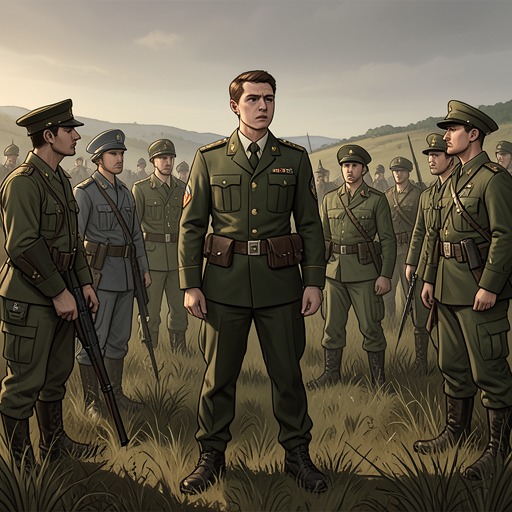
Once Mabel is back in the army, she and Aury see each other often. Their contact is set within the routines and constraints of the soldiers’ lives, not apart from them. Mabel worries that Aury, whom she considers weak, will have to adjust to the soldiers’ diet. Her response is practical: she decides that food should be strictly controlled so that soldiers do not eat until they become tired and sleepy during training. She contrasts this plan with other armies’ practice of punishing overeating with lashes. Her concern for Aury therefore becomes part of a wider effort to keep the soldiers fit without resorting to that punishment.
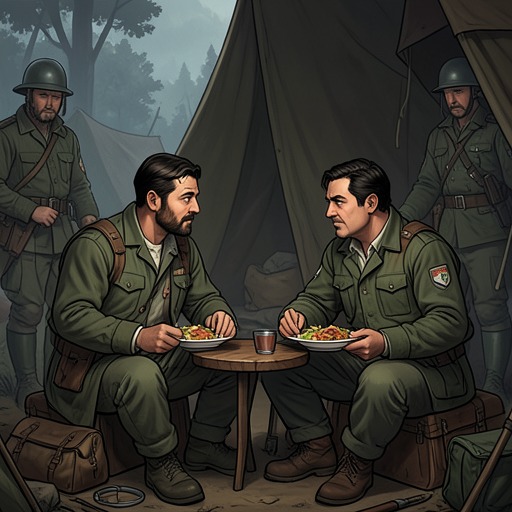
At a soldiers’ meal, Mabel is seated beside Sven, while Vilanis presses close on her other side; the cramped arrangement leaves her struggling to reach her plate and breathe comfortably. A glass slides along the table to her. She drinks, then suppresses her physical reaction to its burn rather than risk appearing weak before the watching soldiers. Yelsew warns that drinking without eating will make the alcohol affect her faster and predicts she will be carried home. Mabel replies that he might be the one carried, and he returns to drinking as she disapprovingly surveys the tavern. The episode places her friendship with Aury within a larger, rowdy social world of soldiers, but it does not turn the meal into a contest between the two friends.
A Request Against the Fear of War
Aury tells Mabel that he intends to marry his girlfriend. He explains that she would not have agreed to date him had he not been in the army, and that she accepts the possibility that he might go to war and not return. He recognizes that she wants to marry someone, whoever that person may be, but says he is already too deeply in love to withdraw. Mabel listens and agrees that, in the end, people want to be with someone. The exchange reveals Aury’s longing for an ordinary future without presenting him as untouched by the danger around him.
He then asks Mabel to seek a position for him in Navi Spyridaki’s guard, or even as the general’s personal servant. His appeal rests on the belief that Mabel can influence the general: he has heard that she was once refused enlistment and that the general later arranged for her to enter the army. Mabel does not pretend the request is easy. She points out that Navi Spyridaki expelled her from the army and barred her from the castle, making him an unlikely person to grant a favor through her.
When Aury protests that they are at war and that he is almost dead already, Mabel tries to calm him and agrees to speak to the general. Her promise is qualified by visible uncertainty: she does not know whether she can succeed. She understands, through this request, the difficulty of promising something beyond one’s power. In the end, Aury, like the other soldiers, will defend Navon at the front. The gap between the refuge he asks for and the duty that awaits him gives the friendship’s tenderness a painful limit: Mabel can offer effort and reassurance, but not safety.
Death and the Meaning of Their Bond
Aury dies in the battle for Navon. When the bodies are collected, he is found among strangers, pierced by a spear at the fifth rib. The account emphasizes that he was fragile and that his only defense was to scream in pain and despair. It imagines that he might have lasted longer had he been braver, but immediately resists treating this as proof of weakness: Aury was trying to survive, and he had tried.
The narration recalls the person the battlefield cannot explain by itself: a boy who wanted to paint what he saw, preserve his perspective in color, and let other people see through his eyes; a boy who wanted to try marriage because he loved someone. After his face is covered by a blanket, those who do not know him will no longer recognize who he was or what he meant. His friends and family are not there as his body is covered, though the text marks them as the people who loved him. The loss therefore falls not only on the army but on the private relationships that give a life its meaning.
For Mabel and Aury, the contrast is stark: he had asked her to help him find a place away from the front, and she had said she would try; the war carries him instead into the fate he feared. Their friendship is not given a final farewell or a later reunion. Its surviving shape is made of the tree they shared, her promise that he would not be rid of her, her concern for his daily well-being, and her uncertain attempt to help him. His death makes those modest signs of attachment consequential without suggesting that affection could overcome the demands of battle.