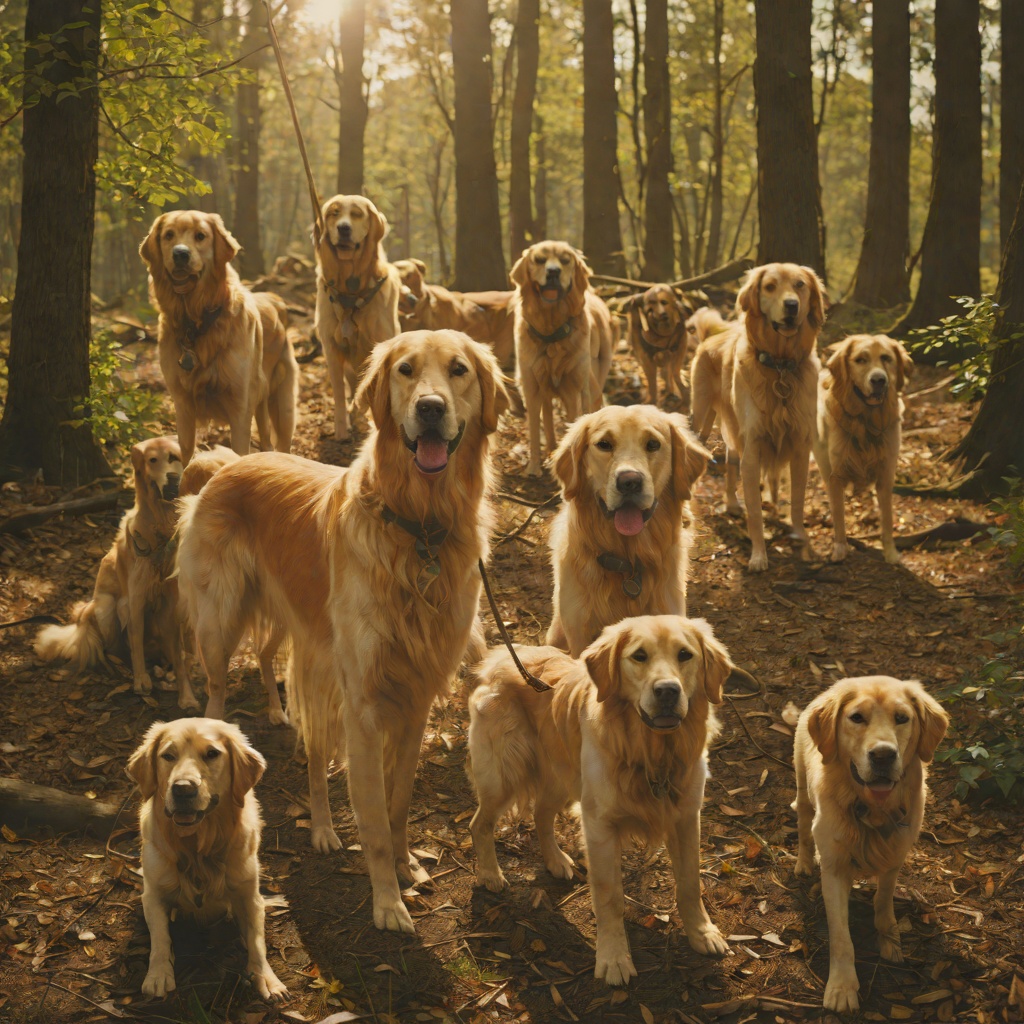
The Dog Pack's First Visit
NightbitchThe Dog Pack's First Visit is the hinge on which Nightbitch's transformation turns. It arrives at a precise point of crisis: she has already found the patch of coarse black hair sprouting from the base of her neck, has already told her husband she thinks she is turning into a dog and heard him laugh, and has already inflated with what she calls mother-rage, composing elaborate, emotional arguments against the system and capitalism and the patriarchy. When she steps out of her house that morning, bag on shoulder, boy in arms, humming through "This old man, he played one" with her son, she stops short and gapes at what she sees on the lawn. Three dogs are waiting for her in the shade of the silver maple: a golden retriever, a collie, and a basset hound. The boy points and says, "Dog." She says aloud, "Oh, come on." But her heart thuds with a horrible terror and a horrible delight, and she asks herself whether she is going insane, whether domesticated dogs really roam in packs, and why they are on her lawn as if convening some society and wanting to initiate her into its ranks.
The 80s Dogs and the Shift in Feeling
The three breeds are not random. Nightbitch has always thought of golden retrievers, collies, and basset hounds as the dogs that girls in the 1980s loved, and she herself loved such dogs as a child, fantasizing about brushing their hair with a pink hairbrush, decorating them with lavender bows, and naming them Lisa or Gem or Mr. Belvedere. In her childhood fantasy, the dogs would also save her if she ever accidentally tripped into the street in front of an oncoming car or fell into a very deep hole. Now they are actually on her lawn, and all turn, panting, to look at her and her child. The boy wiggles against her hold, she lets him down, and he bounds into the yard and right up to the dogs, who wag their tails wildly and push their wet noses toward his face. He squeals and runs back to his mother, who waits for him, speechless, on the porch. She approaches the dogs, kneels, and holds out her hand. The hound is first to trot over, plopping in the grass between her feet, while the collie and retriever jump to put their paws on her stomach and shoulders, lick her face, and sniff all her parts that need sniffing. Normally she would have recoiled at such unrestrained, obsequious affection. She has grown to have a very certain disdain for dogs and their willing, uncritical love, thinking they should demand more, be moodier, have more conditions. But something has shifted, and these 80s dogs with their wet tongues and needy paws and warm, thudding bodies are so lovely that she opens her arms and draws them in. They knock her onto her back, and she lies there laughing as they walk all over her, wag and lick, and finally lie on her, while the boy screams with joy and piles onto her as well.
The Attempted Lure and the Howl
The dogs do not merely visit; they try to take her. The retriever tugs on her hand, leading her away from her home and the boy and the life she both wants and doesn't. The other dogs tell her, "It will all be okay. Go on." A bird calls, high and shrill, and the mother starts. She looks down at the retriever, then over at her son and the other dogs, pulls her hand from the dog's mouth, horrified, and darts toward her son, yelling at them all as she grabs the bewitched boy from the ground. She shouts "Shoo!" with a flip of her wrists and insists, "Go home!" The dogs move toward the street, casting their big sad eyes back to her on the porch. She scolds them as evil beasts and tells them to go. Then, without thought, she tilts her head back and howls from the cavern in her chest where everything is: the crushing anger and joy of that morning, the wealth of golden sunlight, how she hasn't slept a whole night in two-plus years, her loneliness, her ugly desires, how silky her son's blond curls are. All of that comes out of her in one giant sound. The dogs freeze in the middle of the street to listen, and then, when she is done, sprint back from wherever it was they had come. That night, late on a Monday, she is on the phone with her husband, scared and crying, and he responds with disbelief: "A PACK OF DOGS?"
The Threshold of Becoming
The visit is the first public proof that her transformation is not merely internal. She has already been stripped of all she had been—her career, her comely figure, her ambition, her familiar hormones—and has come to feel that society, adulthood, marriage, and motherhood are masterfully designed to put a woman in her place and keep her there, an anti-feminist conspiracy that seems not only plausible but nearly inevitable. The dogs on the lawn answer this despair not with argument but with bodily invitation. They offer her the freedom to bark and snarl and not have to justify it, to run free, to be a body and instinct and urge, to be hunger and rage, thirst and fear, nothing more, to revert to a pure, throbbing state. She recalls that she had that freedom when she gave birth, had screamed and shat and sworn and would have killed had she needed to, while her husband nearly passed out from the noises coming from her mouth. The howl she unleashes on the lawn is the first sound of that freedom returning. It is also the first time her body acts on its own, before thought, and the dogs' response—freezing to listen, then sprinting away—confirms that something real has passed between her and them. The scene foreshadows the fuller violence to come, the night when the pack will tear her clothes from her body on the driveway and she will lunge into the throng with teeth searching for flesh, becoming pure movement, pure darkness, the animal's first dream. But on the lawn, in the golden sunlight, the encounter is still almost innocent: a woman laughing on her back in the grass, a boy screaming with joy, three dogs lying on top of them both, and then one giant sound that changes everything.