The Final Stage Performance
NightbitchThe Final Stage Performance is Nightbitch’s decisive public enactment of the creature she has become. What begins as a staged encounter between a naked woman, live animals, music, and an audience expands into an unstable ritual in which art and reality can no longer be separated. Its significance lies not only in the spectacle’s violence, but in the reversal of positions it produces: Nightbitch is first watched, then becomes the watcher and hunter, while the audience is forced to experience the vulnerability it had expected to consume safely as entertainment.
Opening Ritual and the Howl
The performance begins in darkness with Nightbitch standing on a stage, her body visibly altered by animal signs. Hair bristles down her back, the hair on her face shifts in an unseen draft, and she stands naked with open palms turned toward the audience. She does not begin with explanation or dialogue. Instead, she opens the space in her chest, opens her mouth, and releases a long, high howl that travels through the room. The howl is both an animal call and a theatrical opening gesture, joining bodily instinct to deliberate performance.
As the lights rise, Nightbitch’s behavior unsettles the audience’s assumptions about what kind of performance they are witnessing. She opens her eyes without seeming to see anyone, drops to her hands, lopes across the stage, and snarls toward the spectators. Someone laughs while someone else suppresses a scream. The mixed response establishes the event’s central instability: the audience repeatedly tries to classify what it sees as either artifice or danger, but the performance derives its power from refusing that separation.
Music intensifies the transformation. Violins swell, trumpets announce an uncertain beginning, and a timpani beats like a pulse. The theatrical sound evokes a distant soprano singing in German or a language resembling German, while the audience imagines a barefoot woman singing beneath a tree at night. The imagined singer, with braided hair and a simple cotton farm dress, extends Nightbitch’s stage presence into a collective vision. The performance therefore operates through more than what Nightbitch physically does; it produces an image shared by those watching her.
The Bone Animals and the Enchanted Hunt
The bunnies arrive gradually: first one, then several, then a dozen. Some cower near the wooded backdrop, while others come so close to the front edge that they seem ready to leap into the audience. Nightbitch remains still and tense, her waiting made legible through every muscle. The bunnies are identified as the inciting incident in later reviews, but the performance’s most elaborate sequence begins with objects that appear to be dead and inanimate.
Small piles of bones, covered in gold, are scattered across the dark stage. Nightbitch raises her hands and slowly lifts them as though conducting an orchestra that makes no sound. As the music fades into a low, throbbing note, the bones shift, glimmer, and catch the spotlight in countless reflected shards. The bunnies flee as the bones rise without visible strings or mechanical trickery. They form small animal bodies unlike ordinary creatures: a coyote with long ear bones recalling prairie rabbits, a deer with a tiny catlike head, and a rabbit-like animal bearing impossibly small antlers.
The bone animals are uncanny precisely because they remain both unnatural and coherent. Their movements seem delicate and careful rather than chaotic. They twitch their heads, take measured steps, tumble onto the black floor, and reassemble themselves as though animated by a god. Nightbitch then performs with them in what critics call an enchanted hunt, alternately moving in harmony with the gilded skeletons and pursuing them. The audience is absorbed by the question of whether the animals are floating through genuine magic or extraordinary stagecraft, but no explanation resolves the uncertainty.
Slaughter and the Reversal of the Audience
The audience has been prepared to expect the next act because the performance has already been written about, reviewed, condemned, and analyzed by critics, writers, animal-rights activists, and the public. Nightbitch’s live killing of the bunnies becomes what she is best known for, even though the performance contains many other strange and carefully constructed elements. Public knowledge turns the slaughter into a promised climax, yet anticipation does not make the act less disturbing; it makes the spectators complicit in waiting for it.
After the dance with the bones, Nightbitch stalks the bunnies hidden in the shadows. The hunt is presented as intoxicatingly beautiful until the moment she pounces, takes one animal in her mouth, and shakes it repeatedly until it hangs limp. She lays the dead bunny on the stage, then looks directly toward the audience and growls. The gesture changes the value of the scene from spectacle to threat. Nightbitch is no longer merely performing violence for the spectators; she appears to be stalking them.
Several audience members rise and edge toward the exits. After a suspended moment, Nightbitch springs from the stage, and the room erupts. Spectators scream, scatter, and flee. The event’s final reversal is therefore spatial as well as psychological: the audience, previously arranged in seats and protected by theatrical distance, becomes a moving herd pursued by the performer. The stage no longer contains the action, and the boundary between represented hunt and actual chase collapses.
The Unspecified Event and Its Afterlives
Some spectators later report that the chase carried them into an inexplicable forest thick with leaves and vines. They cannot determine whether Nightbitch constructed this space or whether a temporary space-time anomaly emerged for the performance and vanished afterward. In the forest, some encounter a den of WereMothers, who shelter them and serve delicious soup. Others meet marvelous bird women with extravagant wings, who teach them to fly out of the theater. Still others describe women who appear and disappear at will, goddess-like figures whose presence produces such an intense feeling of goodwill and unity that the witnesses weep and fall at their feet.
These contradictory accounts become known collectively as the unspecified event. Their variation does not resolve the performance’s meaning; it multiplies it. Each group experiences a different passage through the same rupture, receiving a different mythic image of female transformation: wolf-mother refuge, avian escape, or divine apparition. The performance thus becomes less a fixed sequence than a machine for generating incompatible but emotionally absolute testimonies.
Psychiatrists study the collective mania and alleged hallucinations at length. One explanation is mass drugging, since every audience member receives a small packet of pills labeled Howl, along with a paper cup of water, and is strongly encouraged to swallow the pills quickly. Another theory proposes that drugs were pumped through the venues’ heating and cooling systems. If no drugs were involved, the psychiatrists reason, the audience must have been hypnotized and led into a shared imagining. Nightbitch denies having studied hypnosis and says she is not a licensed practitioner, but the competing explanations leave the event’s central uncertainty intact.
Maternal Spectacle and Grotesque Liberation
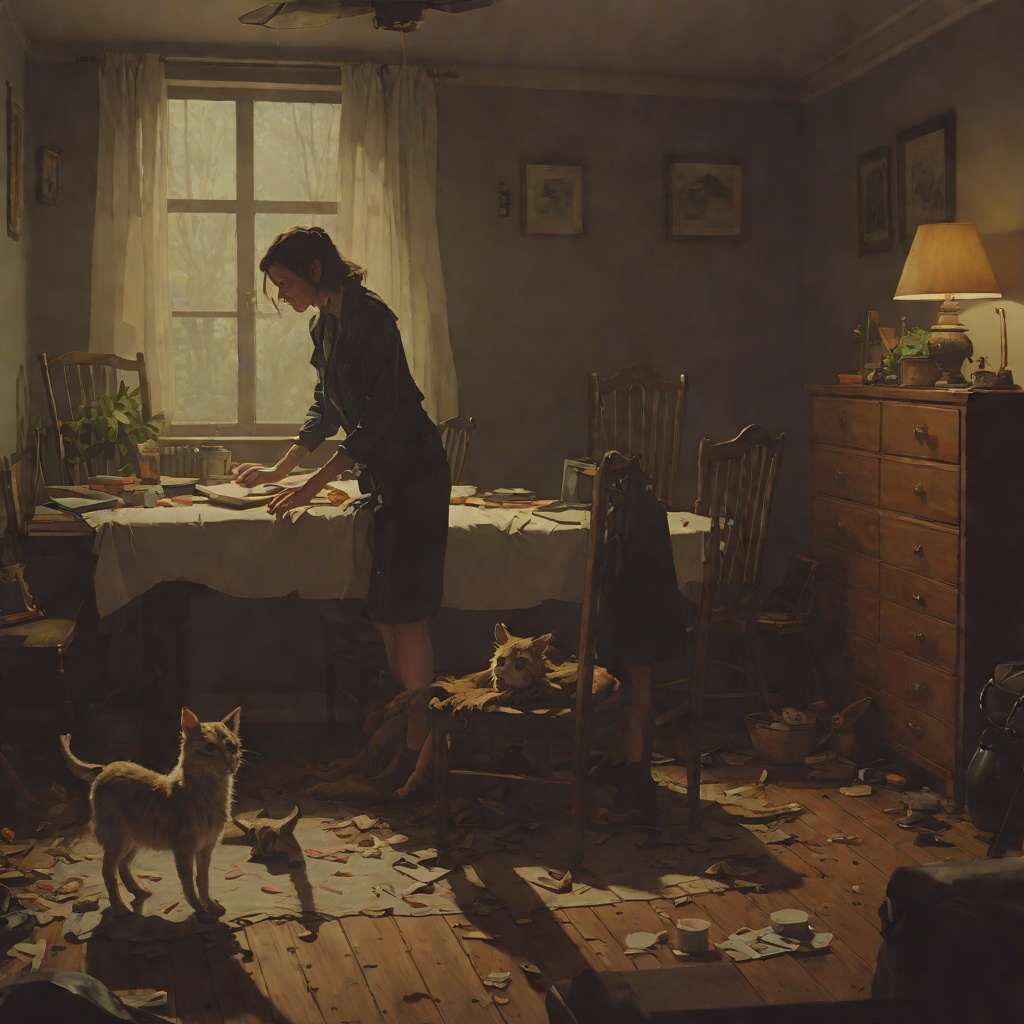
The final performance condenses the book’s recurring conflict between socially approved motherhood and Nightbitch’s suppressed bodily life. Earlier, her animal self finds release through concrete acts of violation: she defecates beside Stanley’s carefully tended grass, tears up clods of turf, and kicks freshly scattered seed onto the sidewalk. Later, after rage and hunger build in the kitchen, she kills The Cat with a knife, tears open its belly, bites its neck, and shakes the body until blood and organs cover the cabinets, floor, her face, and her bare feet. These private or domestic acts give the public performance its physical grammar: waste, blood, teeth, appetite, and motion return as an organized artistic language.
The performance’s grotesque power comes from the way it makes the body open, excessive, and difficult to contain. Nightbitch’s howl opens a channel between chest and voice; her mouth becomes an instrument of hunting; the dead bunny and golden bones turn death into choreography; and the stage becomes porous enough for the audience to enter forests, dens, and other mythic spaces. The event does not present animality as a temporary disguise that can be neatly removed. It gives Nightbitch a public form in which maternal identity, artistic identity, and feral identity occupy the same body.
The performance also clarifies the function of violence in Nightbitch’s transformation. Her earlier hunt teaches her that what she has needed is not medical attention, psychotherapy, a decision to choose happiness, or a change of attitude, but the sensation of biting into living flesh and feeling its essence drain away. One night of violence lets her stop caring what others think, stop being needed by any living thing, and become only a body moving through darkness under the mandates of that body. The final stage performance converts that private discovery into a collective encounter: the audience is made to witness the freedom it fears, then to flee from it.
The event’s ending remains deliberately unresolved. The spectators leave with incompatible accounts, the psychiatrists offer explanations that cannot be proved, and Nightbitch’s performance survives both as reported slaughter and as a larger, stranger experience that exceeds criticism. Its achievement is to make uncertainty itself part of the art. The final stage is not a secure platform on which Nightbitch displays a finished identity; it is the threshold through which woman, dog, mother, artist, audience, and myth pass into one another.