Precariat
NomadlandPrecariat names the temporary, low-wage workers who gather for seasonal jobs without the stability traditionally associated with a company town. In the book, they are often older nomads who bring their homes on wheels to the job site, then move on when the work ends. Their circumstances show that mobility can be a form of adaptation to economic insecurity, not simply a freely chosen alternative to settled life.
Seasonal work and temporary company towns
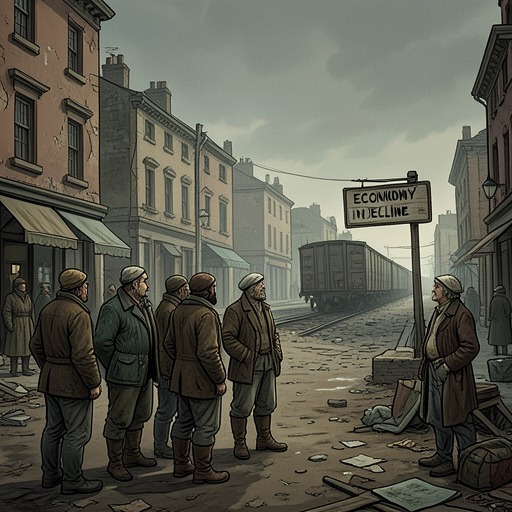
The term appears as Empire, Nevada, is fading and a different company town is taking shape seventy miles to the south. Unlike Empire’s promise of middle-class stability, the new settlement near Fernley consists of itinerant workers living in RVs, trailers, vans, and tents. Many are in their sixties or seventies, and some have traveled hundreds of miles for short-term warehouse work. Before hiring, they face criminal background checks and drug tests; the work offers $11.50 an hour plus overtime, while their homes may not be built for subzero temperatures.
Amazon recruits these workers through CamperForce, a seasonal labor unit intended to help staff fulfillment centers during the three or four months of peak shipping before Christmas. The temporary settlement grows around the work and disperses when the season ends. Workampers are useful to employers because they arrive where staffing is needed, bringing their own housing and leaving when the job is over. The arrangement can reduce some costs and obligations for employers, while the workers’ short stays make it difficult to organize and strenuous shifts can leave little energy for social life.
Workamping also covers arrangements with very different terms. Some jobs provide an hourly wage; others offer an RV site and hookups in exchange for labor, or provide only a place to park. A llama-training position, for example, offered a site in return for twenty to twenty-four hours of weekly work, with pay after that at $7.50 an hour. A volunteer water-taxi position sought as many as forty hours of work a week in exchange for an RV site but no wages. During the annual sugar beet harvest, by contrast, workers might work twelve-hour shifts and receive a starting wage of $12 an hour plus overtime and a parking space. The range makes visible how access to a place to stay can itself become part of compensation.
The infrastructure of moving
Nomadic workers are difficult to count because the law requires them to maintain a fixed domicile. An official address determines where they register vehicles, renew licenses, pay taxes, vote, serve on juries, and obtain health insurance, among other responsibilities. The address can be largely nominal even when a person’s life is spent traveling. Florida, South Dakota, and Texas are popular choices because they have no state income tax, and mail-forwarding services help travelers receive correspondence while on the road.
South Dakota’s residency process illustrates the practical workaround described in the book: a traveler can spend one night at a local motel, register with a mail-forwarding service, and present both receipts to the state department of public safety. This paper domicile makes an itinerant life administratively possible, but it also helps make nomads statistically hard to distinguish from the settled population. Their movement depends on stationary systems—addresses, vehicle registrations, mail, and access to places where they can stop.
Public land offers another part of that infrastructure, but access is conditional. Near Quartzsite, the Bureau of Land Management allows free camping for up to two weeks; after that, campers must move at least twenty-five miles or pay to stay in La Posa Long Term Visitor Area. Its permits cost $40 for two weeks or $180 for as long as seven months. The permit sticker, placed on a vehicle windshield, can also identify travelers to one another. A practical rule governing where people may stop thus shapes both their mobility and their sense of belonging.
Mobility under regulation
The freedom to move does not remove the possibility of being treated as though living in a vehicle were itself a violation. In Coconino National Forest, rangers have questioned people in vans and RVs about their home addresses. Campers who appear to be permanent nomads—including those whose vehicles carry a Quartzsite boondocking sticker—can be cited and evicted for residential use of the forest. The book also describes a proposed Forest Service smartphone app for reporting suspected long-term campsites.
These restrictions expose a tension in mobile life: a person may be permitted to own and drive a vehicle yet be challenged for using it as a home. The road is not an unregulated refuge. It depends on places where a vehicle can legally remain, and those places may be limited by time rules, fees, scrutiny, or removal. Even the seasonal journey described in the book ends each day with a search for somewhere to rest, often a Walmart parking lot, a quiet suburban street, or a truck stop, before setting out again in the morning.
Mutual aid and its limits
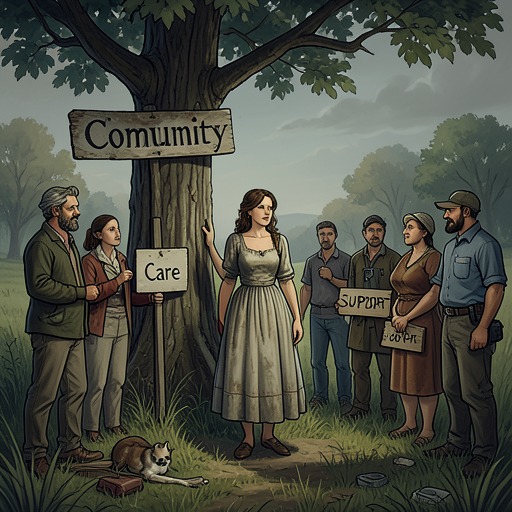
Economic insecurity is not the whole story of the precariat. Nomads form relationships through online contact, jobs, and remote campsites, and those relationships can provide concrete help when formal resources are scarce. At the Rubber Tramp Rendezvous, skills and goods circulate without a conventional market exchange: people offer haircuts, teach basic repairs, build shelves and bed frames, share excess solar power, and make food in a solar oven. A free pile lets people pass along useful belongings rather than carry them in limited living space.
Other acts of sharing answer immediate needs. A camper starts a morning fire and makes coffee for whoever arrives with a cup; communal meals gather ingredients into shared pots. When the Valentinos run out of fuel while trying to keep warm, Vincent drives them to town, where they return with food-bank groceries as well as fuel. When Linda falls ill in Ehrenberg, nearby nomads bring food while she is too weak to cook. A stranded vehicle is hauled from a ditch with a neighbor’s van and a length of nylon webbing. These are not merely symbols of community: food, power, repair skills, and care help people get through specific shortages and setbacks.
Such support can make a precarious life more bearable, but it does not turn seasonal work into secure employment or replace stable housing and formal protections. The concept’s force lies in holding both realities together: workers supply flexible labor and carry the costs of their own housing, while their shared practices create a mobile safety net. Their communities offer connection and practical assistance amid uncertainty, even as the next job, the next legal stopping place, and the next journey remain unresolved.