Company towns
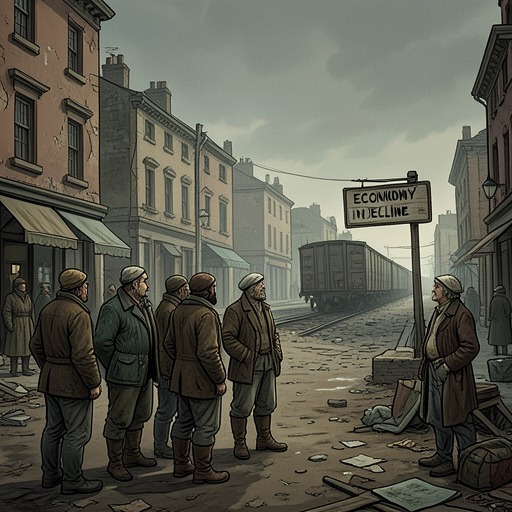
NomadlandCompany towns bind employment to the place where workers live, making a company’s fortunes consequential not only for jobs but for homes and civic life. In the book, Empire, Nevada, embodies the older model: a settlement wholly owned by United States Gypsum Company, where subsidized housing and paid services helped make industrial employment a basis for family and community stability. Its closure reveals the vulnerability built into that arrangement. The comparison with the seasonal RV village around Fernley, Nevada, shows a newer, looser form of company-centered settlement: workers gather near an employer, but their homes remain mobile, their jobs temporary, and their departure expected.
Empire: Work, Housing, and Community
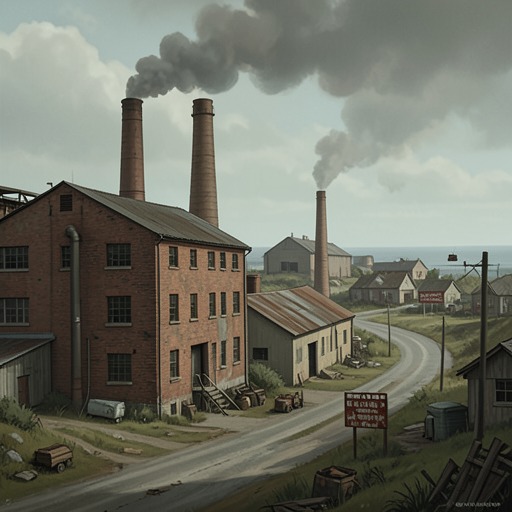
Empire was a factory village of roughly three hundred people on the edge of the Black Rock Desert. United States Gypsum Company owned the town as well as the gypsum operation that sustained it. The industrial chain ran from open-pit mining six miles away to a drywall plant at the town’s edge, where gypsum was processed into wallboard used in homes across the American West. Work and residence were therefore joined in a particularly direct way: the same enterprise provided jobs, owned the cottages, and shaped the settlement’s daily life.
The material terms could offer real security. Rents were subsidized, as low as $110 for an apartment or $250 for a house. Mechanics could earn up to $22 an hour, and workers’ expenses were low enough that a month’s rent might be covered with a day or two of work. The company also paid for television, sewer, trash, and internet service. With income comparatively reliable and housing affordable, the precarious paycheck-to-paycheck existence common elsewhere felt remote. For workers, Empire could mean more than a place to report for a shift: it offered a foothold from which to raise a family and save money.
That economic structure was accompanied by a close-knit civic life. Empire had once housed more than 750 people; by 2010, its population had fallen to less than half that number, but residents still knew one another. Front doors were left unlocked, cars could be parked with keys inside, and block parties, potlucks, and Bunco gatherings filled some of the town’s social calendar. Residents also hunted in the high desert, while cultivated lawns made a conspicuous patch of green against the surrounding brown landscape. The intimacy had its costs: neighbors watched one another closely, and the town’s isolation left residents with few alternatives for entertainment or services. Company ownership offered community and low expenses, but also concentrated the conditions of local life within one employer’s reach.
Closure and the Company Town’s Afterlife
On December 2, 2010, the company announced at a mandatory morning meeting that Empire would close. Employees were told they had until June 20 to leave. The announcement joined two losses in one: workers were losing both their jobs and their homes. The shutdown followed the housing-market collapse and the prolonged slump in construction, which reduced demand for wallboard. United States Gypsum Company had lost $284 million by the end of the third quarter of 2010; the town’s local security could not protect it from the company’s wider market or financial decisions.
The closure also ended a long industrial history. In January 2011, longtime quality-control supervisor Calvin Ryle, who had worked at the plant for thirty-nine years and seven months without missing a day, was given the task of stopping the production line. His son also worked at the factory. The shutting down of the line marked the loss of a livelihood shared across generations, while Ryle’s plan to dig up the rosebushes he had planted in his yard showed how the town’s domestic life had become bound to a place residents were about to leave.
After the families departed, chained gates, security cameras, and no-trespassing signs sealed the settlement. Cottages, a public pool, two churches, a post office, and a nine-hole golf course were left behind; even the local ZIP code was expunged. Two dozen goats were brought in to keep weeds down. The factory office preserved smaller traces of interrupted work, including unfinished coffee and calendars still showing the shutdown date. Yet Empire survived in a different form on Google Maps Street View: as of 2017, a visitor could still see the town as it had appeared in 2009, with cars, lawn furniture, and residents watering their yards. The contrast is stark: the physical town was emptied and closed, while its earlier, inhabited image remained available online.
A Seasonal Counterpart Near Fernley
As Empire was dying, a very different company-centered settlement was taking shape near Fernley, seventy miles south. Each fall, hundreds of itinerant workers arrived in RVs, trailers, vans, and tents and filled mobile-home parks around the town. Many were in their sixties or seventies. They came from far away for temporary warehouse work, passing background checks and drug tests for the chance to earn $11.50 an hour plus overtime. Their employer was Amazon, which recruited nomads through Amazon CamperForce for the holiday shipping rush.
This was not a company town in Empire’s strict sense: the evidence describes workers gathering in surrounding parks, not Amazon owning their homes or providing a permanent civic settlement. The resemblance lies instead in the way a single employer could organize a seasonal population and give its presence a predictable rhythm. CamperForce workers stayed through early winter, sometimes in vehicles not designed for subzero temperatures. Their shifts lasted ten hours or more; some walked over fifteen miles on concrete floors while scanning, sorting, and packing merchandise. When the rush ended, Amazon no longer needed the temporary workforce, and workers drove away in what managers called a taillight parade. Where Empire’s company town offered residents a comparatively durable home alongside steady employment, the Fernley encampment gathered mobile workers around a job whose ending was built into the season.
Mobility, Regulation, and the Meaning of Place
The comparison opens onto a wider change in how work and residence connect. The book describes nomads as returning to the road when seasonal jobs end, moving across the country in search of work, friends, family, or warmth. Their mobility depends on practical arrangements that do not fit the idea of living nowhere: travelers must maintain an official domicile for vehicle registration, licenses, taxes, voting, jury service, and other obligations. Some choose states with fewer administrative burdens and use mail-forwarding services. For example, establishing South Dakota residency can require a night at a local motel and registration with a mail-forwarding service. A mobile life thus still needs an address recognized by settled institutions.
Public land and parking also shape where mobile workers can stay. Near Quartzsite, Arizona, free Bureau of Land Management sites allow camping for up to two weeks before campers must move at least twenty-five miles or pay to stay in the La Posa Long Term Visitor Area. The regulations make mobility a condition of access: a place to stop can be available, but not indefinitely or without rules. On the Coconino National Forest, rangers have questioned van and RV campers about their home addresses, and a Quartzsite boondocking sticker could mark someone as a permanent nomad liable to be ticketed and evicted for residential use. The freedom to move therefore rests on permissions that can be restricted, as well as on parking places that are not always treated as homes.
In this account, the company town is not simply a historical form superseded by a more mobile economy. Empire shows how an employer could make a settlement feel secure while retaining the power to end the arrangement; the seasonal workers near Fernley show how employment can gather a temporary population without offering the older promise of a company-owned home. Between them lies a transformed relation between work, housing, and belonging. For nomads, the road becomes home, but movement still depends on jobs, addresses, public-land rules, and places where a vehicle may stop. The book’s recurring image of the parking spot as the last free place in America gives that dependence a precise edge: the mobile worker may escape a fixed company town, yet even a brief place to rest remains part of the struggle over who can stay where.