Vandwelling·Rubber Tramping
NomadlandVandwelling/Rubber Tramping describes life organized around a vehicle as home and the road as a route between work, shelter, and community. In the book, it is neither simply a chosen adventure nor merely a consequence of hardship: people may value movement and reject conventional housing while still depending on low-wage jobs, legal registration, public land, and help from other travelers. Its central tension is that mobility can offer room to remake a life, but the ability to keep moving is constrained by money, rules, vehicles, weather, and health.
Definition and Conditions of Mobility
The practice takes varied material forms, from vans fitted with sleeping bunks and shelves to trailers and large motorhomes. For some, a vehicle makes independent living possible when renting a conventional home is beyond reach. Vincent Mosemann, burdened by more than $25,000 in student loans after leaving college, bought his mother’s minivan, installed linoleum flooring, curtains, shelves, and a bunk, and named it Tillie. He set out hoping to learn to stand on his own. His conversion of a family vehicle into a modest home shows how the practice can turn an existing asset into shelter without removing the economic pressures that made it necessary.
Movement also requires administrative ties to a fixed place. Because nomads must maintain an official domicile for tasks such as vehicle registration, taxes, voting, and renewing a driver’s license, the book describes a legal home address that may not correspond to where a person actually lives. Florida, South Dakota, and Texas are popular choices, and mail-forwarding services help travelers receive correspondence. South Dakota’s process, as described in the book, can involve spending one night at a local motel, registering with a mail-forwarding service, and presenting both receipts to the state. A life lived on the move therefore depends on a stationary address, even when that address is largely a formal requirement.
Work is another part of the infrastructure. Seasonal jobs draw travelers to camp-hosting positions and harvests, where compensation may include an hourly wage, an RV site, or both. At the annual sugar beet harvest, hundreds of RV dwellers work twelve-hour shifts for starting pay of $12 an hour plus overtime. Such opportunities make continued travel possible, but their seasonal nature and sometimes limited compensation leave workers exposed to layoffs and changing conditions. The book notes that reliable population counts are difficult because official domicile rules make full-time travelers hard to distinguish statistically. Still, employers described a marked rise in interest after the 2008 housing collapse: one campground operator reported a waiting list capped at 25,000 names for a small number of jobs.
Routes, Rules, and the Price of Staying
Public land can provide room to camp, but access is conditional. Near Quartzsite, Arizona, travelers use Bureau of Land Management land to camp without the amenities of an RV park, carrying water and relying on solar panels or generators. On free sites, a stay is limited to two weeks; after that, campers must move at least twenty-five miles or pay to stay in the La Posa Long Term Visitor Area. Its listed rates were $40 for two weeks or $180 for as long as seven months. More than 40,000 RVers were estimated to spend the winter months in the desert near town. The permits, displayed as brightly colored windshield stickers, make the rules visible and also let travelers recognize one another across the dispersed camp.
The road’s promise of freedom likewise meets policing and restrictions on where people may remain. In Coconino National Forest, rangers have questioned people in vans and RVs about their home addresses; those deemed to be making residential use of the forest can be ticketed and evicted. A Quartzsite camping sticker could serve as a clue that someone was a permanent nomad. The book also describes proposals for citizens to report suspected long-term campsites through a smartphone app. These practices make clear that having a vehicle does not guarantee permission to inhabit the places through which it travels.
The pattern of movement follows both opportunity and necessity. When seasonal work ends and winter approaches, travelers pack up and move in search of warmer places, friends, family, or another job. Their routes pass through towns and commercial landscapes, and overnight rest may mean a Walmart parking lot, a suburban street, or a truck stop. Linda May’s overnight stop in Needles illustrates the careful calculation behind an apparently ordinary night’s sleep: after a long drive from an Amazon warehouse in Fernley, she looked for a free place where she could park her large motorhome without attracting police attention. Morning brought another practical task, renewing an expired vehicle registration before continuing toward Quartzsite. Mobility is sustained by a chain of small decisions, not by movement alone.
Community, Exchange, and Identity
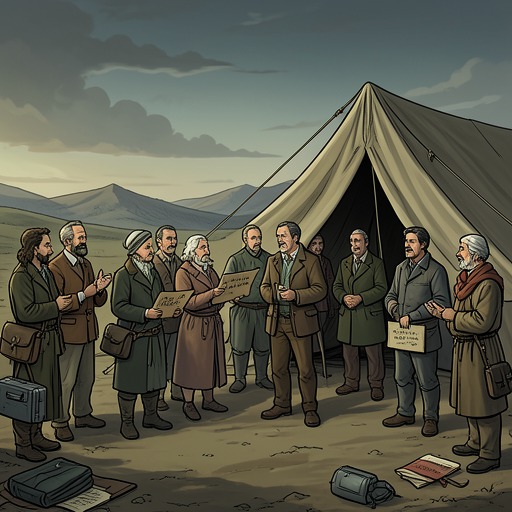
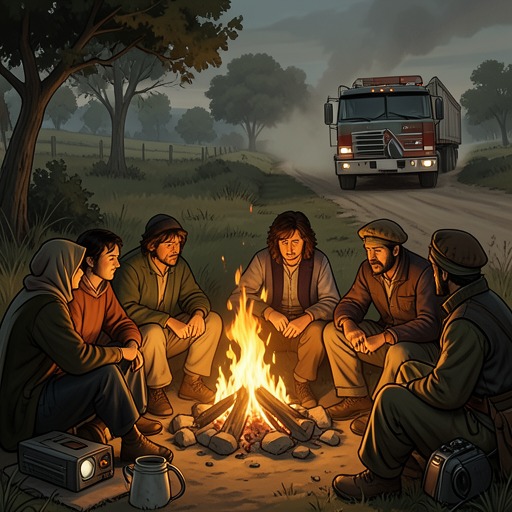
The same movement that separates travelers from settled neighbors can connect them to one another. Bob Wells’s Rubber Tramp Rendezvous offers a deliberate gathering point for people who spend much of the year apart. Its invitation presents periodic assembly as a counterpart to the need to be alone and on the move. At the gathering, practical knowledge and material goods circulate: people teach basic vehicle repairs, share solar power, give haircuts, and offer skills such as American Sign Language. At sunrise, a campfire and shared coffee invite passersby to join; group dinners are assembled from contributions brought by the participants. These exchanges do more than create sociability. They provide useful resources in a life where space, income, and access to services may be limited.
Care continues outside organized gatherings. After a freezing night near Quartzsite, the Valentinos ran out of fuel while trying to keep their van warm. Vincent drove them to town for fuel, and the group returned with food from the local food bank, including apples, sausages, and a large bag of salad. When Linda later became ill with bronchitis near Ehrenberg, Arizona, neighbors brought her food while she was too weak to cook. The book also describes a traveler who broke an arm and received help with everyday tasks from companions. These episodes show how loosely connected travelers can form a practical support network: food, labor, and attention move between camps when formal resources are scarce or distant.
The name a traveler uses for this life matters, too. Sameer Ali recognized that the law might classify him as homeless, yet resisted letting that label define his identity. After a family member rejected him during a visit for Ramadan, he described himself as a traveler instead. The book presents this distinction as personally consequential, while also showing its limits: a chosen description cannot erase laws, exclusion, or material insecurity. In contrast with people who expect to return to conventional housing, some of the modern nomads interviewed say they do not intend to go back. For them, the road is not simply a temporary detour.
Meaning and Limits of the Road
The book holds hardship and possibility together. Nomads are portrayed neither as helpless victims nor as carefree adventurers: the same person can face unstable work and insecure shelter while finding meaning in friendship, shared meals, and a campfire. The gatherings can feel like a community built from connection rather than from a fixed address, but they do not eliminate the economic pressures that shape who can travel and for how long. Positive outlook and practical mutual aid are part of how people adapt; they are not evidence that the underlying difficulties have disappeared.
The seasonal cycle gives the practice its recurring shape. Travelers leave jobs as winter approaches, move toward warmer regions, and look for places to sleep before setting out again. The image of the parking spot becomes a concise measure of both access and limitation: a place to stop may be temporarily available, yet a traveler still has to navigate property rules, local enforcement, and the next day’s need to move. In that tension, Vandwelling/Rubber Tramping becomes a way of life with no single boundary between freedom and necessity. Its routes offer chances for independence and community, while repeatedly exposing how fragile mobility can be when the conditions that support it—work, a functioning vehicle, legal access, and other people—are uncertain.