Workamping
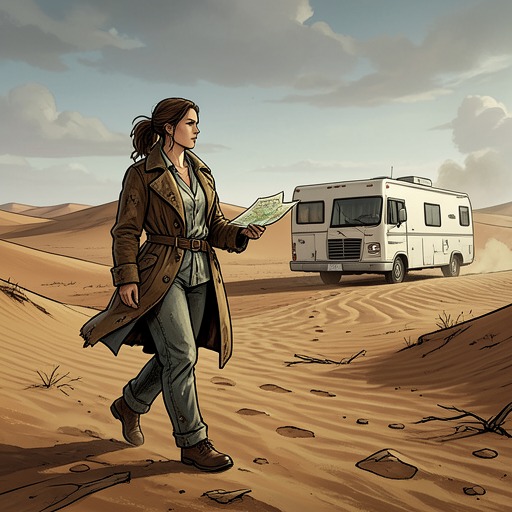
NomadlandWorkamping is a mobile way of life organized around temporary jobs: workers travel in recreational vehicles, bringing their homes to the places where employers need seasonal labor. Compensation may include a campsite and utility hookups, a stipend, an hourly wage, or only room for the vehicle. The arrangement promises movement and community, but also exposes how much that freedom depends on finding the next job, maintaining a legal address, and having somewhere to park. In the book, workamping is at once a resourceful survival strategy and a labor system that makes workers’ mobility useful to employers while leaving much of its cost to the workers themselves.
Definition and historical lineage
Don Wheeler, a worker at an Amazon warehouse, described workampers as modern mobile travelers who take temporary jobs around the country in exchange for a free campsite, usually with power, water, and sewer connections, and sometimes additional pay. His account connected the practice to a much older tradition of itinerant workers who moved from job to job with their tools. He traced a line from people who repaired equipment and cookware, built stone walls, and helped clear and cultivate land to today’s travelers, who use motor coaches and trailers in place of wagons. The equipment has changed; the underlying bargain—labor and skills exchanged for a place to stay and some means of support—has not.
The skills workampers bring reflect that history and its modern adaptations. They may run shops, drive trucks and forklifts, pick and pack goods, repair machinery, manage computer networks, work in agriculture, landscape, or clean bathrooms. Some describe themselves as retired, though many expect to keep working into their seventies or eighties. Others prefer names such as travelers, nomads, or rubber tramps. The variety of labels reflects a population with no single occupation or life story, joined by a pattern of mobility and temporary work rather than by one fixed identity.
A national circuit of seasonal jobs
Workampers follow a dispersed labor market, assembled through classified advertisements and job-listing services such as Workamper News and Workers on Wheels. Its jobs change with the calendar. Travelers can pick raspberries in Vermont, apples in Washington, or blueberries in Kentucky; give tours at fish hatcheries; staff NASCAR events; guard gates at Texas oil fields; run amusement-park rides; and work concessions. The circuit also includes specialized or irregular tasks, such as checking hunters’ game and processing birds at a South Dakota hunting lodge. Employers recruit people who can move to where a short-term need arises, often with their own accommodation already in tow.
Recruitment is visible at the Quartzsite Sports, Vacation & RV Show, known among attendees as the Big Tent. Amazon representatives collected names for its CamperForce program, while Forest Service concessionaires recruited campground hosts and Express Employment Professionals sought workers for the annual sugar beet harvest. The beet recruiter presented the opportunity as immediately available to anyone willing to apply. Months later, the narrator’s application was accepted. The Red River Valley’s harvest depends on itinerant workers because the region’s near-full employment makes local hiring difficult; those workers arrive from far away with their own homes to help bring in the autumn crop.
The harvest illustrates how sharply the terms of work can vary. Some employers pay wages, while others offer a vehicle site and hookups in exchange for labor. One Georgia farm offered a site for twenty to twenty-four hours of work each week, with pay only for additional hours. A volunteer water-taxi position required as many as forty hours a week but offered no wages, only an RV site. At the other end of the range, the American Crystal Sugar Company brought RV dwellers to Montana, North Dakota, and Minnesota for twelve-hour shifts, when weather allowed, with a starting wage of twelve dollars an hour plus overtime and a parking space. A job advertisement may therefore promise a place to stay without guaranteeing that the labor performed will be paid.
Scale, mobility, and the fixed-address problem
The number of people living nomadically in the United States is difficult to establish. Full-time travelers are hard to count partly because official life still requires an address. People must designate a state of residence for vehicle registration, driver’s licenses, taxes, voting, jury service, and other obligations, even when they do not maintain a conventional home there. Some use mail-forwarding services and choose states with comparatively few administrative burdens. South Dakota’s process, for example, could be completed by spending a night at a local motel, registering with a mail-forwarding service, and presenting the receipts to the state department of public safety. On paper, a person can be settled in one place while continually moving through many others.
Although there is no definitive count, accounts cited in the book suggest that demand for this kind of work grew after the housing collapse. Recreation Resource Management, which managed 110 campgrounds and employed about 300 workampers, reported a list of 25,000 people interested in hearing about jobs; its president estimated that the applicants represented roughly 50,000 people competing for 50 openings. Before 2008, he said, the company had struggled to persuade retirees to work. Kampgrounds of America hired about 1,500 couples each year, and Workamper News reported reaching 14,000 members. These figures do not produce a census, but they show how seasonal employers and workers increasingly encountered one another through a national network.
The system also depends on permission to stop. On public land near Quartzsite, Arizona, free camping is limited to two weeks at a time, after which travelers must move at least twenty-five miles or pay to stay in the La Posa Long Term Visitor Area. More broadly, the book describes rangers in Arizona’s Coconino National Forest questioning van and RV campers about their addresses and citing or evicting people judged to be making residential use of the forest. Vehicle travel alone does not guarantee a place to live: the workampers’ ability to keep moving is conditioned by parking rules, public-land limits, registration requirements, and the practical availability of campsites.
Flexibility for employers, insecurity for workers
Workampers are attractive to employers because they can be recruited for a particular season and arrive with a place to sleep. Their temporary presence can turn a trailer park into a short-lived company town, which disperses when the work ends. That flexibility can help employers staff up quickly, but it also leaves workers with repeated transitions and little time to organize collectively. After physically demanding shifts, workers may be too tired to socialize; when a season is over, they must search for the next job and decide where to go next. The arrangement places mobility at the center of the employment relationship, but mobility is not the same as security.
The narrator’s reporting sets the upbeat public image of workamping against the conditions that can prompt people to take it up. A segment on NPR’s All Things Considered presented an Amazon worker’s cross-country travel and new friendships as a cheerful holiday story. Workamper News, meanwhile, advised readers with job problems to adjust their attitudes and treat the work as a temporary means to travel or pursue a dream. The narrator argues that this optimism need not be false: hardship and joy can coexist, and shared life among travelers can create genuine meaning. But a sunny account that focuses only on adventure can conceal how housing costs, employment instability, or financial need shape the decision to live and work on the road.
Work, community, and the next departure
Workamping offers more than a wage or a place to park. At the Rubber Tramp Rendezvous, participants exchanged practical skills and resources: people taught basic repairs, built shelves and bed frames, shared solar power, and cooked communal meals. Such exchanges are distinct from paid seasonal jobs, but they help explain how mobile workers can build support around a life that lacks the steady services of a fixed home. The social network can supply help and belonging even as people continue moving between employers and campgrounds.
For Linda May, seasonal work included camp hosting, and the narrator followed her while she searched for the next position. She and LaVonne Ellis tried to find spring work; Linda believed she had secured another camp-hosting job with California Land Management, only to learn that the position had been eliminated. Later, Linda planned to finish a camp-hosting job before reporting to Amazon with her friend Gary, who also intended to work there. Her experience makes the seasonal circuit concrete: a job can anchor a stretch of life, then disappear, sending a worker back into the search. A later illness brought food from neighbors in camp, showing that the same mobile community could provide care when work and health faltered.
Across the book, the road’s promise of opportunity is inseparable from its recurring departures. Seasonal layoffs send travelers on toward another job, another town, or somewhere warm; overnight stops may be truck stops, suburban streets, or Walmart parking lots. Workamping makes that movement possible for some people by linking temporary employment to mobile housing. Yet every new destination requires the same practical negotiations—work, fuel, an authorized place to stay, and the next address or campsite. Its central tension is therefore not simply between freedom and hardship, but between the real possibilities created by movement and the fragile arrangements that allow movement to continue.