Madame Gaillard
PerfumeMadame Gaillard is the first person to provide the infant Jean-Baptiste Grenouille with a stable, if utterly loveless, home, and she is the one who, after eight years, expels him into the brutal world of Grimal's tannery. Her own story—a life of emotional numbness followed by a long, ironic decline into the very public death she had spent decades trying to avoid—forms a dark counterpoint to Grenouille's own trajectory, illustrating the novel's themes of order, justice, and the ultimate failure of a life lived without passion.
Identity and Background
Madame Gaillard's life was effectively over before she was thirty, though she would live for many more decades. As a child, her father struck her across the forehead with a poker, just above the base of the nose. The blow destroyed her sense of smell and, with it, every human passion. Tenderness, enmity, joy, and despair all became equally foreign to her. She felt nothing when she later slept with a man, nothing when she bore her children, and no grief when they died. When her husband beat her, she did not flinch, and she felt no relief when he died of cholera in the Hôtel-Dieu. The only sensations she was aware of were a very slight depression at the approach of her monthly migraine and a very slight elevation of mood at its departure. This total lack of emotion, however, gave rise to a merciless sense of order and justice. She showed no preference for any of the children entrusted to her and discriminated against none. She served three meals a day and not a single snack more. She changed the nappies of the little ones three times a day, but only until their second birthday; whoever soiled himself after that received an uncensorious slap and one less meal. Exactly half of the boarding fees were spent on her wards; exactly half she retained for herself. She did not attempt to increase her profits when prices went down, nor did she charge a single sol extra in hard times, even when it was a matter of life and death. Her business was of value to her only if it was run according to this strict arithmetic. She needed the money for a single, overriding goal: in her old age, she wanted to buy an annuity, with just enough beyond that to afford to die at home rather than perish miserably in the Hôtel-Dieu as her husband had. She dreaded a communal, public death among hundreds of strangers. She wanted to afford a private death.
Life and Plot Trajectory
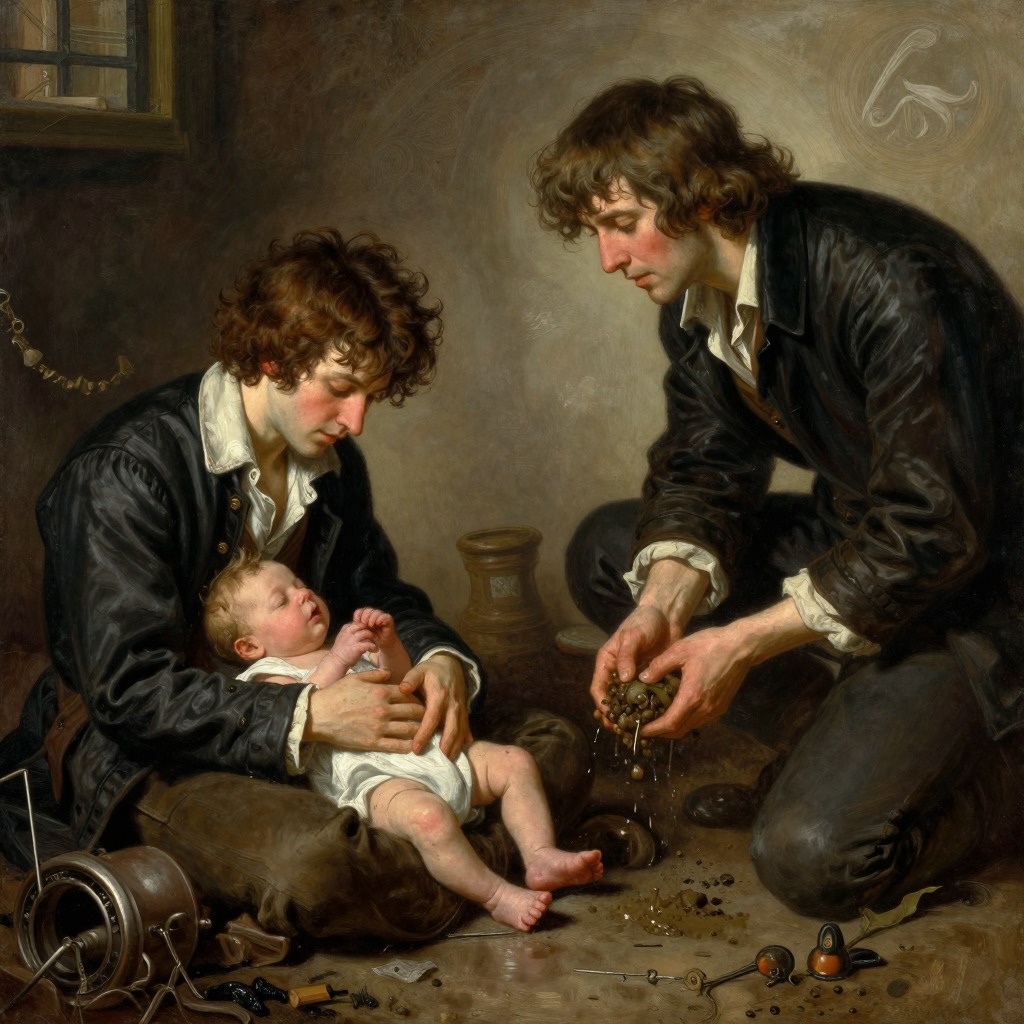
When Father Terrier, desperate to be rid of the screaming infant Grenouille, ran to the far end of the rue de Charonne, it was to Madame Gaillard's establishment that he came. She took children to board no matter their age or sort, as long as someone paid for them. Terrier paid a year in advance and fled. For little Grenouille, Madame Gaillard's house was a blessing. He probably could not have survived anywhere else. He was as tough as a resistant bacterium and as content as a tick sitting quietly on a tree, requiring a minimum ration of food and clothing for his body and nothing at all for his soul. Every other woman would have kicked this monstrous child out, but not Madame Gaillard. She could not smell that he did not smell, and she expected no stirrings from his soul because her own was sealed tight. The other children, however, sensed at once that Grenouille was a sinister presence. They avoided him, tried to suffocate him, and were afraid of him because they could not smell him. Grenouille lived with Madame Gaillard until he was eight. During that time, she noticed that he had certain abilities that were highly unusual, if not supernatural. He seemed to have no fear of darkness and could find his way around the cellar or the shed on the blackest night without a light. More remarkably, he appeared able to see through paper, cloth, wood, and even brick walls. He knew how many of her wards were in the dormitory without ever entering it. He knew if there was a worm in a cauliflower before the head was split open. And once, when she had hidden her money so well that she could not find it herself, he pointed without a second's search to a spot behind a fireplace beam—and there it was. He could even predict the approach of a visitor long before the person arrived. Madame Gaillard, whose sense of smell had been destroyed, did not guess that he was using his nose. She was convinced that the lad had second sight. And since she knew that people with second sight bring misfortune and death, he made her increasingly nervous. What made her more nervous still was the unbearable thought of living under the same roof with someone who could spot hidden money. When the cloister of Saint-Merri ceased to pay its yearly fee, she did not dun them. She waited an additional week for appearances' sake, and when the money still had not appeared, she took Grenouille by the hand and walked with him into the city. She was acquainted with a tanner named Grimal, who lived near the river in the rue de la Mortellerie and had a notorious need for cheap young labourers for the most perilous jobs. She knew that by all normal standards Grenouille would have no chance of survival in Grimal's tannery, but she did not bother herself about such things. Her custodianship was ended. She had Monsieur Grimal provide her with a written receipt for the boy, gave him in return a receipt for her brokerage fee of fifteen francs, and set out for home. She felt not the slightest twinge of conscience. She thought her actions not merely legal but also just, for if a child for whom no one was paying were to stay on with her, it would necessarily be at the expense of the other children or, worse, at her own expense, endangering her own private and sheltered death.
Change and Ending
Although dead in her heart since childhood, Madame Gaillard lived to be very, very old. In 1782, just short of her seventieth birthday, she gave up her business, purchased her annuity as planned, sat in her little house, and waited for death. But death did not come. What came in its place was the French Revolution, a rapid transformation of all social, moral, and transcendental affairs. At first it had no effect on her personal fate, but then, when she was almost eighty, the man who held her annuity had to emigrate, was stripped of his holdings, and forced to auction off his possessions to a trouser manufacturer. For a while it looked as if even this change would have no fatal effect, for the trouser manufacturer continued to pay her annuity punctually. But then came the day when she no longer received her money in the form of hard coin but as little slips of printed paper, and that marked the beginning of her economic downfall. Within two years, the annuity was no longer worth enough to pay for her firewood. She was forced to sell her house at a ridiculously low price, receiving in return only these stupid slips of paper, which within another two years were as good as worthless. By 1797, nearing ninety, she had lost her entire fortune, scraped together from almost a century of hard work, and was living in a tiny furnished room in the rue des Coquilles. Only then—ten, twenty years too late—did death arrive, in the form of a protracted bout with a cancer that grabbed her by the throat, robbing her first of her appetite and then of her voice, so that she could raise not one word of protest as they carted her off to the Hôtel-Dieu. There they put her in a ward populated with hundreds of the mortally ill, the same ward in which her husband had died, laid her in a bed shared with total strangers, pressing body upon body with five other women, and for three long weeks let her die in public view. She was then sewn into a sack, tossed on to a tumbrel at four in the morning with fifty other corpses, driven to the newly founded cemetery of Clamart, a mile beyond the city gates, and there laid in her final resting place, a mass grave beneath a thick layer of quicklime. This was in the year 1799. The narrator notes that thank God Madame had suspected nothing of this fate as she walked home that day in 1746, leaving Grenouille behind, for she might possibly have lost her faith in justice and with it the only meaning that she could make of life.
Narrative Role and Evaluation
Madame Gaillard functions as a crucial early environment for Grenouille, the only place where his tick-like, self-sufficient nature could have survived infancy. Her emotional deadness makes her the perfect caretaker for a child who requires nothing, and her inability to smell his odorlessness means she never recoils from him as others do. At the same time, her merciless sense of order and justice, and her single-minded pursuit of a private death, mark her as a figure of grotesque, almost mechanical rationality. Her ultimate fate—a public death in the very hospital she had spent a lifetime trying to avoid, followed by a mass grave—is a devastating irony that underscores the novel's bleak view of human plans and the indifference of history. She is a minor character whose arc, told in a few concentrated pages, provides a complete, chilling miniature of a life lived without love and ended without dignity.