Marquis de la Taillade-Espinasse
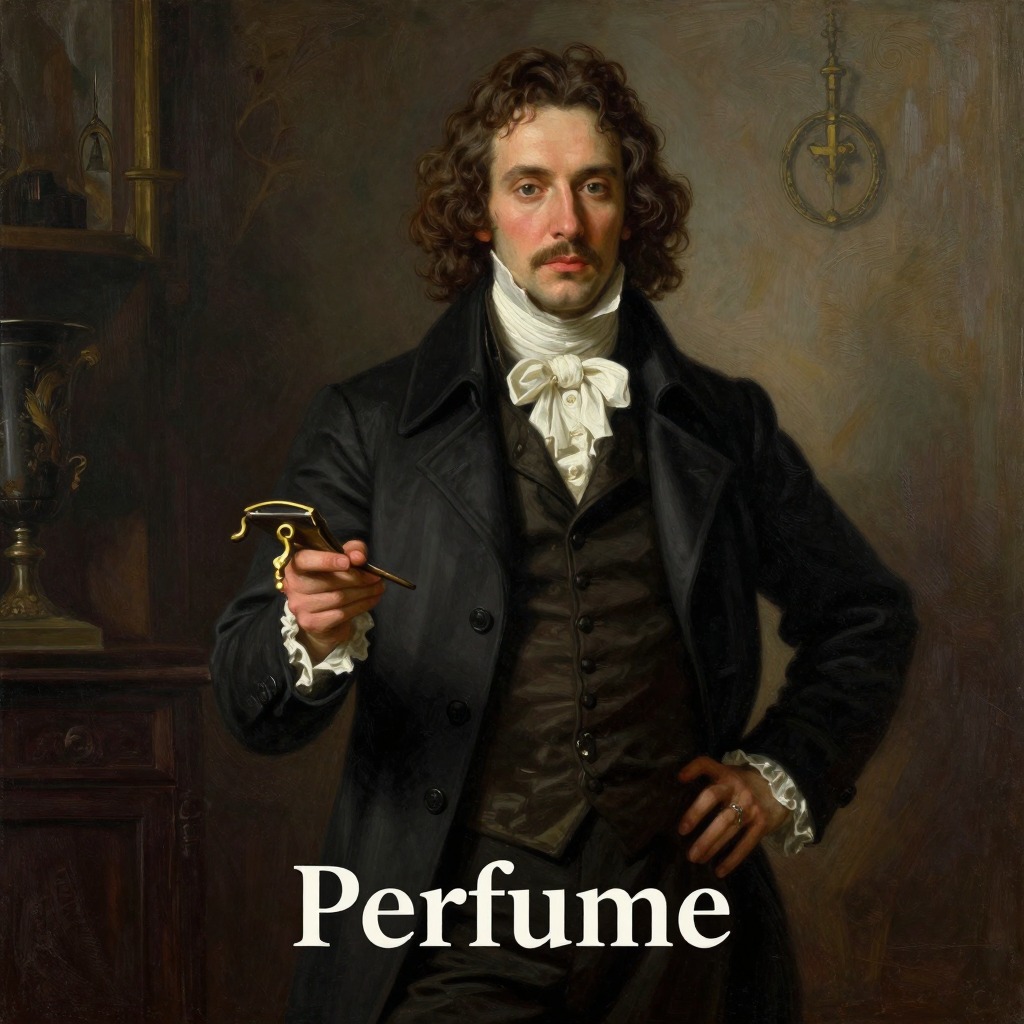
PerfumeThe Marquis de la Taillade-Espinasse is a provincial nobleman and pseudoscientist whose encounter with Jean-Baptiste Grenouille becomes the vehicle for his greatest public triumph and, ultimately, his legendary disappearance. A man who turned his back on life at the court of Versailles at the age of forty, he retired to his estates to devote himself entirely to science. His intellectual career was a restless sequence of ambitious projects: he wrote a work on dynamic political economy proposing an upside-down progressive income tax that would hit the poorest hardest; he composed a tract on raising children; and he attempted to create a milk-yielding animal-vegetable hybrid by spreading bull semen over grasses, producing a cheese that the Academy of Sciences of Lyon described as "tasting of goat, though slightly bitter." These experiments, abandoned because of their enormous cost, led him to a grander theory about the earth itself and its relationship to all living things.
The Fluidum Letale Theory
Taillade-Espinasse's central thesis was that life could develop only at a certain distance from the earth, because the earth constantly emits a corrupting gas he called "Fluidum Letale." This gas, he argued, lames vital energies and eventually extinguishes them. All living creatures instinctively distance themselves from the earth by growing upward—hence ears of grain, blossoms, and the human head are lifted heavenward. In old age, as bodies bend and buckle back toward the earth, they inevitably fall victim to this lethal gas, into which they are finally transformed after death. When word reached him that a man had been found in Pierrefort who had dwelt in a cave for seven years—completely encapsulated by the corrupting element—he was beside himself with delight and immediately had Grenouille brought to his laboratory for examination.
The "Cure" and Scientific Demonstration
Taillade-Espinasse subjected Grenouille to a thorough examination and found his theories confirmed most graphically: the Fluidum Letale had so assaulted Grenouille that his twenty-five-year-old body showed clear marks of senile deterioration. The marquis declared that only the fact that Grenouille had been given earth-removed plants for nourishment had prevented his death, and that his former healthy condition could only be restored by the wholesale expulsion of the fluidum using a vital ventilation machine of his own devising. He had such an apparatus standing in his manor in Montpellier, and if Grenouille would make himself available as the object of a scientific demonstration, he would not only free him from hopeless contamination but also provide him with a handsome sum of money. Two hours later they were in a carriage, traveling the sixty-four miles to Montpellier in just under two days, with the marquis personally whipping both driver and horses whenever an axle or spring broke. Grenouille was forced to sit wrapped in rags and a blanket drenched with earth and clay, fed raw vegetable roots to preserve the contamination in its ideal state.
Upon arrival, Taillade-Espinasse had Grenouille taken to the cellar and sent out invitations to all the learned societies of Montpellier. Several days later, he presented Grenouille on a dais in the great hall of the University of Montpellier as the scientific sensation of the year. In his lecture, he stripped Grenouille of his rags piece by piece, explaining the devastating effects of the corruptive gas: pustules and scars, a giant shiny-red gas cancer on his breast, general disintegration of the skin, and clear evidence of fluidal deformation of the bone structure—a club-foot and a hunchback. He pledged that within eight days, using ventilation therapy combined with a vital diet, he would restore this doomed creature to complete recovery, and invited those present to return in one week to witness the proof. The lecture was an immense success.
The Transformation and Grenouille's Deception
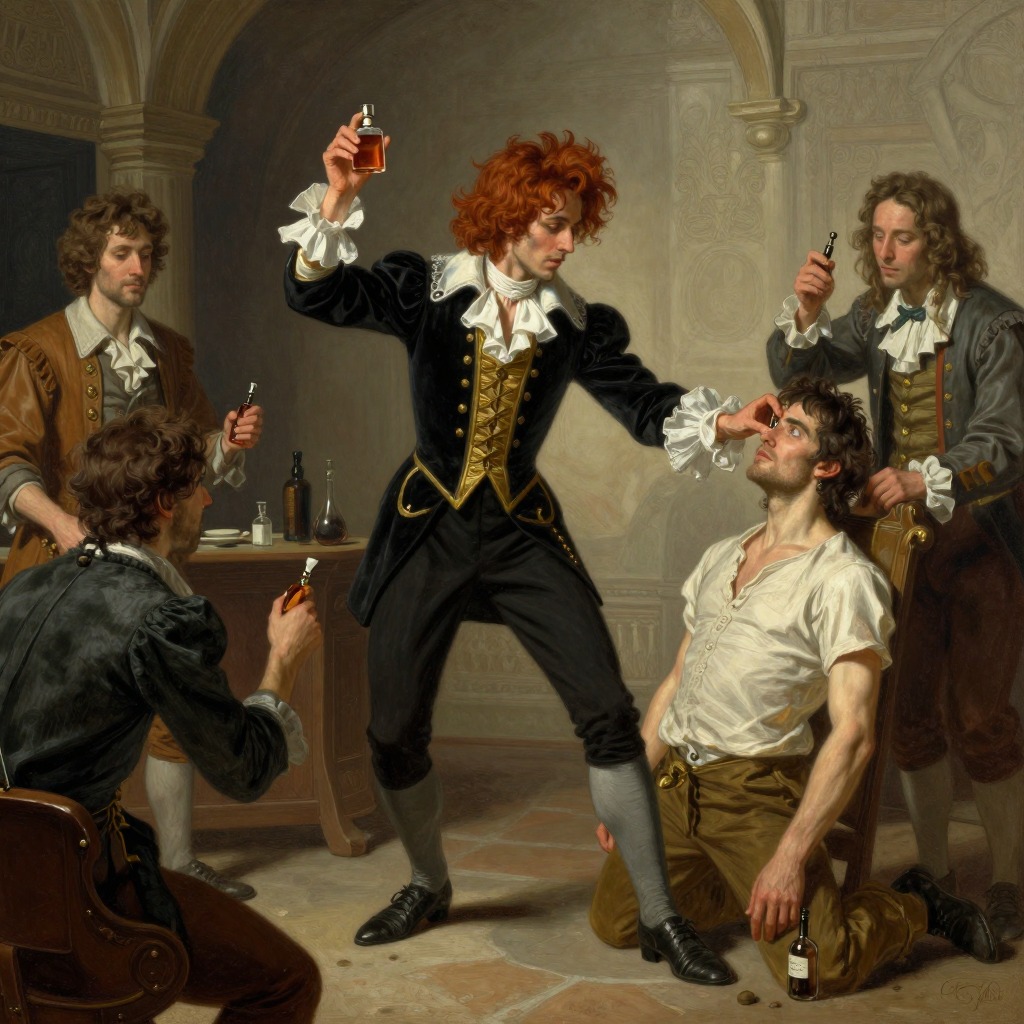
Taillade-Espinasse locked Grenouille in his vital ventilation machine—a box of tightly jointed pine boards with a suction flue extending far above the house roof, flooded with air extracted from the higher regions. Surrounded by the constant purifying stream of air, Grenouille was fed dove bouillon, lark pie, ragout of wild duck, preserves of fruit picked from trees, bread made from special high-altitude wheat, wine from the Pyrenees, chamois milk, and frozen frothy meringue from hens kept in the attic. After five days, the marquis had Grenouille bathed in lukewarm rainwater, waxed with nut-oil soap from Potosi in the Andes, trimmed, shaved, and fitted out in a silk shirt, white jabot, silk stockings, a blue velvet frock coat, and handsome buckled shoes—the right one cleverly elevated for his crippled foot. He personally applied white talcum make-up to Grenouille's scarred face, dabbed his lips and cheeks with crimson, and gave a noble arch to his eyebrows with linden charcoal. Then he dusted him with his own personal violet perfume.
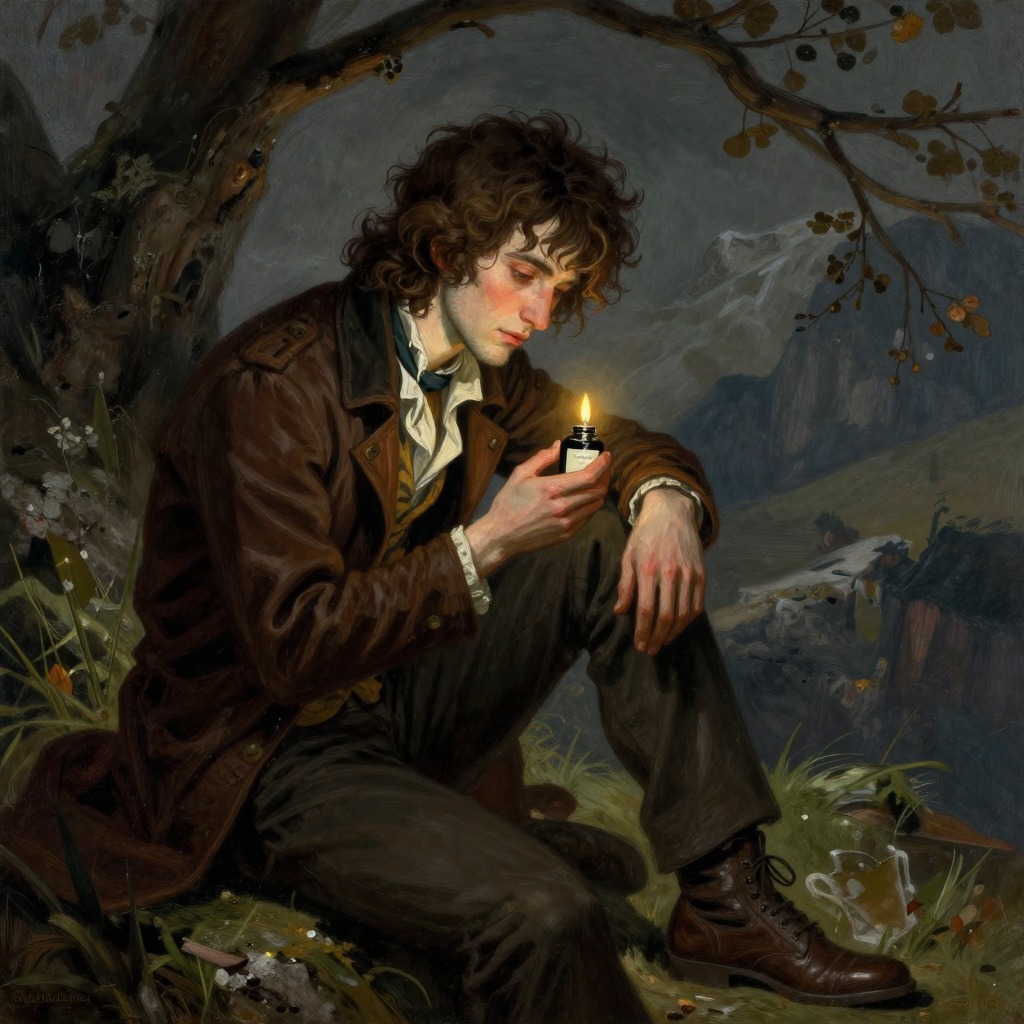
Taillade-Espinasse was thrilled with himself, declaring that he had made a man of a beast—a veritable divine act. He told Grenouille to regard himself in the mirror and realize for the first time in his life that he was a human being. It was the first time anyone had ever said "monsieur" to Grenouille. But Grenouille, seeing in the mirror an odourless figure dressed and made up like a man, understood that it was not the dove bouillon nor the ventilation hocus-pocus that had made him appear normal, but solely the clothes, the haircut, and the cosmetics.
The Second Demonstration and Grenouille's Escape
Grenouille then faked a fainting spell, claiming that the violet perfume—being of subterranean origin—was poisoning him with the Fluidum Letale. He convinced the marquis to let him create his own perfume, which he did in Runel's laboratory, secretly producing the human scent that would allow him to pass among people undetected. Taillade-Espinasse, deeply impressed by the argument presented under the aegis of his own theory, anointed himself with the conventional floral scent Grenouille gave him and felt revitalized. He embraced Grenouille, called him "my fluidal brother," and promised to win him as the first proselyte of an international lodge dedicated to vanquishing the Fluidum Letale.
Precisely one week after the first lecture, Taillade-Espinasse presented Grenouille again at the university. The crush was monstrous. He first circulated drawings depicting the cave-man in all his ugliness, then had the new Grenouille led in—handsome, erect, rouged, powdered, and coiffed. The change was so egregious that even his enemies were speechless. As Taillade-Espinasse delivered his lecture, Grenouille's scent worked on the crowd, and at the lecture's end the entire assemblage rose to its feet in frenetic cheering. The marquis experienced the greatest hour of his life, unaware that the ovations were in reality meant for Grenouille.
Grenouille left Montpellier secretly the next month. The marquis, privately dreadfully annoyed, soon found his fame spreading without any tour. A long article about the Fluidum Letale appeared in the Journal des Sçavans and even in the Courier de l'Europe. In the summer of 1764, he founded the first Lodge of the Vital Fluidum with 120 members in Montpellier, establishing branches in Marseille and Lyon.
The Final Expedition and Legend
Determined to provide a propaganda base for his crusade, Taillade-Espinasse decided on a heroic feat that would overshadow the cure of the cave-man. In early December 1765, he led a company of fearless disciples on an expedition to the Pic du Canigou, considered the highest mountain in the Pyrenees. Though on the threshold of senescence, he intended to be borne to the summit at nine thousand feet and left there in the sheerest vital air for three whole weeks, after which he would descend on Christmas Eve as a strapping lad of twenty. The disciples gave up shortly beyond Vernet, but the marquis, casting his garments from him in the icy cold and whooping in exultation, began the climb alone. The last that was seen of him was his silhouette: hands lifted ecstatically to heaven and voice raised in song, he disappeared into the blizzard. He returned neither as an old man nor a young one, and when searchers scaled the still-snowbound summit the following summer, they found no trace of him—no clothes, no body parts, no bones.
His teachings, however, suffered no damage. Soon the legend spread that on the mountain peak he had wedded himself to the eternal Fluidum Vitale, merging with it, and now floated forever—invisible but eternally young—above the peaks of the Pyrenees. Whoever climbed up to him would encounter him there and remain untouched by sickness or aging for one full year. Well into the nineteenth century, Taillade's fluidal theory was advocated from many a chair at faculties of medicine and put into therapeutic practice by occult societies. Even today, on both sides of the Pyrenees, particularly in Perpignan and Figueras, secret Tailladic lodges meet once a year to climb the Pic du Canigou, lighting a great bonfire ostensibly for the summer solstice but in reality to pay homage to their master and his grand fluidum, and to seek eternal life.