Kawashima Masayuki and Sanada Chiaki
PiercingKawashima Masayuki and Sanada Chiaki are connected by an encounter that turns a planned act of violence into a fraught, unresolved relation of care, fear, and mistaken recognition. Kawashima approaches Chiaki as a prospective victim, but when she is in crisis he stays, intervenes, and becomes recognizable to her as the person she has imagined as her recurring hospital escort. Her trust grows from that recognition; his conduct remains divided between helping her and fearing the violence he wants to commit against her.
Background and Unequal Circumstances
Before meeting Chiaki, Kawashima has already constructed a plan to kill a woman he does not know. He reasons that choosing a prostitute would reduce the likelihood of an established connection to the victim, and considers how the setting might limit attention and risk. He wants a woman without a pimp or office to report her absence, and considers using an S&M appointment to get her alone. His plan turns another person into a carefully selected target before he has met her as an individual.
The practical details reveal how deliberately he tries to control the encounter. He rejects love hotels as unsuitable because staff might investigate a concern, their entrances could hinder escape, and their quieter surroundings would make it difficult to disappear into a crowd. Instead, he considers hotels in West Shinjuku, intending to reserve rooms under different names and choose a busy front desk where guests attract less notice. At the Keio Plaza Hotel, a scheduled visit coincides with a crowded Friday afternoon: weddings, a ward accountants’ gathering, and a computer manufacturers’ conference have overwhelmed the lobby. The scene gives him the inattentive reception he sought, but the crowd and the people he encounters do not become controllable pieces of his plan.
Kawashima’s capacity to respond to Chiaki is shaped by his own childhood, though the narrative does not make that history a simple explanation for his actions. After his father died, his mother beat him; he learned to think of himself as the cause of the abuse and to endure it by distancing himself from what was happening. A middle-school teacher later arranged for him to enter the Home for abused children. There he began drawing, repeatedly depicting narrow roads at night. As an adult, he has rarely spoken about this history. When he once confides it to Yoko, she takes his hand, offering a contrast to the abandonment and violence he remembers.
The Encounter Turns into an Intervention
When Chiaki is frightened and unable to approach or send Kawashima away, he recognizes a pattern that recalls the children he knew in the Home. His memory of being a child who feared adults yet could not survive without them informs his judgment that Chiaki needs someone present without being pressed to respond. He tries not to approach her directly or leave her, and tells another person that he is on her side even though she does not yet understand that.
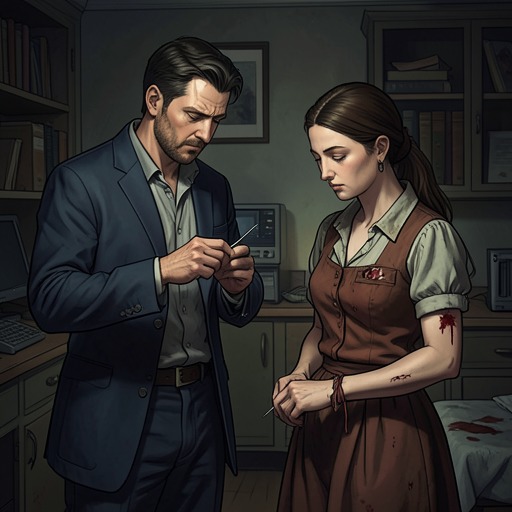
The crisis becomes physical when Chiaki is near a receiver with a Swiss Army knife. Kawashima seizes her wrist, opens her hand, and sends the knife out of reach. He holds her from behind as she struggles, repeatedly reassuring her that he will not hurt her. The intervention is not uncomplicated: he restrains her, and from Chiaki’s perspective the man holding her is also someone taking control. Yet his steady repetition gives her fear and anger a form she can recognize. She gradually relaxes, and he carries her to a sofa, where he attends to her condition.
Kawashima’s response exposes the conflict at the center of their relation. Even after Chiaki is still, he considers the possibility of killing her and has the means to do so nearby. He also recognizes that her detached state makes her especially vulnerable. His decision to care for her does not erase the earlier plan or immediately make her safe; rather, it places practical protection and contemplated violence within the same encounter. The gap between his actions and intentions is central to the danger she cannot yet see clearly.
Recognition and Misreading
After a brief sleep, Chiaki becomes fully aware of her surroundings and of the pain from her injured thigh. The person who had been with her has just been beside her, and she remembers his voice and the warmth of his arms. At the hotel, she later emerges from room 2902 in a confused state. Kawashima sees her in the corridor as an elderly couple nearby are about to turn toward the elevators. Her appearance and unexpected presence force him to respond to an unfolding situation rather than follow the clean sequence his plan had imagined.
For Chiaki, the encounter joins two previously separate experiences: the man who intervened and the mysterious person who has repeatedly ensured that she reaches a hospital. When she recognizes Kawashima, she feels that she has finally found that figure. The recognition is emotionally real, but her account of how he came to be there is partly an interpretation: she imagines that he had watched her from a distance, arranged to meet her through an appointment, and never intended to harm her. She takes his decision to remain after being bitten and to help her as evidence that he is not an ordinary client. The evidence supports her sense of connection, but not the story she constructs to explain it.
That mistaken understanding makes the relation asymmetrical. Chiaki reads Kawashima’s intervention as confirmation that he is a protective presence. Kawashima, meanwhile, concludes that she has read his notes and takes that as a reason to kill her quickly, partly because he fears being seen with her. The more she approaches him as someone trustworthy, the more his hidden intentions threaten the meaning she assigns to his actions. Care does not arrive as a stable truth between them; it is something Chiaki infers from what he does while Kawashima continues to conceal what he has planned.
Attachment, Violence, and Unresolved Change
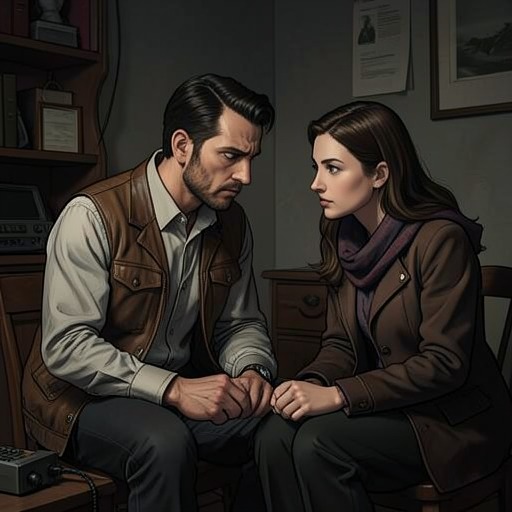
As their contact continues, Kawashima’s own account of his motives becomes less secure. While sitting with Chiaki as they drink coffee, he hears an internal voice challenge his explanation that he is acting because she may have read his notes or because he fears harming the baby. The voice directs his attention instead to his fear of losing Chiaki and to the fact that his desire to remain close to her is bound up with violent imagery. This does not establish a straightforward change of heart. It shows that his stated reasons for pursuing her do not fully account for the attachment developing alongside his wish to hurt her.
Chiaki, for her part, does not approach him as someone simply seeking protection. Her visible scars and previous injuries lead Kawashima to recognize her as someone with a persistent drive toward self-destruction, and he wonders whether she wants him to kill her. She asks whether there is something he wants to do to her, while he tells her she need not be afraid. His interpretation of her invitation turns care into another source of alarm: he imagines himself becoming an instrument of her death, rather than a person able to offer uncomplicated help. Her trust and his suspicion therefore intensify one another without resolving the danger.
The relationship remains unresolved in the available evidence. Kawashima’s past helps him recognize a frightened childlike dependence in Chiaki, and his memory of powerlessness shapes his effort not to abandon her. But the same man who intervenes still considers killing her, and later identifies his attachment as entangled with the wish to stab her. Chiaki’s recognition of him as her hospital escort gives her a reason to trust; it does not give her access to his concealed conflict. Their connection is significant precisely because protection, projection, and threat coexist, with neither the caring act nor the violent intention fully cancelling the other.