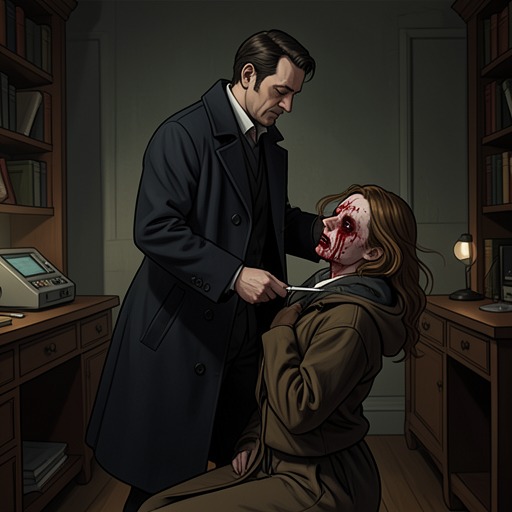
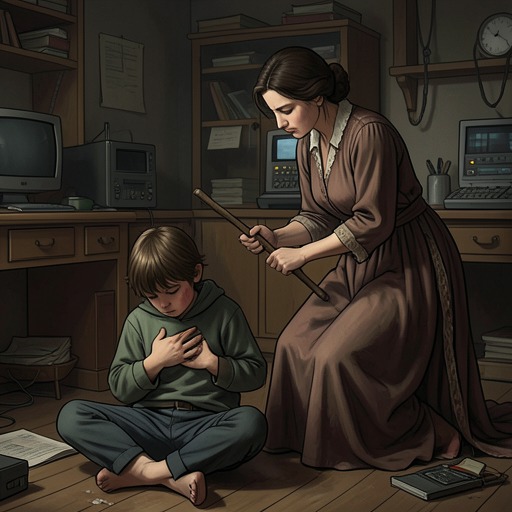
Kawashima Masayuki and his mother
PiercingKawashima Masayuki and his mother are bound by an abusive childhood relationship whose consequences persist long after he leaves her home. Her treatment of him teaches him to mentally distance himself from pain, while her preference for his younger brother leaves him with a lasting sense of exclusion. Years later, an apology and demand for forgiveness provoke the only occasion on which he hits her. The relationship’s influence also returns indirectly: in recurring memories, in the roads he draws after being placed in care, and in the protective inner voice that helps him endure later crises.
Childhood abuse and unequal treatment
Kawashima explains that his mother began hitting him after his father died, when he was four. He remembers little about his father beyond a vague impression of being taken for drives; his understanding of the man comes partly from his mother’s account of a financially foolish husband. At Kawashima’s high-school graduation, she would say that she had treated him as she did because he reminded her of his father. As a child, however, he did not know that explanation. He assumed the beatings meant he was a bad child, and learned to expect them even when there was no warning.
The distinction between how she treated him and how she treated his younger brother was especially painful. The three of them sometimes went to a children’s play area on the roof of a department store in Odawara, the nearest city of any size to their small town. When Kawashima was about five or six, his mother began locking him at home and taking only his brother. On one occasion, he climbed out and ran after them. His mother brought him back and tied him to the bathroom water pipes. He later recalled falling asleep on the tiled floor and waking after dark, with the narrow road outside the window in view. The memory concentrates both the practical fact of his confinement and the contrast between the family outing from which he was excluded and the brother who went in his place.
Survival, separation, and care
Kawashima describes mentally separating the child being struck from himself as a method he developed through repeated practice. He concentrated on the idea that the person experiencing the violence was not really him; the more his mother hit him, the harder he focused on that distance. At the same time, he feared that withdrawing too far might prevent him from finding his way back. He therefore imagined himself waiting nearby, able to return when the circumstances allowed. The account presents this not as a cure for the abuse but as a survival strategy formed under conditions in which he could neither stop nor escape it.
The strategy began in childhood and later returned involuntarily in moments of distress. At a convenience store, an ordinary interaction triggers the sensation that he has separated from his body; he connects it to the distancing he had practiced as a boy. In another recollection, he remembers being locked outside on a cold night after his mother had caused pain to his hand. He recalls that fear, pain, and the sense of losing control came together before he again felt himself separate from them. These later experiences show the persistence of the childhood response, without making it the inevitable result of his past.
A middle-school teacher eventually arranged for Kawashima to be placed in a home for abused children. He remained there for a little over two years before going to live with his paternal grandmother. He says that he began drawing after entering the Home, and that from the outset his pictures repeatedly showed roads at night. The image recalls the road he saw through the bathroom window after being left alone in the dark; drawing turns a specific childhood memory into a recurring form through which the experience can be revisited.
The graduation confrontation and lasting estrangement
Kawashima’s mother apologized to him at his high-school graduation. He regarded the apology as self-serving, particularly because she followed it by asking whether he forgave her. He initially nodded without thinking. Then, as he recounts it, something in him snapped: he slapped her hard. He identifies this as the only time he ever hit her. The moment does not resolve their relationship; it marks a rupture in which a gesture of forgiveness, apparently offered before he had chosen it, gives way to an act of anger.
The separation remains consequential in adulthood. When Kawashima marries Yoko, they forgo a wedding ceremony. Yoko tells her parents that the decision reflects values she and her fiancé share, but the account reveals another consideration: she knows Kawashima has not forgiven his mother and younger brother and does not want to place him in an awkward position. Her choice shows that the family estrangement continues to shape decisions beyond the childhood home. When Kawashima tells her about his abuse, she takes and squeezes his hand; the scene offers a contrasting experience of being heard and met with care, without suggesting that this undoes the earlier injury.
Memory, voice, and the meaning of the past
The past returns not only through conscious recollection but through images that surface in the present. At the Keio Plaza Hotel, the sight of families photographing themselves recalls a scene from Kawashima’s childhood: his mother poses his younger brother for a picture and beckons Kawashima to join them. He shakes his head. In the remembered image, her expression changes, and she looks at him without acknowledging him as a person. The recollection makes visible the emotional meaning of the unequal treatment he had described: exclusion is not simply an absence from an outing, but an experience of being disregarded within the family itself.
The relationship also helps explain the protective voice Kawashima remembers during a later crisis. He recognizes it as a voice that had protected him in childhood, returning with rules for enduring an attack: not to apologize in the hope of stopping it, to wait for it to end, and then to meet the other person’s eyes. These instructions carry the logic of a child who had little power to change what was happening and had to find a way to preserve a sense of self. His mother’s abuse thus remains present in his adult life not as a single closed episode but through learned defenses, remembered scenes, and the strained family ties that continue to affect him. The care Yoko offers provides a significant contrast, while the recurrence of old fear shows that present security does not simply erase the past.