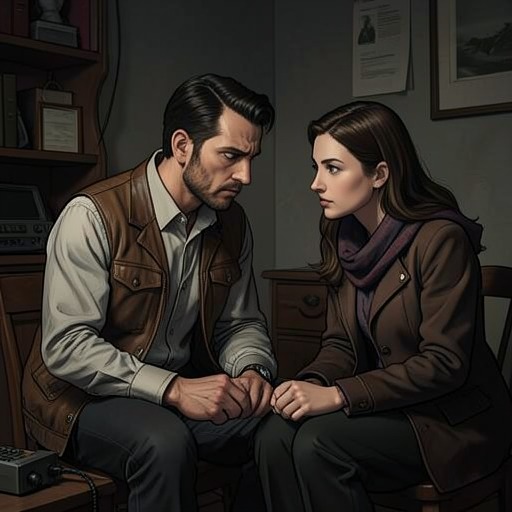
Kawashima Masayuki–Sanada Chiaki
PiercingKawashima Masayuki–Sanada Chiaki is a relationship formed through transactional intimacy and transformed by a violent confrontation that makes tenderness and danger impossible to separate. Sanada Chiaki secretly drugs Kawashima Masayuki, attacks him when he is incapacitated, and later sees him as neither a rescuing ideal nor simply another man who changes without warning. Their connection persists in contradiction: she remembers feeling unusually happy beside him, yet expects him to leave and tries to prepare herself for the loneliness that would follow.
From Transaction to Uneasy Intimacy
Their connection begins within a commercial encounter, but Sanada Chiaki’s thoughts and actions move beyond the roles of customer and sex worker. During a meal, she disguises crushed Halcion tablets in a spice bottle and mixes about two tablets into Kawashima Masayuki’s soup. She uses extra curry powder to mask the bitterness. Her caution is informed by a previous occasion when she put Halcion in Kazuki’s food, and by her concern that the drug might temporarily increase a man’s sexual interest before making him unconscious. She does not want that possibility to revive painful memories.
Kawashima Masayuki eats the soup and two rolls without suspecting anything. He is hungry and has not eaten since buying an overnight bag at Haneda Airport. The meal warms him and eases some of his tension, while Sanada Chiaki watches him from the kitchen. He notices that her manner has changed but cannot tell why; he wonders whether she is frightened or might try to entice him again. The discrepancy between his uncertainty and her concealed plan establishes how differently they experience the same quiet domestic moment.
The relationship also carries traces of a more tender encounter. Sanada Chiaki later recalls walking arm in arm with Kawashima Masayuki and riding in a taxi surrounded by the lights of high-rise buildings. She remembers those moments as unusually full of beautiful feeling. That recollection does not cancel the circumstances of the confrontation, but it explains why she cannot reduce him to a stranger or regard their intimacy as meaningless.
Violence, Recognition, and Fear
As Kawashima Masayuki begins to recover from the drug, Sanada Chiaki’s defensive rage becomes the means by which she confronts what she experiences as hostility. When he calls for Yoko, she strikes him with a can opener. She continues attacking as he tries to protect himself and move away. Her violence is not presented as a settled judgment about him: when her strength gives out, she drops the weapon and sobs, suddenly unsure whether he is angry, whether he will leave, and whether she ought to apologize and beg him to stay.
For Kawashima Masayuki, the assault brings him sharply out of his drugged state. The pain and shock break through his dulled awareness, and a remembered voice returns with instructions he learned to endure abuse as a child: not to apologize, to wait until an attack is over, and then to look at the attacker. He recognizes the voice as one that had protected him throughout childhood. It helps him read Sanada Chiaki’s sobbing not as another immediate threat but as evidence that she is frightened and no longer holding the weapon. He lowers his guard. The same episode therefore brings each of them to a different kind of exposure: she is spent and afraid of abandonment, while he is injured but newly alert to her fear.
Sanada Chiaki’s later assessment preserves both sides of what happened. She considers Kawashima Masayuki unlike the other men she has known: when he says he will do something, he follows through, and she does not attribute that consistency simply to Halcion. This judgment is not a claim that he is harmless. She has just experienced him binding her and threatening further violence, and she struggles to reach the door while restrained. Her recognition of his consistency gives the relationship a particular meaning, but does not make it safe.
The Same Man, Not Two Men
After she frees herself, Sanada Chiaki does not call the police. She expects that dealing with the authorities could keep her at the station for hours or even days. Instead, she searches Kawashima Masayuki’s overnight bag and reads his notebook from beginning to end. She finds another tape-wrapped package containing a dangerous-looking knife, and cannot decide whether the notebook describes an actual crime or the fantasies of a disturbed mind. Whatever its status, it changes her understanding of the man beside her: he is not a distant admirer who has come to rescue her, and she sees that he may regard her as a body to rent.
Yet she does not settle on an uncomplicated account of him as a villain. She remembers that the man who whispered to her while she bit his finger, the man who waited for her outside a hospital in the cold, and the man who restrained her are all Kawashima Masayuki. Their actions and expressions do not, in her view, make him seem like several different people. This matters because she has experienced other men as turning almost instantaneously from an ideal to their worst selves; that reversal has left her disillusioned, and sex has sometimes helped her counter the resulting despair. Kawashima Masayuki is not like her father, she thinks, but he is not like the other men she names, including Kazuki and Atsushi, either.
The distinction is not absolution. Sanada Chiaki knows that Kawashima Masayuki has behaved tenderly and violently, and she has evidence of both. What is unusual to her is that she can hold those actions together as the conduct of one person rather than treating violence as proof that the tenderness belonged to someone else. Her recognition makes their bond more complex, not less precarious: she can remember their closeness without mistaking it for protection.
Separation, Chosen Pain, and an Unsettled Ending
While Kawashima Masayuki remains unconscious, Sanada Chiaki imagines that he will return to the woman waiting for him. She believes that threats or another blow might not stop him if he has decided to go home. Her practical expectation that he will leave sits beside the intimacy she remembers, making anticipated separation part of the relationship before either of them has resolved what it means.
She responds to that anticipated loneliness by deciding to pierce her other nipple. Sanada Chiaki believes that choosing pain, accepting it, and leaving something beautiful on her body can make her stronger. She wants that strength because she expects to feel lonely when Kawashima Masayuki leaves. The piercing is thus an act she chooses for herself, not a demand made by him; it turns her attention toward what she can decide while the future of their connection remains outside her control.
Kawashima Masayuki wakes and sees her preparing to pierce herself. He remembers the previous night and thinks that he did not stab her; he also decides he will discard the knife and ice pick but keep the notebook, whose contents still feel exciting and mysterious to him. Sanada Chiaki meets his gaze briefly, then continues. When he asks what she is doing, she answers that she is piercing herself. The restrained exchange leaves them together in the same room, each attending to a different unresolved fact: his fixation on the notebook and her effort to make a deliberate choice of pain. Their relationship ends this episode neither repaired nor simply broken, but marked by recognition, distrust, remembered beauty, and the expectation of departure.