Kawashima Masayuki and Yoko
PiercingKawashima Masayuki and Yoko’s relationship develops from a chance meeting into a marriage shaped by mutual acceptance and the gradual sharing of painful personal histories. Yoko’s attentiveness does not erase Kawashima’s childhood trauma or his later anxiety, but it changes how he can face them: she listens without dismissing his fears or reducing him to them, and her presence becomes a source of support through major decisions and renewed distress.
Meeting and Courtship
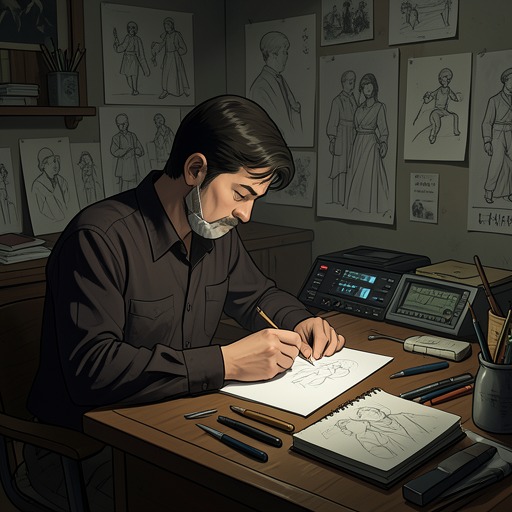
Kawashima and Yoko are the same age and meet in early summer at an art gallery in Ginza, where an exhibition of work by Nicolas de Staël has drawn no other visitors. Kawashima carries a sketchbook; Yoko speaks first, asking whether he is an artist. Their meeting begins with her curiosity about his drawing, a practice that is already central to his life even though he is then employed by a graphic design firm.
They begin seeing each other about once a week, going to dinner, museums, or films. At the time, Kawashima’s drawings are devoted to narrow roads in moonlight. Near the end of summer, he draws Yoko’s face from memory and gives her the sketch on their next date. She then invites him to her apartment for the first time. The drawing marks a small change in his work and in their intimacy: he has made her, rather than the lonely roads that usually occupy him, the subject of his attention.
At the apartment, Yoko tells him that about a year earlier she had taken sleeping pills after a relationship with an older colleague ended, and asks how he regards her because of it. Kawashima responds that he does not consider it a major issue, and the narration makes clear that he means what he says. His answer establishes an early pattern between them: difficult disclosures are met not with condemnation but with an effort to understand the person speaking.
Trust and Disclosure
Not long after beginning their courtship, they move in together. About six months into sharing a home, Kawashima wakes in the middle of a freezing winter night in a state of terror and leaves alone for a walk. He returns roughly two hours later and explains that he has experienced night terrors since childhood. When he was young, he would wake in panic, sometimes scream and run around the room, and afterwards remember only the fear and the loss of recognition of himself and the people around him. The episode is less severe in adulthood, but still unsettles him enough that his instinct is to remove himself from other people until he has calmed down.
Yoko asks why he went out alone instead of letting her hold him. Kawashima cannot offer a more intimate solution: he has long believed it safer to be by himself when he loses control, where he can walk and breathe until the episode passes. Her question nevertheless exposes the difference between his habitual retreat and the kind of closeness she is offering. He tells her about the night terrors, then about the childhood circumstances he has not shared with anyone before.
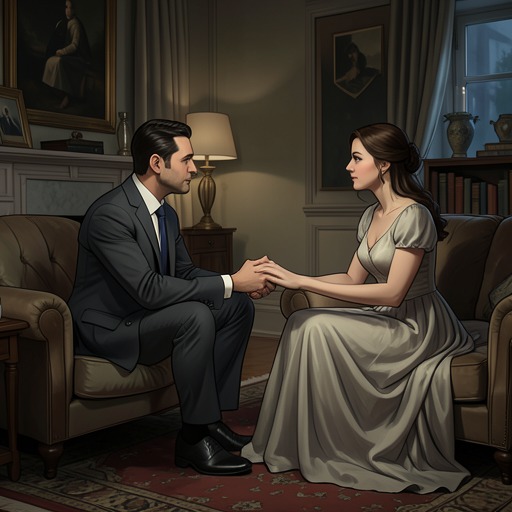
Kawashima recounts being abused by his mother, feeling singled out in comparison with his younger brother, and being placed in a home for abused children after a middle-school teacher intervenes. He says that he began drawing after entering the Home, and that his first pictures were already of narrow roads at night. Yoko takes his hand after he tells her. In the relationship, this gesture follows a disclosure that connects his present artistic preoccupation with the isolation and fear of his childhood; her response offers physical reassurance without turning the revelation into a demand for an immediate resolution.
Marriage and Shared Life
Kawashima and Yoko marry a year and eight months after meeting. Yoko tells her parents that she and her fiancé do not want a wedding ceremony because of their shared values. The account clarifies that this explanation conceals a more personal consideration: she knows Kawashima has not forgiven his mother and younger brother and does not want the occasion to put him in an awkward position. Her choice makes the wedding arrangements an instance of practical consideration for his history, rather than simply an expression of a stated principle.
Kawashima has told Yoko that, after spending a little over two years in the Home, he lived with his paternal grandmother. At his high-school graduation, his mother apologized, then asked him to forgive her. He initially nodded, but something in him gave way and he slapped her; he identifies this as the only time he ever hit her. The marriage takes shape with Yoko aware that the reconciliation remains unresolved. Her decision not to insist on a ceremony accommodates that estrangement instead of requiring Kawashima to perform a family harmony he does not feel.
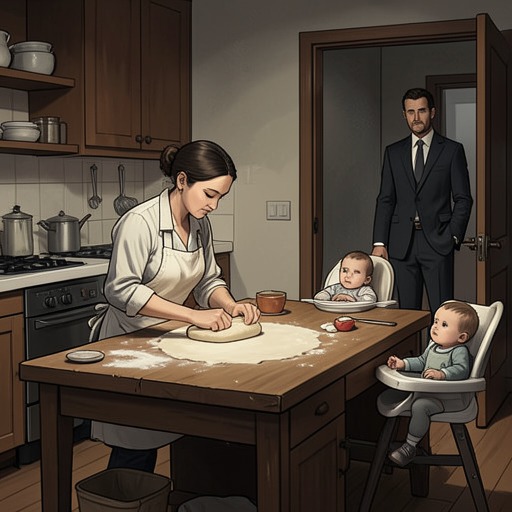
He supports Yoko when she decides to quit her job and does not object when she says she wants a baby. After their marriage, colleagues remark that he seems more cheerful, though he is unsure whether he has changed. He does recognize that since meeting Yoko, and especially since they decide to marry at her suggestion, his bouts of self-loathing have nearly disappeared. Even the birth of their child, Rie, and the first time he holds her do not bring back the old panic and terror.
Support Through Renewed Anxiety
The calm does not prove permanent. Ten nights before the present events, Kawashima’s old cycle of anxiety returns: he fears being alone, then becomes anxious when someone comes close, until solitude seems like the only way to escape the fear. He is also troubled by the possibility that he might stab the baby, while recognizing this as an imagined fear rather than a wish to harm her. The distinction matters to his understanding of himself, but it does not make the anxiety disappear.
A memory of watching Basic Instinct together during the last month of Yoko’s pregnancy helps him understand why his fear focuses on the baby rather than on Yoko. The film’s opening murder, committed with an ice pick, initially makes him want to leave; Yoko’s detached interest in the story helps him remain in the room. Looking back, he thinks that Yoko can talk with him, and that speaking with another person can reduce the power of his imagination. Her support is neither dismissive nor indulgent: she does not tell him simply to get over his fears, but neither does she treat him as helpless.
Yoko compares living with a chronic illness to learning to live in harmony with it, and reflects on how adults forget how vulnerable children are. She also admits that she did not understand the stress of having children until Rie was born, and considers that even Kawashima’s mother may have wondered what she was thinking at the time. Their exchanges allow compassion and painful history to coexist. Yoko’s understanding of childhood does not excuse the abuse Kawashima suffered, but it makes room for the complexity of parenthood without asking him to deny what happened to him.
Significance of the Relationship
Their relationship is significant not because Yoko cures Kawashima’s distress, but because it offers an alternative to the isolation he has treated as necessary for survival. He continues to experience night terrors and later anxiety, and his first response to terror can still be to leave. Yet the history of their marriage includes repeated acts of disclosure, listening, and accommodation: she receives his account of childhood abuse, adjusts the wedding plans around his estrangement, and helps him remain with a frightening film through conversation.
That support changes the conditions under which Kawashima confronts his fears. He identifies Yoko’s ability to talk with him, and her measured way of responding to his wounds, as reasons that his imagination has less power in her presence. The relationship therefore joins ordinary shared decisions—work, marriage, and having Rie—to the more difficult work of living with remembered harm. Its strength lies in a form of closeness that does not demand that fear vanish before either person can remain present.