16's trail through the House
Piranesi16's trail through the House makes an unseen arrival legible: a perfume lingering in a doorway gives way to yellow chalk at marked doors and precise written directions, allowing Piranesi to follow 16's route and begin a written exchange. The marks are practical navigational aids, but they also alter the terms of contact in a place where distance, dangerous passages, and The Other's warnings have kept people apart. Eventually, finding 16 becomes bound up with the urgent task of reaching her before The Other can.
An Arrival Detected by Its Traces
Piranesi first recognizes that someone has crossed his path through scent. While travelling from the Third Northern Hall toward the Sixteenth Vestibule, he passes out of the First Northern Hall and into the First Vestibule, takes a few steps, and stops: a strong perfume has caught his attention. When he retraces his steps and breathes in at the doorway, he identifies a mixture of lemons, geranium leaves, hyacinths, and narcissi. The scent is concentrated around one spot, as if its wearer had paused there to look out across the Long Vista of Receding Halls.
He follows the trace south along the wall beneath a Statue of a Minotaur, then loses it between the doorway to the First Western Hall and the doorway to the corridor leading to the First South-Western Hall. The route is partial, but it is enough to establish that someone has moved through this particular network of doorways. Piranesi rules out The Other, whose perfume he knows, and the Prophet, whose distinct scent he remembers. He concludes that the wearer is new—and then recognizes the presence as 16.
That recognition does not bring relief. Piranesi's heart beats faster as he looks around the darkened vestibule, where shadows cast by the Minotaurs are broken by splinters of golden light. 16 does not emerge from hiding, and Piranesi can only infer that the visitor may have passed through less than an hour earlier. The encounter begins as an absence: 16 is present in the House, but remains unseen.
The Route Made Legible
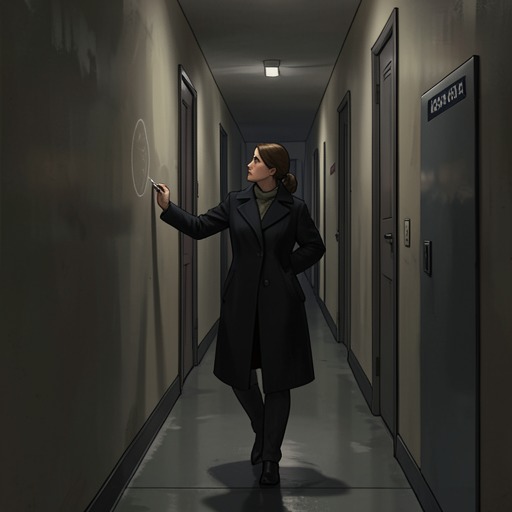
Later, in the Sixth North-Western Hall, Piranesi is feeding the rooks scraps of fish. The birds descend from their high perches, wheel and flap around him, and two land on his shoulders; one pecks his ear. Distracted by them, he initially misses a bright yellow slash of chalk on a nearby door. Its color provokes an old memory: he once marked doors and floors because he feared losing his way, but he has not done so for years. He also knows the mark cannot be his, since he has never possessed yellow chalk.
More marks appear in white on the pavement beside the door, and Piranesi discovers words. They are not The Other's writing; he realizes that 16 has left directions, and that written communication is a possibility he had not considered. The Other's warnings had focused on speaking to or listening to 16, so Piranesi wonders whether those cautions concern the danger of 16's voice rather than the written word. He tests the possibility instead of accepting that all contact must be unsafe: the writing is directions, and he finds no immediate sign that reading them has made him mad or inclined him toward self-destruction.
The instructions lead from the Sixth North-Western Hall to the First Vestibule. Though the route meanders, 16's directions are clear, precise, and efficient; the letters themselves are square, upright, and pleasing. Piranesi uses them to trace 16's path back toward the First Vestibule. At each doorway, yellow chalk marks the way, and 16 has repeated the directions beneath each doorframe so that they remain available if a mark is destroyed by a tide or other mishap. Their placement below Piranesi's eye level lets him estimate that 16 is twelve to fifteen centimetres shorter than he is. In a House subject to water, weather, and disrupted routes, the duplicate instructions show a practical effort to make the trail survive damage.
From Following to Answering
After following the directions, Piranesi goes to the Second Northern Hall to fetch blue chalk. He returns to the Sixth North-Western Hall, apparently the furthest point 16 has reached, and writes beneath 16's message. This gesture converts the trail from a one-way record of movement into a possible exchange. The surviving evidence presents the beginning of that reply rather than a completed conversation, but the change is decisive: Piranesi no longer treats 16 only as a figure whose presence must be feared or inferred. He answers the marks with marks of his own.
The chalk system also differs from the House's ordinary means of orientation. Piranesi's old habit of marking doors arose from fear of losing his way; 16's signs are a deliberate, repeated set of directions, laid out so that others can retrace a route. Their methodical placement makes movement readable across distance. A doorframe becomes both a waypoint and a writing surface, and navigation acquires a social use: one person can leave knowledge for another without appearing in person.
Contact Under Threat
The written trail has to be read against Piranesi's earlier experience of reaching a distant hall. When The Other asks why the journey to the One-Hundred-and-Ninety-Second Western Hall is a problem, Piranesi explains that the path through the Seventy-Eighth Vestibule is often flooded. Although it is dry at that moment, tides scatter debris from the Lower Halls, including jagged pieces of broken marble that can cut bare feet and risk infection. He can make the passage, but it will be laborious and slow. The Other points out that Piranesi has crossed the area before; Piranesi replies that what has changed is that he no longer has shoes. The episode makes clear that following a route is never simply a matter of knowing where it goes: the body's condition, the tides, and the material state of the passage determine whether it can safely be travelled.
That vulnerability matters when Piranesi learns that 16 is in the House. He has been told that 16 is associated with destruction and madness, and the lovely perfume initially seems at odds with that warning. He corrects his own assumption: a pleasing appearance and friendly manners would not disclose ill intentions. The later discovery of the directions therefore brings both opportunity and suspicion. The words may offer a way to communicate, but they do not cancel the danger Piranesi has been taught to expect.
The threat becomes more immediate when Piranesi makes finding 16 his most important task. He believes The Other has set a trap, possibly by promising to meet 16 at a particular hall and time and to reveal how she can find Matthew Rose Sorensen. Although looking for The Other seems the most reliable way to locate 16, Piranesi would rather avoid him. He recalls the Prophet's warning that The Other will become more dangerous as 16 draws closer, and hopes to find her before she reaches The Other. The quiet trail of chalk thus belongs to a larger struggle over who can reach whom, who controls the information that guides them, and whether contact will lead to rescue or danger.
Significance of the Trail
The trail gives the House a second kind of geography. Its halls and doorways already form a vast physical network, but 16's repeated directions make part of that network readable and shareable. The yellow marks register passage; the written instructions preserve route knowledge against tides and mishaps; Piranesi's blue chalk begins an answer. What had seemed to him a warning left by a dangerous stranger becomes, at least provisionally, a means of communication.
That change remains precarious. The House's routes can be hazardous, the signs can be damaged, and Piranesi's fear of 16 is reinforced by The Other's warnings. Nor does the trail itself settle the question of 16's intentions. Instead, it sharpens the stakes: a person who can leave a careful route through the House may be found, but the same route can draw her toward an encounter Piranesi believes has been arranged as a trap. The marks matter because they make connection possible without making it safe.