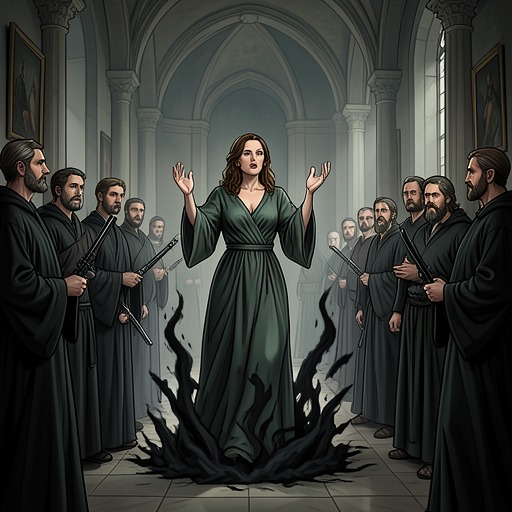
Acadian
PleasureAcadian is a K’ypruti torturer, political conspirator, and concealed power within the Senate whose identity is difficult to separate from the roles she wears. Her campaign against the royal household and Sanctuary joins institutional ambition to private vengeance: she works through Nicoya’s attempted coup and hired assassins, while arranging suffering for those she holds responsible for her daughter’s death. The danger she poses comes not only from violence, but from the uncertainty over which respected public figure may be Acadian in disguise.
Identity and Concealed Position
Acadian is renowned for her skill as a torturer, a reputation established during the wars. Yet her face remains unknown to the people who have reason to seek her. Trace, whom she held captive for nearly a year, never saw it; later, Guin could find no one who knew what she looked like. Nicoya disclosed that her mother was a member of the Senate, revealing that Acadian was not merely an enemy operating outside the political order. She occupied a position within it, hidden behind an alternate identity and able to work against the twins from close to the institutions they governed.
That concealment makes recognition a problem in its own right. When Acadian confronts Daenaira in the Dreamscape, she invokes the public identities that might hide her: Senator Helene, a woman known for charity, support for the Chancellors, regular Temple attendance, and accepting penance after confession; Angelique, who resents Malaya’s authority; and Malaya herself, whose appearance Acadian assumes while taunting Daenaira. The scene makes her capacity to pass between faces part of the threat. Rather than confirming one stable public identity, Acadian insists that her real persona will remain unknowable.
Torture and the Attack on Trace
Acadian’s violence is deliberate rather than simply destructive. During the invasion of the twins’ household in the civil war, Rika believed Trace had died. Acadian had actually taken him prisoner. She healed his wounds so that he would be physically restored before she began torturing him, keeping him captive and inflicting suffering for the better part of a year. The scars Trace still bears testify to the prolonged abuse; his survival does not erase its effects.
Guin’s rescue of Trace became one of the best and worst moments of his life. Guin knew Trace’s intelligence and strength, but on finding him, he thought only of a damaged body and feared there was little of his friend left. Trace did recover, a recovery presented as evidence of his will and character. Acadian, however, had withheld the one detail that might have helped expose her: her face. Her treatment of Trace thus served both cruelty and concealment, leaving a survivor marked by the ordeal while preserving the torturer’s anonymity.
Nicoya’s Coup and Acadian’s Political Campaign
Acadian’s daughter Nicoya attempted to seize control of Sanctuary, the religious house and education center run by Magnus. In the weeks before the later plot developments, Nicoya came close to placing herself on its religious throne. She had killed priests, turned others to her cause, victimized students, and contributed to the disappearance of Sagan. Sanctuary and religious law operated independently of the royal household and common law, so control of the religious institution offered a route to power separate from control of the state. Acadian’s larger ambition depended on the possibility of controlling both.
The coup failed, and Acadian’s network inside Sanctuary was mostly destroyed or driven out. The loss was especially bitter because she had been close to securing power for Nicoya after years of plotting and manipulation. But Nicoya’s actions were part of a broader campaign against the twins’ rule. From her hidden position in the Senate, Acadian worked to weaken them through legal deception and attempts to assassinate people around them, leaving the rulers isolated and vulnerable. Karri’s attempts against Magnus and Malaya, as well as two attacks on Trace, were connected to this effort.
Nicoya also set an assassination legacy in motion against Trace’s family. She arranged for assassins to target Trace’s wife, Ashla, and baby, with the hunt scheduled to begin two months after the child’s birth. Guin understood that a hired clan would not simply abandon such a contract. Because few clans would accept the killing of a child, he recognized that the choice of killers pointed toward someone with inside knowledge of the assassin trade. The clans had been dissolved and the remaining killers operated as illegal guilds; the threat was therefore both organized and difficult to pursue. Acadian’s political campaign extended beyond direct attacks on rulers to the future safety of their allies’ families.
Revenge Against Daenaira
Nicoya’s death changes Acadian’s campaign from political calculation into explicit revenge. Daenaira killed Nicoya, and Acadian’s response to news of Daenaira’s pregnancy is to plan suffering in return. She sees the unborn child as an opportunity to make the loss reciprocal, considering when an attack would cause the greatest pain. Her aim, as she presents it, is not simply to kill Daenaira: she wants her to suffer, and she intends to make Magnus pay through the danger to his wife.
Acadian carries out the threat in the Dreamscape, where she binds Daenaira with its energies. The restraint prevents Daenaira from fighting or using her third power, the power of a berserker fighter. Acadian tells her that she will not die unless Magnus makes a mistake while freeing her; more cruelly, she says that the rescue itself will cause him to kill the child. She reserves the choice of whether Daenaira can tell him this, making knowledge another instrument of control. The trap turns Magnus’s effort to save his wife into the means by which Acadian hopes to destroy him emotionally.
Anonymity as a Continuing Threat
Acadian’s strength in these episodes lies in the combination of public respectability, political access, and concealed violence. She can be associated with charity and religious observance while also being notorious for torture; she can pursue power through an attempted takeover of Sanctuary and through attacks carried out by others. The gap between those appearances is not incidental. It lets her remain difficult to identify even as the consequences of her plans accumulate around Sagan, Trace, Malaya, Magnus, and Daenaira.
Her threat also exposes how separate forms of authority can be exploited against one another. Sanctuary’s independence from the royal household gives Nicoya a distinct route to power, while Acadian’s Senate position gives her a place inside the political structure she seeks to destabilize. When Malaya’s arranged-marriage decision becomes imminent, Acadian claims that she has secured the outcome and expects the resulting household to begin collapsing. The evidence leaves that plan and Acadian’s hidden identity unresolved, preserving the central tension around her: the danger is visible, but the face behind it may not be.