Valera
PleasureValera is a human natural-born Witch whose history joins the dangers of misused magic to the possibility of recovery. Once drawn into necromancy and afraid that magic had permanently stained her, she learns to use her powers with moral care. Her arrival among the Nightwalkers makes that recovery more than a private achievement: when she heals the dying Guin, her magic offers evidence against the assumption that all magic-users must be killed and gives her a public purpose as an advocate for others who might be saved.
Identity and Background
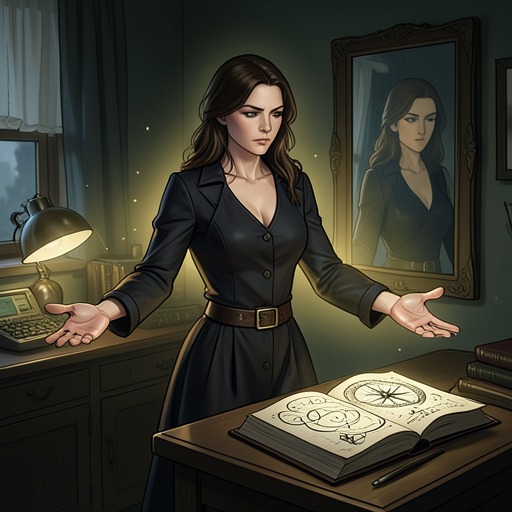
Valera lives in a secluded cabin in central Alaska, where winter darkness, severe cold, wind, and snow are familiar parts of her surroundings. Her solitary life is interrupted when Morrigan and another attacker threaten her in the cabin. Valera remains controlled in the face of Morrigan’s threat to cut her throat, then gathers her strength, speaks an incantation, and sends blue fire into her hands. She strikes both men with the magical projectiles. Their deaths devastate her, not because she doubts that they posed a danger, but because using magic against anyone brings back the fear of what magic once did to her.
Valera’s power is innate. Penchant identifies her as a natural-born Witch: unlike a necromancer, who can be made, a Witch is born with magic. That distinction does not make her immune to corruption. A Witch can become a necromancer if she lacks guidance or uses magic without care. Valera’s grandmother recognized the family’s gift and guided her before Valera fell in with necromancers, whom she mistakenly believed to be like herself. Her story therefore begins not with a simple opposition between magical and nonmagical people, but with a difference between inherited capacity, harmful influence, and the choices that shape how power is used.
Magic, Harm, and Recovery
Valera develops a moral test for magic based on intent. Healing and protection are not automatically good simply because they are beneficial kinds of spells: healing a serial killer so he can continue killing, for example, would make the use of magic harmful. Likewise, a spell used to escape the consequences of a crime would serve a foul purpose. In her understanding, the intent behind a spell affects the person who casts it; repeated misuse can deepen a stain until darkness overtakes the person they were.
That understanding comes from experience. Valera spent four months practicing bad magic unintentionally, then five years trying to cleanse its stain from her soul. The process left her wary of harming others or herself through a mistake. When the attackers invade the safety of her cabin, she uses magic against them for the first time in nine years. She expects the familiar blackness of magical backlash and is afraid of what their deaths might mean for her. Instead, no such corruption comes. She understands the outcome as confirmation that she did not place evil into her own sphere: the attackers invaded the place she was protecting, and her magic answered that threat. The distinction does not make the deaths easy for her, but it prevents the use of force from becoming proof that she has returned to necromancy.
Valera’s powers also include an unusual connection to animals. After a spring trip to town, a crowd of stray cats began following her; it was then that she first heard animal thoughts. She comes to understand that cats pass down their accumulated wisdom, though they share it sporadically and on their own terms. The cats make their home with her, and their guidance helps her recognize that not all magic is bad. Their role in her understanding complements her grandmother’s earlier instruction: moral discernment comes through both personal history and relationships that teach her how to interpret what she can do.
Relationship with Sagan
Sagan is Valera’s beloved and the person who asks her to enter a world she has long avoided. After ten years without being near many people, she is excited by the prospect of meeting Vampires and Demons and learning who they are, but that curiosity gives way to panic about how they will judge her. Sagan does not promise that everyone will trust her. He acknowledges that suspicion is their right, while insisting that her recovery from necromancy is valuable and that she can help persuade others that people who made a mistake may be worth saving.
Valera accepts that task on the condition that Sagan stays with her. He promises to share the rest of her life and admits that nine days would never have been enough. Their exchange turns her movement toward the wider world into a shared commitment: she will face the people who may fear or distrust her, and he will accompany her rather than treating the undertaking as a mission from which he can depart. At the Senate crisis, Sagan arrives no longer as a priest but as Ajai Sagan, bringing Valera with him. His public choice to leave the priesthood makes their relationship part of the practical future she is building, not merely a private refuge from her past.
Healing Guin
At the Senate, Guin is near death from a blade wound, and Malaya fears that if he dies, Drenna will take him to the Beyond. Valera offers to help, but the proposed healing confronts a deep distrust: Malaya fears that magic might stain Guin and prevent the gods from carrying him safely into the afterlife. Valera does not dismiss the risk. She makes her case through a demonstration, cutting her own hand and healing it in front of Malaya and the others. Malaya searches for the familiar stench associated with dangerous magic; when it is absent, she recognizes that Valera’s magic is different and asks her to proceed.
The cure requires close coordination. Valera tells Magnus to wait until she repeats her phrase before removing the blade, and specifies that it must come out in one clean pull, straight upward. As she chants, Magnus follows her instructions. Sagan kneels behind Valera and supports her with a touch to her back; through his telepathy, he understands her trembling as the combined force of effort and fear. Valera is afraid both of failing Guin and of failing Sagan, but the support steadies her as she continues.
After sixty seconds of spellcasting, Guin takes a visible breath. A minute later he opens his eyes and speaks to Malaya. Valera tells Malaya that she can kiss him without interrupting the healing, though she cautions that knocking Valera’s hands away would hurt him. She continues chanting, and within another sixty seconds Guin is completely healed. The sequence makes her magic’s operation concrete: it demands concentration, timing, and another person’s careful assistance, but it restores a life that was slipping away. Guin’s recovery also turns Malaya’s fear into trust in the immediate crisis.
Change and Narrative Significance
The healing brings Valera into close contact with the people whose suspicion she feared. Its importance extends beyond the survival of Guin. Magnus recognizes that Valera’s existence demonstrates that good magic can exist and that Nightwalkers can no longer simply assume they should kill every magic-user. Because Valera recovered from her accidental involvement in black magic, her history also supports the possibility that natural Witches who became necromancers can be rescued from the sickness that overtook them.
Valera and Sagan’s next task is to visit the different Nightwalker courts so that she can prove what she is to them. She wants those communities to learn that good Witches exist and that people who have become entangled in necromancy through ignorance or error may be saved. Her trajectory thus moves from an isolated cabin, where she fears the moral consequences of using magic, to a public encounter in which she risks her powers to preserve Guin’s life. Recovery does not erase her fear, her grief over the deaths caused by the cabin attack, or the years spent cleansing herself. Instead, those experiences become the grounds on which she can make a careful case for discernment: magic’s danger is real, but it does not make every practitioner irredeemable.