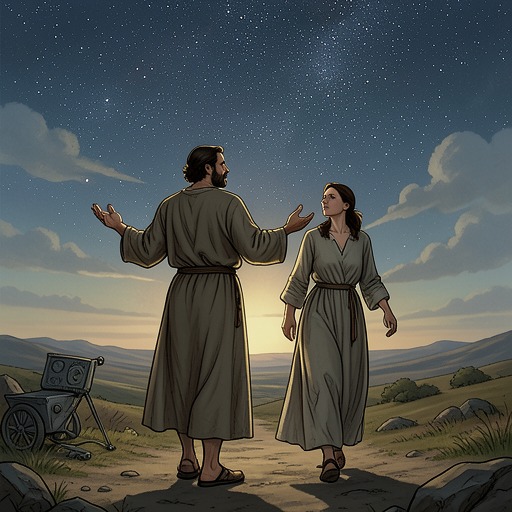
Drenna
PleasureDrenna is the goddess of Darkness, a divinity whose domain is also glossed as Heaven. She never appears directly in the scenes covered here, yet her name recurs at moments when characters face death, love, danger, and grief. Rather than supplying a single, settled doctrine, references to her show faith at work in several registers: as Sagan’s confidence in an afterlife, as a framework for interpreting fate, and as an urgent address when loss threatens to overwhelm the living.
Identity and Divine Domain
Drenna’s name is defined as Darkness and Heaven, making her the clearest divine presence in the evidence. The pairing is significant in the story’s religious imagination: darkness is not simply the absence of life, but the realm Sagan expects to enter after death. His faith gives that prospect a welcoming aspect even as the immediate prospect of torture makes it terrifying.
The religious setting is also concrete. Sagan is a priest connected to Sanctuary, described as the Shadowdwellers’ religious house, and his commitments are shaped by its laws and expectations. The evidence does not describe Drenna’s appearance, mythology, or rites of worship, so her characterization comes instead through what believers think, say, and do in her name.
Sagan’s Faith and the Afterlife
After Nicoya poisons Sagan and he is taken away by Acadian’s followers, he recognizes that he may die. He has lost a battle against enemies of Sanctuary and the royal house, and the poison burns through him after even a small scratch. He also knows what Acadian has done to a tortured friend. Against those immediate horrors, his faith offers a particular consolation: he believes Drenna will welcome him gently in the Beyond. The expectation does not erase the pain or guarantee that he will survive long enough to reach death; it gives him a destination he can face without surrendering entirely to fear.
Drenna’s significance to Sagan extends beyond this hope of welcome. When he explains to Magnus why he does not regard his relationship with Valera as sinful, he argues that fate and free will meet in the circumstances that brought her to him. Valera was there when she needed to be and became part of saving his life; Sagan understands their encounter as a moment of fate that he chose to accept through his own free will. His religious reasoning does not lead him back to obedience for its own sake. Instead, it allows him to interpret love as meaningful within a divine order, even when that love conflicts with religious law.
Love, Choice, and Religious Law
Sagan’s refusal to repent is bound to the cost of his choice. He knows that Sanctuary may strip him of his title and work, and that the Shadowdweller city could offer him a purpose without the priesthood. But he cannot imagine living near Valera without reaching out to her, or continuing to serve a culture that leaves no room for someone he considers precious. He tells her he has no regrets and would choose their time together again, despite the conflict it brings. His declaration makes the tension plain: the relationship has threatened his place in the religious institution, but surrendering it would mean denying an experience he regards as central to his life.
When Magnus asks how breaking religious law could not be a sin, Sagan answers through the distinction between fate and free will. Magnus identifies the specific breach: Sagan has been with a woman outside the relationship permitted with a priestly handmaiden. Sagan says yes, but, sensing that Magnus will not understand his reasoning, stops trying to explain. Drenna is not presented as issuing a judgment in this exchange. Her importance lies in the religious vocabulary through which Sagan makes his own judgment: he sees his choice not as a rejection of faith, but as the free acceptance of a fated encounter.
Prayer in Moments of Danger and Grief
Drenna’s name also appears when other characters face threats they cannot control. After Malaya foresees Acadian’s steel claws tearing Guin’s back while he is chained, the name comes to her like a curse. The vision does not offer comfort; its vividness makes the danger feel immediate and terrible. Elsewhere, when Guin is gone and Malaya fears he may have left for good, she turns toward prayer for his safe return. She kneels by a small fountain outside his room, on a woven pillow whose beaded fringe recalls hours spent with Rika and Guin. In that scene, prayer is inseparable from longing and from the concrete memories of the people she fears losing.
The name can also break into speech as an exclamation. During an intimate moment with Malaya, Guin invokes Drenna in frustration at his own restraint and desire. The invocation is not a developed statement of belief; it shows how divine language can become part of ordinary emotional speech, carrying intensity into a private exchange.
The sharpest contrast comes when Daenaira, grieving her miscarriage, refuses Malaya’s visit. She knows what happened to her child and fears that religious consolation about the afterlife would make the loss harder to bear. Her refusal establishes a limit to what faith-language can do: what might console one person can feel unbearable to another in the immediate aftermath of loss. Magnus, meanwhile, urges her not to blame herself for Nicoya’s death or the danger to the child, placing responsibility on Acadian and arguing that Daenaira’s action saved many lives. The scene makes room for competing responses to religious explanations without suggesting that grief can be settled by doctrine alone.
Narrative Significance
Drenna functions in these scenes less as a visible actor than as a point of reference through which characters confront uncertain outcomes. Sagan’s belief in welcome after death helps him face the possibility of torture; his appeal to fate and free will helps him defend a love that violates religious law. Malaya’s prayer expresses fear for Guin, while Daenaira’s reluctance to hear consolation shows that faith can become painful when it arrives before grief is ready for it.
The recurring name therefore gathers together the story’s unresolved tensions: divine order and personal choice, hope and bodily suffering, religious law and intimate love. Drenna’s presence is clearest not in a narrated intervention, but in the different ways the living invoke, interpret, or resist the meanings associated with her.