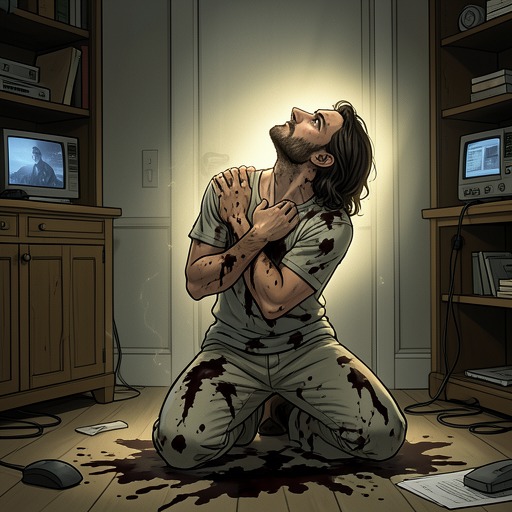
Sagan
PleasureSagan’s story turns on a change of vocation: the priest who devoted his long life to enforcing religious law comes to believe that love can make breaking that law right. Poisoned and abducted after Nicoya defeats him, he survives through Valera’s healing, falls in love with her, and ultimately gives up his priesthood so they can build a life together. His return as Ajai Sagan, no longer a priest, joins that personal choice to a wider challenge to Nightwalker hostility toward magic-users.
Identity and Vocation
Sagan is a Shadowdweller and a Nightwalker, one of five elite penance priests chosen by the gods. His work is to hunt those who sin and compel them to repent. The role has made him a forceful representative of Sanctuary, the Shadowdwellers’ religious house, and a protector of his people; his reputation rests on discipline, solitude, and the ability to administer penance and punishment with dark efficiency. He has served faithfully for more than two centuries, and his disappearance is serious enough that those who know his history fear that, like Trace before him, he may have been taken alive and made a captive’s plaything.
His vocation is more than a title. Sagan understands himself through its rules and through the nighttime world of blessed blackness that he calls home. That disciplined self-conception becomes especially visible when poison strips away his control: in the fever, he repeats basic facts about who he is and what he does, trying to hold himself in the present. Even the truth that he is dying offers comfort because it is something he can still know with certainty.
Poisoning, Abduction, and Awakening
Sagan’s ordeal begins in defeat. Nicoya, a K’ypruti enemy of Sanctuary and the royal house of the Chancellery, has poisoned her weapons; a small scratch is enough to make the poison burn through him. While he is incapacitated, Acadian’s lackeys carry him off to become Acadian’s newest toy. He believes he has lost the battle and that Nicoya will be free to continue her violence unchallenged. The scene makes his helplessness an inversion of his usual function: the priest who hunts and punishes wrongdoers is now a victim beyond his own power to protect.
When Sagan opens his eyes, he is in darkness, with a heavy pressure against his chest. His return to consciousness feels like coming out of Fade, the crossing between Realscape, Shadowscape, and Dreamscape, yet he feels out of place in both time and setting. He can tell that the pain, weakness, and death he expects are absent, but cannot remember why they should be there. The gap in his memory leaves instinct in command: hearing a woman nearby, he believes she means to harm him and those he cares about. The contrast between his restored body and his missing explanation establishes how completely the poisoning and rescue have unsettled him.
Faith, Law, and Free Will
Sagan’s deepest break with his former life becomes explicit in his conversation with Magnus. Magnus hears that Sagan regrets breaking a religious rule, but not what he did after crossing the line; Sagan answers, “There was no sin.” He does not deny that he broke the law. Instead, he argues that the act was meant to happen: fate placed Valera where she needed to be, in a position to help save his life, and his free will allowed him to accept what fate offered. He sees their meeting not as an excuse to evade responsibility but as a moment in which choice and destiny converge.
That argument marks a change in how Sagan serves his faith. The former priest who compelled others to repent now refuses to condemn his own love simply because it violates religious law. His choice is personal, but it is also a direct test of the distinction between a rule and the moral purpose it claims to uphold. When he later tells Valera, “Because I love you. Because I can’t let you go. Because I found a way that I could keep you and you can keep me if you want to,” he makes the decision mutual: he offers a shared future rather than demanding that she accept his sacrifice or his return.
Valera and a New Life
Valera is the human woman who heals Sagan and becomes his beloved. His attachment to her grows from the circumstances of his rescue into a deliberate rejection of separation. When he returns to her, she gives him only five minutes to explain himself before demanding that he show what he means through their intimacy. The scene is playful, but the stakes beneath it are serious: Sagan has come back because he cannot let her go, and he needs to tell her that he has found a way for them to remain together.
That way requires him to leave a position he has held for over two centuries. Valera worries that he may miss the priesthood or fail to find contentment without it, while resolving to help him make a life with her. Sagan’s new name, Ajai Sagan, and his declaration that he is no longer a priest make the change public and unmistakable. When Valera grieves the missing band of office that once marked his rank as M’jan, he tells her, “It is not an end, but a wonderful new beginning. With you.” Her reminder that the cats belong in that future too draws his agreement. The small exchange gives their decision an ordinary, domestic horizon beyond his dramatic renunciation.
Return and Narrative Significance
Sagan’s return to the Senate crisis shows what his new life does not mean: he has not ceased to care for others. Hearing of the tragedy, he runs every step from Sanctuary and arrives with Valera, whom Malaya initially distrusts and orders him to take away. Sagan reassures Malaya that Valera will not hurt them and that he has brought her to help. His faith in Valera is now practical as well as intimate: he entrusts her magic with the life of the queen’s dying mate, Guin.
As Valera works to heal Guin, Sagan uses his third power, telepathy, to sense her trembling fear that she will fail and her wish to make amends for the harm necromancers have done. He kneels behind her and touches her back; the support strengthens her, and her posture and voice grow firm. After Valera’s spell restores Guin’s breathing and then fully heals him, Sagan holds her as she leans back into his arms. The moment binds his personal commitment to a broader consequence: Valera’s good magic offers evidence against the assumption that all magic-users should be killed, and her recovery from black-magic corruption suggests that natural witches who become necromancers may be saved. Sagan’s altered place in the world is therefore not simply a departure from religious discipline. By standing beside Valera and bringing her before those who need her help, he helps make room for a different response to magic—one based on discernment and the possibility of restoration rather than automatic condemnation.