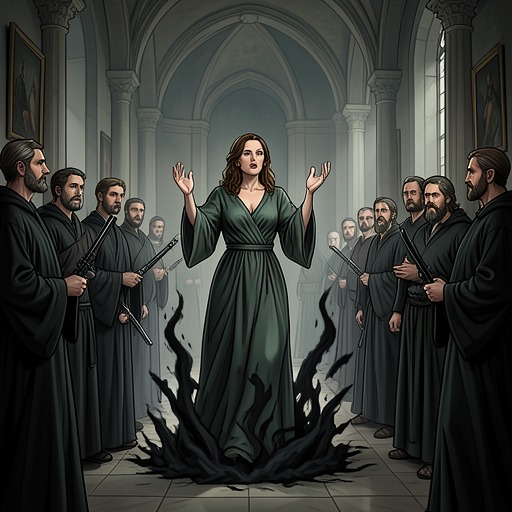
Daenaira
PleasureDaenaira is Magnus’s wife and handmaiden at Sanctuary, a former slave whose fierce independence and warrior’s strength stand beside her emerging religious role. Her pregnancy and her abduction into the Dreamscape bring those parts of her life into direct conflict: an enemy exploits the realm she helps guard, threatens the child she carries, and leaves her with a grief that changes her relationship to sleep and vulnerability.
Identity and Background
Daenaira is introduced as a fighter as well as Magnus’s handmaiden. When Sagan encounters her during the crisis involving Nicoya, he remembers running through Sanctuary’s halls with her, but not the events that followed. Later, when Sagan returns, Daenaira’s relief over his survival breaks through her usual reserve: she hurries to him and embraces him so forcefully that Magnus has to remind her to let him breathe. Her reaction conveys both the closeness formed under pressure and a temperament that does not make tenderness seem effortless.
Her toughness has a history. Daenaira spent almost half her life enslaved and subjected to abuse, including the whip; Magnus had to earn her automatic trust in physical touch. She dislikes being touched by strangers, a vulnerability made more complicated by her people’s tendency to regard a pregnant handmaiden as a blessing and crowd around her. Her independence is not a decorative trait: she resists being described as frail, even when Magnus worries that her young body may struggle with pregnancy.
The book presents her entry into Magnus’s life as an upheaval of his established identity. He had lived celibately for more than two centuries, concentrating on his work, before Daenaira came to him as a gift from Drenna and a difficult lesson in relinquishing his plans. She is described as a beautiful slave whom he frees and makes his reluctant handmaiden. Her position therefore joins intimate attachment to institutional duty: she becomes Magnus’s wife and religious partner while remaining a person whose own history makes trust a hard-won choice.
Marriage, Pregnancy, and Sanctuary
Daenaira’s relationship with Magnus is affectionate, teasing, and shaped by their different temperaments. When she approaches him with a sudden string of endearments, he immediately suspects that she wants something and tries to keep her from touching him until she explains herself. Her news that she is pregnant overturns his composure; he is so startled that she has to help him sit down. The scene turns their playful familiarity into a recognition of the stakes of a first blood child for a man who had never expected to have one.
Magnus’s joy is shadowed by concern. He fears that Daenaira is physically young for pregnancy, even while acknowledging that she is not weak. He also anticipates the unwanted attention she may receive from people eager to touch a pregnant handmaiden. Their closeness matters in this context: she has learned to trust his touch, but that trust cannot be assumed to extend to everyone around her.
At Sanctuary, Daenaira occupies a role connected to the protection of the Dreamscape. Priests and handmaidens guard against people who would abuse the realm, where a vulnerable dreamer can be subjected to nightmares that blur dream and reality. Magnus has protected the various planes for centuries, and Daenaira now shares that work. She is still a novice: entering the Dreamscape through a deliberate double Fade would bring memory and control, while entering through sleep leaves the dream more random and difficult to recall. In the attack that follows, she is asleep and dreaming, without the control that a trained, deliberate passage would provide.
Acadian’s Attack in the Dreamscape
Daenaira senses that she is being watched while dreaming, then faces an attacker who exploits uncertainty about identity. Acadian appears first as Acadian Helene, presenting the respectable public persona of a charitable senator who supports the Chancellors and attends Temple. She shifts into Angelique, then Malaya, before revealing herself as Acadian. The transformations make Daenaira’s confusion part of the assault: she cannot know which face, if any, is real, and later tells Guin that she could not distinguish what she had seen.
Acadian’s purpose is revenge against Magnus for Nicoya’s death. She binds Daenaira with the energies of the Dreamscape, preventing her from fighting or using her third power, the berserker strength that makes her dangerous in combat. Acadian intends to use her as a means of bringing Magnus to his knees and threatens that freeing Daenaira could kill the child. The attack is thus aimed at more than Daenaira’s body: it weaponizes Magnus’s duty to rescue her and turns their unborn child into leverage.
The trap also serves a wider political purpose. Acadian says she has secured the outcome of the Senate’s arranged-marriage dispute and plans to use the resulting household to destabilize the Chancellor’s position. Later, Guin understands that Daenaira’s captivity is meant to punish her and Magnus while keeping them occupied, giving Acadian an opportunity to approach the Chancellor privately. Daenaira is therefore caught at the intersection of personal vengeance and a scheme against Malaya’s rule.
Rescue, Loss, and Aftermath
When Guin reaches Daenaira, she is still restrained, with a collar, wristlets, and gag. Guin removes the restraints and holds her securely as he prepares to bring her down. Once freed, she can describe Acadian’s shifting faces, but the experience has left her uncertain about what was real. Her report confirms that the disguises were not merely a visual trick; they had made recognition itself unreliable.
Daenaira also takes an active part in the confrontation that follows. When Fatima betrays Acadian and turns against her mother, Daenaira throws a sai at Acadian, striking her shoulder and driving her back against a table of torture. The act answers the earlier scene in which Acadian had denied Daenaira the use of her fighting power: once able to act, she uses a weapon to help bring the attack to a halt.
The child does not survive. Acadian’s assault ends in the premature loss of Daenaira’s pregnancy, and Magnus later finds her quiet and fixed on nothing, her spirit defeated by grief. He approaches her gently, but she will not willingly sleep; only utter exhaustion can overcome her resistance. Because sleep leaves her vulnerable to the Dreamscape, the realm she helped protect becomes a source of dread. Magnus, whose vocation is to keep innocent dreamers safe, recognizes that he has failed to protect his own wife from its abuse.
Daenaira’s arc connects strength with exposure rather than treating them as opposites. She is a fighter who can strike back, a handmaiden charged with guarding a dangerous realm, and a survivor whose history makes unwanted touch and helplessness especially charged. Acadian finds a way to turn Daenaira’s protective duties, her pregnancy, and Magnus’s love into instruments of pressure. The resulting loss leaves not a triumphant return to ordinary life, but a lasting fear of sleep and a grief shared by the couple.