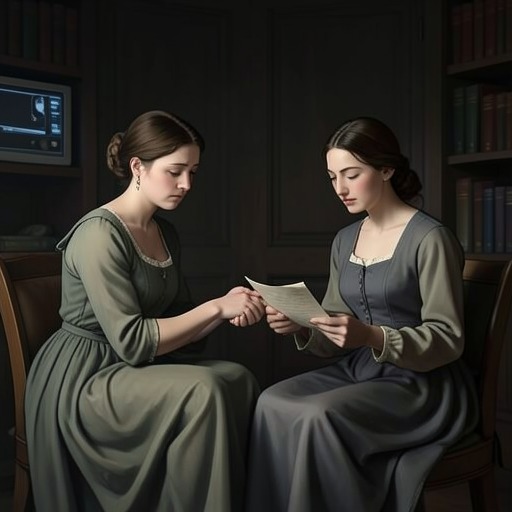
Christabel LaMotte—Blanche Glover
PossessionThe partnership between Christabel LaMotte and Blanche Glover is at once a shared domestic life, an artistic companionship, and an experiment in women’s independence. Blanche’s suicide note gives that experiment its clearest account: the women had tried to sustain useful and creative lives together without relying on men or outside assistance, but their household did not survive the economic and social pressures bearing on it. The note’s distribution of their few possessions and its appeal to LaMotte to preserve their paintings make the intimacy of the partnership visible even as Blanche’s death exposes its limits.
A Shared Household and Artistic Ideal
LaMotte and Glover lived together in a house that belonged to LaMotte. Glover’s account distinguishes the ownership of the home from the furnishings and household goods that the women had bought together from their savings; because LaMotte was the richer partner, Glover recognized that those shared chattels belonged more to her. Their home was therefore both a common undertaking and a relationship shaped by unequal resources. Glover describes its earlier life as happy, but her final arrangements show how much depended on LaMotte’s greater financial security and continued presence.
Their companionship also rested on a consciously chosen ideal. Glover says that she and LaMotte had tried to live as independent single women, in each other’s company, without recourse to help from the outside world or from men. The life they imagined was frugal, charitable, philosophical, artistic, and harmonious with nature. The partnership was not simply a private arrangement: it was an attempt to establish that women could build a useful and fully human life on their own terms. Glover leaves open whether the experiment failed because the world was fiercely hostile to it or because the women themselves lacked sufficient resources and strength of mind, and concludes that both explanations had sometimes applied.
Shared Work and Unequal Means
Art was both the substance of their common life and what Glover hoped would outlast it. She acknowledges that she could no longer afford paint and had sold little work in recent months. Four flower paintings remained wrapped in the drawing room, and she hoped a former buyer might pay enough for them to cover her funeral. Her financial desperation stands in stark contrast to her conviction that her art had value, even if it was not wanted by many in her own time.
Glover counted twenty-seven finished paintings in the house, besides sketches and drawings. Two large works, “Christabel before Sir Leoline” and “Merlin and Vivien,” belonged to LaMotte. Glover asked her to keep them and, if she wished, to hang them in the room where she worked, as she had done before; they might recall happier times. If that memory proved too painful, Glover still asked that LaMotte not give or sell the paintings during her lifetime, but make provision for them afterward. They were, in Glover’s words, the best of her. Her request binds artistic stewardship to personal memory: the paintings are not only works to be preserved, but material reminders of the life the two women had made together.
She likewise entrusted LaMotte with the fate of her other works, hoping they could remain together until a future audience developed the taste and judgment to recognize their worth. Glover imagined a readership not yet born, since she had wanted to be understood by those who came after her. Yet she also understood that she would soon lose the ability to watch over her work. The paintings’ future and the partnership’s future thus converge in the same appeal: what the present has failed to value should not be scattered before another judgment becomes possible.
Dependence, Separation, and Blanche’s Death
The note describes the conditions that made continued independence difficult. Glover refuses to return to governess work, describing service in another household as a life of enslavement even when employers were kind. She also refuses to depend on LaMotte’s charity, recognizing that LaMotte has obligations of her own. Her resolve to avoid making LaMotte responsible for her death appears in her explanation that she had deceived Jane Summers, their servant, by pretending dissatisfaction so that Jane would leave without feeling directly answerable for what followed. In Glover’s account, that deception is meant to shield another person from guilt; it also reveals how deliberately she has arranged her final separation from those around her.
Glover’s requests preserve the partnership in small, exact objects. She leaves her wardrobe to Jane Summers and gives her a choice of the remaining trinkets, but reserves the friendship brooch made of two clasped hands for LaMotte, asking that LaMotte take back the gift she had given. Their worn shared books—Shakespeare, Keats, and Tennyson—are intended for Eliza Daunton, with whom Glover had often read them. Meanwhile, the house and most of the jointly acquired furnishings remain LaMotte’s to dispose of. The inventory records both the closeness of their daily life and the material distinction between Glover, who has little of her own, and the partner with greater means.
The newspaper account confirms that Glover carried out her plan. On the night of June 26, in driving wind and rain, she plunged into the swollen Thames; her body was recovered two days later below Putney Bridge, and large round stones had been sewn into the pockets of her clothing. She was identified as a Miss Glover who had lived alone in a house once shared with LaMotte. The newspaper reports that LaMotte’s whereabouts were unknown and that Jane Summers, recently dismissed, said they had been unknown for some time. Glover’s note and the report together establish the final separation while leaving LaMotte’s absence unexplained.
What the Partnership Leaves Unresolved
For Maud Bailey, reading the note brings a recurring shiver and sharpens rather than resolves the questions around LaMotte’s disappearance. Scholars had assumed that the two women quarrelled, but Glover’s account changes the appearance of that supposed quarrel without clarifying what LaMotte thought when she read the note, where she had gone, or why she was absent at the time of Glover’s death. The evidence establishes neither a specific cause for their separation nor LaMotte’s response to Blanche’s final appeal.
That unresolved absence is central to the relationship’s significance. Glover’s note gives a woman’s own account of the household’s ambitions and failure, rather than reducing their shared life to a conventional story of domestic conflict. It also shows the strain within their ideal: solidarity and artistic collaboration could not by themselves supply money, protection, or a durable independence from the world beyond the house. Yet Glover’s confidence in the value of the work she leaves behind prevents the partnership from ending as a simple tale of defeat. Her hope that stronger spirits might renew the experiment, and that future readers might recognize her art, turns the record of a failed household into an appeal to women and audiences still to come.