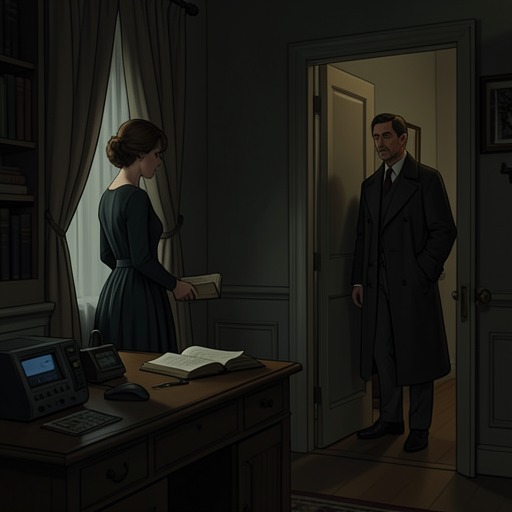
Randolph Henry Ash and Christabel LaMotte’s relationship
PossessionRandolph Henry Ash and Christabel LaMotte’s relationship is at once a love affair and an intellectual partnership conducted through letters. Its decisive significance lies in the correspondence’s double life: the letters are written to one particular person with an urgency absent from Ash’s other surviving correspondence, yet their poetic and reflective contents also become part of a literary record that neither writer could fully control. The exchange brings their minds into unusually close contact while making the privacy and afterlife of that contact central to its meaning.
Recognition and the beginning of the exchange
Christabel’s first letter presents her as a writer whose identity is inseparable from her craft. She describes herself as living circumscribed and self-communing, comparing her position to a spider at the centre of a shining web. Her sympathy for Arachne, the honest craftswoman whose patterns are exact but whose defensive bites may strike visitors and trespassers alike, gives the image both artistic pride and guardedness. She refuses to equate her private self with the spider in her poem: the poet’s work is her best self, but the poem’s spider is a more savage and businesslike sister. In this self-portrait, creative work is not a decorative accomplishment but the strongest means by which she can meet another person.
That emphasis shapes her invitation to Ash. Rather than offering the polite sociability of cucumber sandwiches, she encloses a poem and suggests that she may write again about subjects such as the Everlasting Nay or Schleiermacher’s Veil of Illusion. The gift is intellectual and personal at once: she offers him access to her thinking through the work, while retaining the reserve expressed in her image of the web. Ash reads the invitation as permission to continue writing, even as he recognizes her wish not to be seen and says that he must respect it. His reply takes up her contrast between poems and sandwiches, turning it into an extended meditation on the poetic imagination’s capacity to idealize what ordinary life could easily provide.
The exchange quickly becomes a form of close reading between writers. Ash responds to Christabel’s poem about Psyche by tracing its movement from a cast-down princess and useful creatures toward a moral conclusion whose meaning he cannot settle. He tests possible interpretations—social affection against romantic love, monarchy, Eros, and Agape—without claiming to have solved the poem. His uncertainty is part of his response: he acknowledges that he has talked himself toward her way of thinking without wholly knowing what it is. The letters let disagreement and attraction coexist, with interpretation becoming a means of staying in conversation rather than closing down the poem’s possibilities.
Intellectual intimacy and poetic influence
Ash’s letters make the relationship’s intellectual charge explicit. He recalls Christabel speaking about the Life of Language and remembers the change in her manner as she moved from apparent shyness to forceful discussion of verse. The recollection is particular rather than conventionally flattering: what holds his attention is the moment when she speaks with conviction about the power of poetry. Her work also prompts him to elaborate on his own poems, including Ragnarök and Déjà-Vu. The correspondence thus circulates creative material in both directions: Christabel’s poems draw out Ash’s interpretations, while their exchange gives him an occasion to return to and extend his own writing.
Their readings of myth and literature help them examine the stakes of love and attachment indirectly. Ash discusses the moral and emotional problems opened by Christabel’s Psyche poem, invoking passionate acts, loveless unions imposed by parental will and lineage, and friendship as a more individual and durable bond than love. In another letter he asks about her work on Melusina, linking the figure to accounts in Paracelsus of transformed, monstrous spirits who might enter a natural human life through marriage. He remembers that Melusina was the subject that began their correspondence and asks whether Christabel’s interest lies in the fairy’s spirit or her capacity for castle-building. These allusions show their letters working as a shared field of inquiry: inherited stories are not simply repeated but become material through which they test ideas about desire, marriage, transformation, and women’s creative agency.
The exchange also complicates the idea that poetry is simply private confession. Ash considers whether poetry expresses a general love of the universe or an unsatisfied love directed toward particular things. He questions whether poets may mistake the desire for new metaphors and visions for love of a particular woman, and whether the Poet assumes and informs both lover and beloved. Yet he also insists on the distinctiveness of friendship. This reflection does not dissolve the personal force of the correspondence; it makes that force harder to categorize. Ash’s letters are addressed to Christabel as an individual, while asking whether poetic desire can ever be separated from the forms through which it speaks.
A private readership and the letters’ afterlife
The letters distinguish their intended reader from the later reader who encounters them as documents. Roland recognizes that Ash’s correspondence with Christabel differs from his other surviving letters, which are urbane, considerate, and often witty but show no comparable urgent interest in their recipients. Ash’s letters to Christabel were written for her, not for Roland. That distinction makes the discovery of the correspondence ethically charged: the surviving words give later readers access to a relationship, but that access does not turn them into its original audience.
Ash himself describes the unusual intimacy of writing to Christabel. He says that her intelligence and quick wit make it possible for him to write as he does when alone, in his true writing, which is for everyone and no one. At the same time, he calls her a place of home and immediately unsettles the metaphor: she can make him feel unheimlich, not at home, on edge, and apprehensive of failing to meet her next thought. His image of poets as creatures of heaths and ranging hounds rather than hearths and firedogs refuses to settle the relationship into domestic comfort. The letter holds belonging and estrangement together, presenting intellectual intimacy as both a shelter and a source of exposure.
The relationship’s vulnerability becomes especially clear when Christabel writes that Ash’s letters have not reached her. She believes they have been taken, after a struggle with the postman in which she and another person snatched at the letters. The interruption shows that their correspondence is not secure simply because it is private in intention: its physical passage can be obstructed and its contents removed from the people for whom they were written. The episode turns the letter’s material form into part of the relationship’s risk. What had served as a channel for intellectual recognition can also become a vulnerable object in other hands.
Love, memory, and contested ownership
A later letter about returning correspondence reveals how difficult it is for a writer to separate the papers from the relationship they contain. The writer says that two letters have already been burned, yet admits an inability to destroy anything written by the other person while it remains in hand. The letters are valued as the work of a wonderful poet, but that admiration coexists with changing feelings about what belongs to whom. Their return is framed as an act of relinquishment, leaving the recipient free to decide what to do with them; the writer nevertheless believes they should be burned and cannot believe that they will be. The result is not a settled transfer but an unresolved question of preservation, destruction, and control.
The same letter imagines memory as an alternative archive. Even if the papers are burned, their words will live on in a stubborn memory, like the after-trace of a spent rocket on the retina. The writer claims to retain every least word, spoken or written, while admitting that the other person’s eventual decision cannot be anticipated. This contrast between physical letters and remembered language gives the correspondence an afterlife beyond its objects, but not a simple escape from loss: memory preserves the exchange from destruction while keeping its writer inside the uncertainty of what the recipient will choose.
That uncertainty connects the private relationship to the later history of the papers. Christabel’s sister Sophia sends her papers and poems to her daughter May after Christabel’s death, saying that Christabel had wished her work to pass through the female line and urging that it be kept safely. The family’s transmission carries the correspondence and writing forward even where the record does not establish how fully later generations valued or understood them. In the modern period, Maud Bailey explains that Christabel’s manuscripts and poems are deposited at the Women’s Studies Resource Centre at Lincoln, while the family has relatively few of her letters. The distinction between papers preserved as a literary legacy and letters retained as intimate communication mirrors the relationship’s central tension: the correspondence matters as literature, yet its original force belongs to the particular bond it records.
Narrative significance
The relationship is disclosed not through a single authoritative account but through a sequence of letters, remembered exchanges, and later acts of preservation. Each letter is an address to a specific recipient, shaped by a particular moment of knowledge and uncertainty; later readers must piece the relationship together from those partial, rhetorically shaped voices. Its epistolary form sustains suspense because writers cannot know how their words will be received, whether they will arrive, or what will happen to them afterward. That incompleteness is not merely a gap in the record. It is part of the relationship’s lived condition, in which a letter can be a gift, an argument, a vulnerable physical object, and a claim on another person’s attention.
The exchange also stands against the commercial and scholarly collection of letters. Mortimer Cropper’s desire to assemble every detail of Ash’s life treats even small pieces of correspondence as additions to the recovery of the whole man. The novel’s attention to Ash’s letters to Christabel insists on a different measure of significance: they are revealing not merely because they add biographical detail but because they were written within a singular relation, for a reader whose intelligence Ash considered essential to his writing. Their enduring importance therefore cannot be separated from the question of whether preservation honors that intimacy or converts it into public property.
The relationship leaves no simple division between art and life, or between the private letter and the public literary work. Christabel’s insistence that she is a creature of her pen and Ash’s account of writing his truest work to her make artistic recognition part of their personal attachment. At the same time, their arguments about poetry, love, friendship, myth, and memory prevent the letters from functioning as transparent confessions. They remain acts of composition, thought, and address: intimate because each writer is speaking to the other, and enduring because the words outlast the moment and the private readership for which they were made.