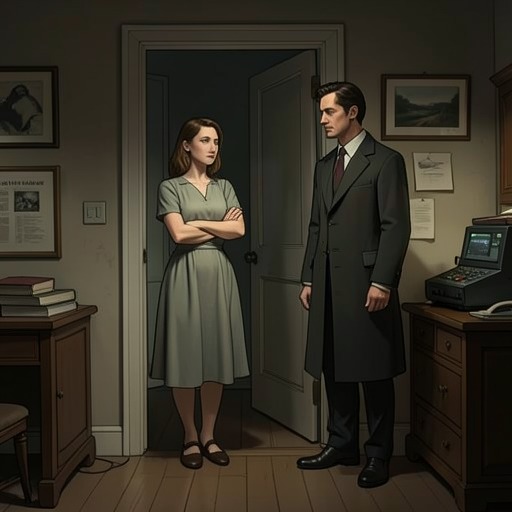
Roland Michell—Val
PossessionRoland Michell—Val is a long-standing domestic partnership shaped by shared life, financial dependence, and an uneven sense of obligation. Roland has lived with Val since his university years, and she is the household’s breadwinner; when his insecure academic position and feelings for Maud Bailey force him to confront the relationship, he describes a bond he cannot simply continue but feels he owes a great deal to. Its deterioration makes the emotional consequences inseparable from the material ones: losing Val also means losing the home she pays for.
Shared Life and Material Dependence
Roland’s account of the relationship is rooted in its duration and practical arrangements. He has lived with Val since he went to university, while she has supported them through temporary work that she does not like. He recognizes that he is partly living on her money and says plainly that he owes her so much. The partnership therefore rests not only on intimacy but on Val’s continuing economic contribution and Roland’s reliance upon it.
That dependence becomes especially acute because Roland’s own work offers little security. He has only intermittent teaching and piecework on an edition, and depends professionally on James Blackadder, whose references make him sound duller than he believes himself to be. Roland cannot tell Blackadder what he is facing, and worries that his situation will make it harder to go on. The pressure is not an abstract career anxiety: his livelihood and his relationship with Val are entangled, since the home he risks losing is hers and its rent is paid by her.
A Relationship Roland Cannot Continue
When Roland tries to explain what will happen after he returns, Val is the part of his life he hesitates to discuss. He says he has never talked about her and feels he should not, as if naming the relationship would itself cross a boundary. Yet he eventually admits that it does not work, while struggling to give a reason. His unfinished explanation turns instead toward an image of a white bed, suggesting that his feelings for Maud have become difficult to separate from his reckoning with Val.
The scene places that confession beside Maud’s quiet attention to an apple she cuts into very thin wafers. She hands Roland a fan of the apple slices on a paper plate; the small, composed gesture contrasts with his halting account of a relationship he cannot make coherent. Maud responds that she has known a comparable entanglement with Fergus Wolff. Her acknowledgment gives Roland space to speak, but it does not erase the material and emotional obligations he has named.
Separation and Its Immediate Aftermath
The consequences become visible at home while Roland is away. Val eats cornflakes, her habitual food there: at first light and pleasant, they become like cotton wool after a day or two. The domestic detail locates her in the home and routine that Roland has already associated with her financial support. When the doorbell rings, she expects perhaps Euan MacIntyre and a dinner invitation, but Fergus arrives asking whether Roland is in. Val says Roland has gone away. The brief exchange makes Roland’s absence concrete without explaining it to Val or resolving their separation.
Later, on the coast with Maud, Roland names the losses in a single reckoning: the piece of his job in the Ash Factory, Val, and, with Val, his home because she pays the rent. He expects that he should feel dreadful and thinks he probably will, but at that moment feels clear-headed and single. The contrast is not a declaration that the costs have disappeared; it records a temporary change in how he experiences them. Sea air and distance from London accompany the clarity, while the possibility of returning to an unstable job and housing situation remains.
Narrative Significance
The relationship joins private attachment to the ordinary economics of a shared household. Val is not merely a past romance that Roland can leave behind without consequence: she is the breadwinner, the person whose work maintains a home, and someone to whom Roland explicitly feels indebted. His recognition that the relationship no longer works therefore comes with an awareness that his departure may unsettle his material as well as emotional security.
The scenes also preserve an asymmetry of knowledge. Roland tells Maud that he has never talked about Val and describes his dependence and uncertainty to her, while the supplied account of Val at home records only her routine, her expectation of a possible invitation, and her reply that Roland is away. The narrative does not present a reciprocal explanation of the relationship from Val. Instead, its strain is registered through Roland’s confessions, the threatened loss of his home, and the stark contrast between his unsettled domestic circumstances and his momentary sense of being single.