Maud Bailey–Fergus Wolff relationship
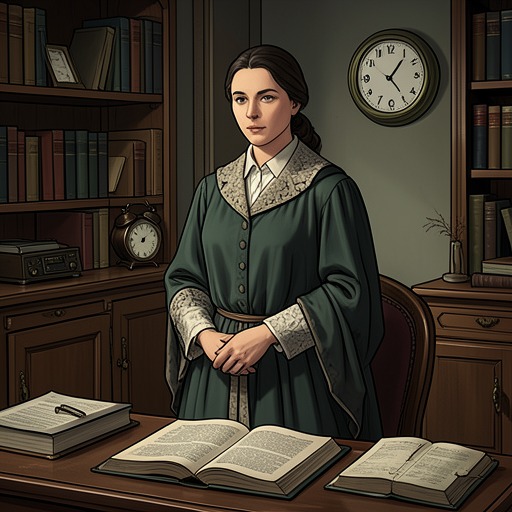
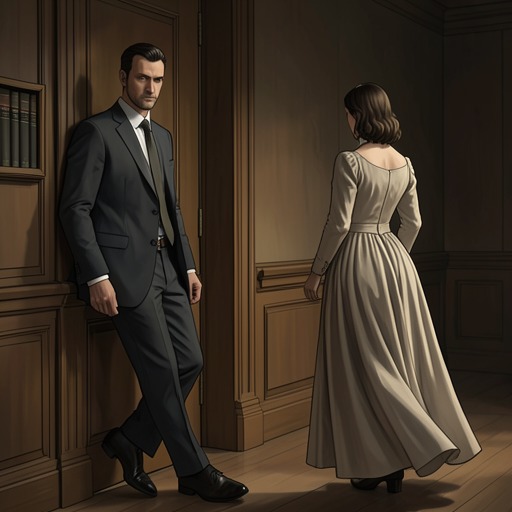
PossessionMaud Bailey and Fergus Wolff’s brief affair begins in the intellectual atmosphere of a Paris conference and ends in arguments, but its consequences persist in Maud’s relationship to her own appearance. The affair is remembered not as a simple romance but as an unsettling mixture of attraction, revulsion, and influence: Fergus encourages Maud to grow her hair, and after they part she refuses to cut it while keeping it hidden from view.
Meeting and the beginning of the affair
Maud meets Fergus at a Paris conference on gender and the autonomous text. Maud speaks about thresholds; Fergus presents an argument on Balzac’s hermaphrodite hero and heroines. Although his argument appears feminist, its delivery carries a mocking, subversive quality and even turns toward self-parody. His performance establishes the pair’s relation as intellectually charged, but it does not prevent an imbalance in how they approach intimacy: Fergus expects Maud to come to bed with him.
He presses his desire with extravagant assurances that they are the most intelligent people at the conference and that Maud is the most beautiful person he has ever seen or dreamed about. Maud later acknowledges that she cannot rationally explain why his appeal proved irresistible, only that it did. Their affair begins in that gap between intellectual self-possession and an attraction she cannot account for.
Attraction and repugnance
Maud’s recollection of the relationship takes shape after the affair, while she is alone in her carefully ordered bathroom. Thinking of Fergus brings to mind a disorderly, unmade bed, which she imagines as an empty battlefield. The contrast with the spotless, organized space around her turns an intimate memory into an image of aftermath: the relationship is present through what remains, even as its principal figure is absent. Maud also recalls the arguments that began after their initial attraction, making conflict part of the affair’s structure rather than an incidental ending.
Her reflection that desire lies on the other side of repugnance captures the relationship’s ambivalence. Attraction does not erase distaste; the two occupy opposing sides of the same recollection. The battlefield image gives that contradiction a domestic form, linking their intimacy to disorder and conflict without presenting the affair as a lasting union.
Hair, appearance, and influence
Fergus’s influence reaches beyond their debates. Maud is uneasy about her appearance and the split between her visible image and her sense of self. She remembers feminists mistaking her long hair for a marketable product, and recalls having worn it almost shaved during her early teaching years. Her concern is not simply whether she is beautiful: the reflection she sees as a doll-mask feels unrelated to who she is.
Fergus challenges her to grow her hair, invoking Yeats’s lines about a young man loving a woman’s hair. Maud answers that she neither believes nor cares about the sentiment. Nevertheless, she grows her hair from eyebrow length down to her shoulders. Its growth lasts almost exactly as long as the affair; by the time they part, it has become a long queue. This close correspondence in duration makes the change an intimate record of Fergus’s influence, even though Maud does not accept the romantic ideal used to urge it.
The separation and its afterlife
When the affair ends, Maud will not cut her hair, but she also does not wear it openly. She keeps it inside a covering. That decision preserves the physical change while withholding it from display: the hair remains, yet no longer functions as a visible offering to Fergus’s challenge or to other people’s judgments. The relationship therefore continues in altered form, not as renewed intimacy but as a private mark that Maud controls.
The affair also appears in the surrounding plot as part of the history that makes Maud’s scholarship visible to others. Roland learns that Fergus had a brief affair with her in Paris and later in England, and that Maud is one of the two people reputed to know everything known about Christabel LaMotte. Fergus points him toward the Women’s Resource Centre in Lincoln, where many of LaMotte’s unpublished papers are held. The disclosure connects Maud’s past relationship to the research story without making the affair the source of her expertise: her reputation and work remain her own, while Fergus’s account makes her private history a route through which another man seeks access to her scholarly world.